How Much Is Ghent Altarpiece (Adoration of the Mystic Lamb) Worth?
Last updated: April 29, 2026
Quick Facts
- Methodology
- comparable analysis
Hypothetical market-facing valuation band: $500 million–$3 billion. This band derives from top-tier Old Master comparables (notably Leonardo’s Salvator Mundi), institutional trophy purchases and a scarcity/national‑treasure premium; in practice the work is effectively unsellable under current patrimony regimes.
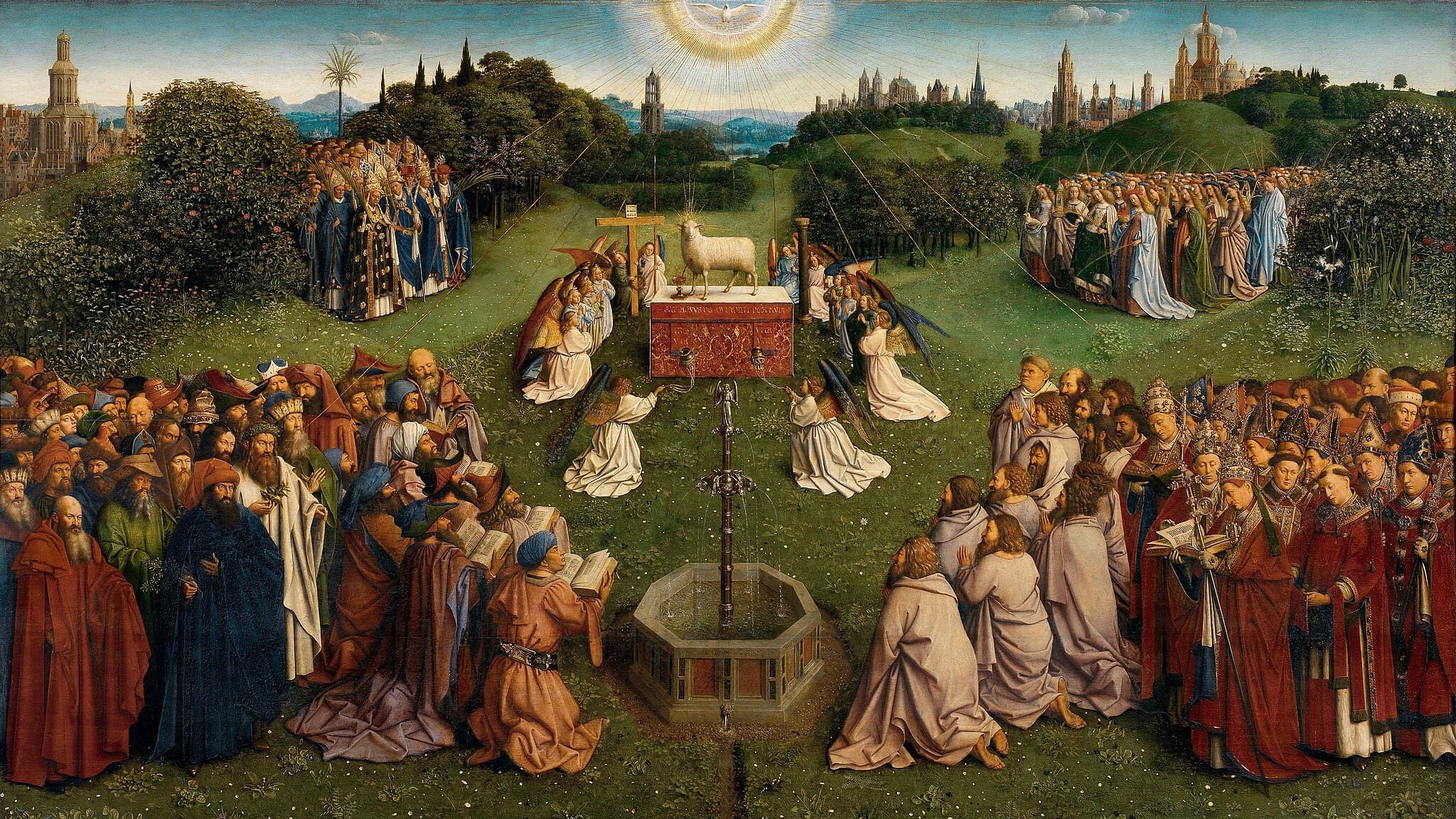
Ghent Altarpiece (Adoration of the Mystic Lamb)
Jan van Eyck • Oil on oak panels (polyptych)
View more by Jan van Eyck →Valuation Analysis
Bottom-line estimate: On a strictly hypothetical, market-facing basis the Ghent Altarpiece (Adoration of the Mystic Lamb) is placed at approximately $500 million–$3 billion. That band positions the altarpiece among the planet’s most valuable cultural objects while explicitly acknowledging that the work remains under church/civic patrimony at St Bavo’s Cathedral in Ghent and has no modern public-sale track record [1]. This is a theoretical market valuation for comparative purposes and not an insured or realized sale price.
Methodology and comparables: The range is derived by comparable-analysis using the highest public and private trophy transactions for canonical Old Master works as anchors. The 2017 Christie's sale of Leonardo’s Salvator Mundi (~$450M) provides a practical auction precedent for a once-in-a-generation Old Master trophy sale and therefore sets a useful lower‑bound reference point for a uniquely important religious picture sold on the open market [2]. Museum-level private treaties and joint-state acquisitions (e.g., major Rembrandt purchases) demonstrate institutional willingness to pay very large sums for cultural flagships; those dynamics justify a multi‑hundred‑million to low‑billion ceiling when scarcity, national‑treasure premium, and sovereign buying power are considered.
Liquidity and legal constraints: The Ghent Altarpiece is functionally unsellable. It is a civic/church possession protected by patrimony rules, public sentiment, and export limitations; historical wartime seizures and thefts have further entrenched custodial commitments. One original panel (the “Just Judges”) remains missing, complicating the object’s completeness and any hypothetical transfer. Those legal, ethical and political barriers mean there is effectively no open market—so any numerical band is an extrapolation of trophy comparables rather than a market-clearing price [1][4].
Condition and institutional investment: Extensive restorations, technical studies and the recent bespoke conservation/display investment (reported at approximately €30 million) improve long-term preservation but also highlight the cost and institutional commitment to retain the work in situ [3]. Conservation outcomes and the multi-panel format influence insurability, buyer risk assessment and practical marketability, but they do not materially reduce the altarpiece’s cultural premium.
Conclusion and next steps: Treat the $500M–$3B band as a reasoned, comparative valuation produced by extrapolating top trophy-work outcomes to a uniquely significant, nationally‑protected masterpiece. For greater precision, pursue confidential indemnity/insurance valuations (City of Ghent / cathedral chapter), secure non‑public market opinions from major Old Master departments at Christie’s/Sotheby’s, and obtain a formal legal opinion on patrimony/export constraints. The valuation approach used is comparable_analysis and the practical probability of a sale remains close to zero.
Key Valuation Factors
Art Historical Significance
High ImpactThe Ghent Altarpiece is arguably the single most consequential surviving object for Early Netherlandish painting and is central to Jan (and Hubert) van Eyck’s canonical stature. Its iconography, technical innovations in oil painting and the ensemble nature of the multi-wing altarpiece make it both a scholarly touchstone and a public cultural symbol for Northern Renaissance art. That unparalleled historic and cultural capital creates an exceptional theoretical market value: potential acquirers would be buying not just a painting but an irreplaceable emblem of European visual culture. Paradoxically, that singularity simultaneously reduces tradability and increases the uncertainty of any hypothetical sale price.
Provenance & Ownership/Patrimony
High ImpactThe altarpiece has been held as a civic/church possession since its commission and is treated as national/church patrimony under Belgian cultural-protection regimes. Legal protections, municipal and ecclesiastical custodianship, and strong public sentiment make alienation and export highly unlikely. Historical episodes (wartime removal, thefts, restitution debates) have reinforced custodial claims. Because the object cannot be freely marketed, the practical buyer pool is effectively restricted to sovereigns, national museums or exceptional consortium arrangements — a narrow set whose acquisition dynamics differ fundamentally from the open private market and push valuation into hypothetical, negotiation-driven territory.
Condition & Completeness
Medium ImpactThe altarpiece is a complex, multi-panel ensemble that has undergone multiple restorations and technical interventions across centuries. One original panel (the 'Just Judges') is missing, a fact that complicates integrity and would materially affect any transactional negotiation. Recent, high-cost conservation and the bespoke climate-controlled display signal significant institutional investment in preservation; that reduces certain risks but also highlights expensive liability for any custodian. Condition and completeness inform insurability and buyer risk premiums: they can depress practical marketability even as they do not erase the work’s exceptional cultural value.
Market Comparables & Scarcity
High ImpactThere are no direct modern auction comparables for an autograph Ghent Altarpiece. Valuation therefore relies on trophy comparables—Leonardo’s Salvator Mundi (~$450M auction price in 2017), major private/museum treaties (high-value Rembrandt acquisitions), and high-profile private purchases of iconic European masterpieces. Those precedents set a practical floor and demonstrate institutional budgets; scarcity (very few museum-quality Early Netherlandish works enter the market) and the altarpiece’s singularity justify a high scarcity premium that pushes a plausible theoretical ceiling into the low‑billions.
Legal, Political & Practical Marketability
High ImpactBeyond formal patrimony law, political resistance, moral considerations and international heritage obligations create enormous friction against any sale. Even a legal pathway would likely require parliamentary approval, international negotiation, or a sovereign‑to‑sovereign transfer—scenarios that are rare and atypical. Practical marketability is therefore near-zero: any transfer would be exceptional, negotiated confidentially, and priced far differently from an open-market auction. That reality keeps the altarpiece’s valuation theoretical and heavily contingent on geopolitical and institutional factors rather than price-discovery mechanisms.
Sale History
Ghent Altarpiece (Adoration of the Mystic Lamb) has never been sold at public auction.
Jan van Eyck's Market
Jan van Eyck is regarded as foundational to Early Netherlandish painting but his securely attributed corpus is extremely small and largely museum‑held. There are effectively no modern auction records for undisputed autograph van Eyck panels, so market signals come from museum acquisitions of high-quality Northern Renaissance works, private-treaty transactions and rare trophy sales in adjacent categories. Scholarship, technical research and major exhibitions drive institutional demand and restrict supply. As a result, a bona fide van Eyck appearing on the open market would be subject to intense institutional competition and command a very high, but largely theoretical, price.
Comparable Sales
Salvator Mundi
Leonardo da Vinci
Record public auction for an Old Master Renaissance masterpiece; useful as a top‑end market precedent for a unique, religious, trophy work even though attribution/market circumstances differ from the Ghent Altarpiece.
$450.3M
2017, Christie's, New York
~$588.1M adjusted
Portraits of Marten Soolmans and Oopjen Coppit (pair)
Rembrandt van Rijn
High‑value, museum‑level private purchase of canonical Dutch Golden Age portraits—shows institutional willingness to pay large sums for culturally significant Old Master works via private treaty.
$179.2M
2016, Joint acquisition by the Rijksmuseum and the Louvre (private treaty)
~$238.9M adjusted
Large 16th‑century altarpiece (anonymous) — National Gallery acquisition
Anonymous / Northern Renaissance
Recent museum purchase of a Northern Renaissance/altarpiece work (reported 2025) — relevant because it illustrates contemporary institutional budgets for altarpieces and the active market for such objects even if the scale is much smaller than trophy masterpieces.
$21.8M
2025, National Gallery, London (private treaty acquisition, reported May 2025)
Portrait of Adele Bloch‑Bauer I
Gustav Klimt
High‑profile private sale of an iconic European masterpiece; while from a different period, it is a useful 'trophy' comparable showing private‑market ceilings for culturally central works.
$135.0M
2006, Private sale (to Ronald Lauder / Neue Galerie)
~$214.2M adjusted
Portrait of Dr. Gachet
Vincent van Gogh
Historic auction record for a single masterpiece (1990); after inflation adjustment it provides a long‑run baseline for top‑tier individual painting valuations.
$82.5M
1990, Christie's, New York
~$202.0M adjusted
Current Market Trends
The Old Masters / Early Netherlandish market in recent years has become highly selective: mid-tier demand softened while museums and well-funded collectors remain active buyers for museum-quality rarities. Major exhibitions and technical research elevate interest and often remove works from the market via long-term loans or acquisitions. Macro volatility tempers private speculative activity, but institutional purchases and sovereign-level transactions set de facto ceiling values for unique masterpieces — a dynamic that supports a large theoretical valuation band for the Ghent Altarpiece while leaving practical sale probability close to zero.