How Much Is Madonna at the Fountain Worth?
Last updated: April 29, 2026
Quick Facts
- Methodology
- comparable analysis
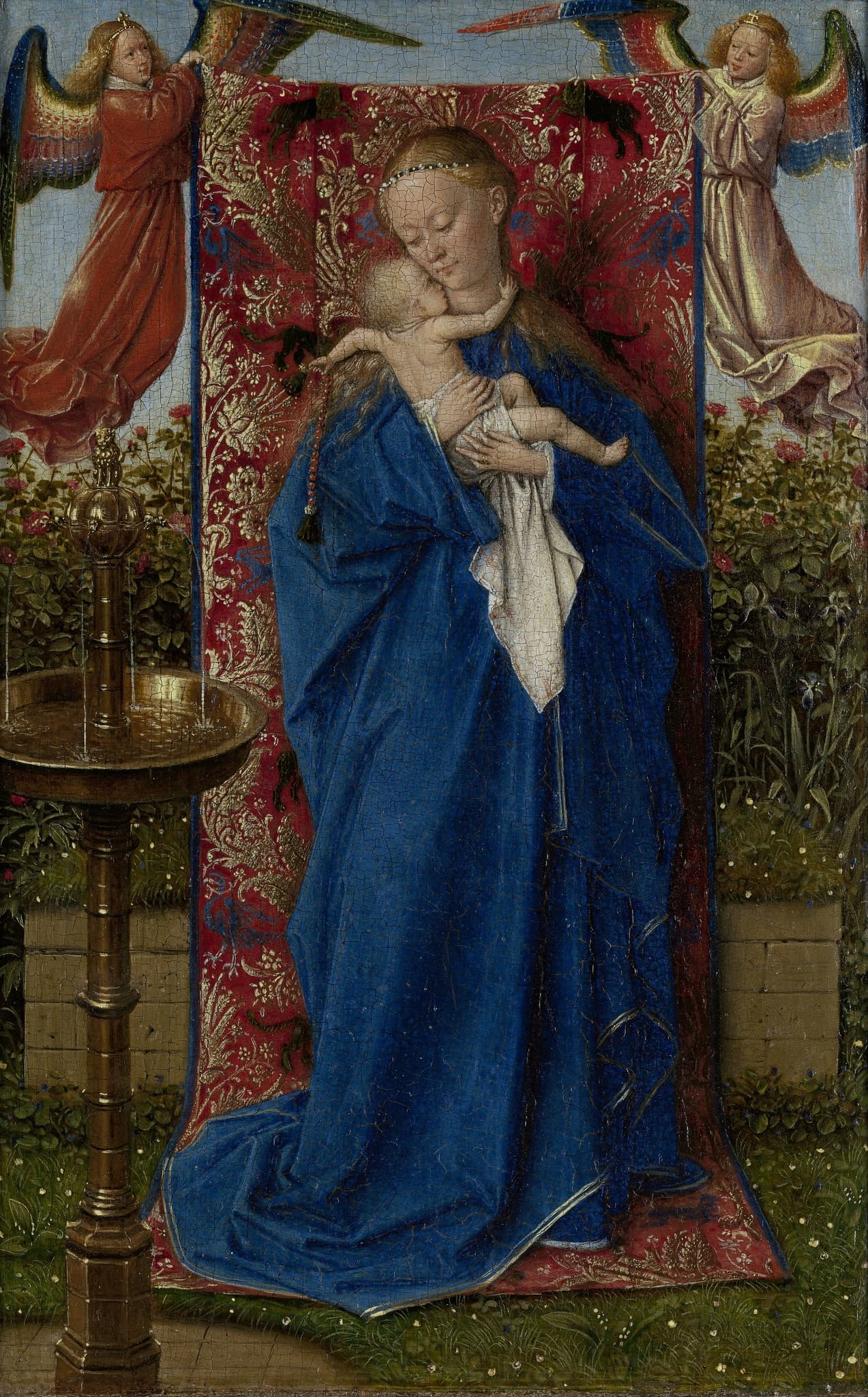
Conditional on its current status as an autograph, signed and dated small devotional panel in the Royal Museum of Fine Arts Antwerp (KMSKA), Madonna at the Fountain (Jan van Eyck, 1439) is preliminarily appraised at $30–120 million. The lower bound assumes constrained marketability (small scale, limited buyer pool, possible condition/restoration concerns); the upper bound assumes unanimous autograph attribution, excellent condition, strong early provenance and active institutional competition.
Valuation Analysis
Valuation conclusion (conditional): Based on comparable institutional purchases of high‑quality Northern Renaissance works, trophy sales of unique Renaissance masterpieces, and the painting’s autograph, signed and dated status in the KMSKA collection, a reasoned market/replacement valuation for Jan van Eyck’s Madonna at the Fountain is approximately $30–120 million. This range is a conditional appraisal that assumes different plausible situational outcomes rather than a single sale prediction.
The panel is a small, private‑devotional work (measuring c. 19 × 12 cm) catalogued and held by the Royal Museum of Fine Arts Antwerp, inv. no. 411 — a fact that supports autograph attribution yet limits public market access and typical buyer types to museums, foundations or sovereign purchasers [1]. Small devotional works, even when signed, typically yield lower open‑market ceilings than state commissions or iconic single‑canvas portraits, all else equal.
Why the range covers $30–120M: The lower bound reflects constrained sale mechanics: because securely attributed van Eyck autographs virtually never appear at auction, liquidity is low and buyers are institutionally oriented. If the panel shows heavy historic restoration, structural panel issues, or an interrupted provenance the market value could settle near the lower end. The upper bound represents an institutional replacement value if the panel is in excellent, unrestored condition, supported by unanimous technical and connoisseurship confirmation and by early, continuous provenance — circumstances that provoke active competition from major museums or state collections and push values toward the high tens to low hundreds of millions [2].
Comparables: trophy private and auction sales of uniquely scarce Renaissance/Old Master works (Leonardo’s Salvator Mundi; the Rembrandt pendants sold to national museums) provide a theoretical ceiling for unique masterpieces. More realistic comparables for a small but secure Northern Renaissance devotional panel are recent museum purchases and private acquisitions of rediscovered Netherlandish works (mid seven‑figure to low eight‑figure institutional prices), which anchor the lower‑to‑mid portion of the range [2].
Key caveats and next steps: This appraisal is conditional. To narrow the range to a single figure, obtain a complete conservation report, dendrochronology and infrared reflectography; compile full provenance documentation; and secure at least two written opinions from leading Early Netherlandish specialists or a major museum department. If you provide those items I will recalibrate the estimate and supply a detailed, source‑backed insurance/replacement valuation.
Key Valuation Factors
Art Historical Significance
High ImpactMadonna at the Fountain is autograph, signed and dated to 1439 and belongs to Jan van Eyck’s small‑scale devotional repertoire; this confers substantial scholarly and curatorial importance. As one of only around two dozen works securely attributed to van Eyck, any authenticated panel carries exceptional cultural value. That significance translates into high replacement/insurance valuations and institutional interest, particularly from European and North American museums seeking canonical Northern Renaissance examples. Even as a comparatively ‘minor’ devotional image in scale, its autograph status elevates its standing well above anonymous contemporaneous works and elevates its theoretical market ceiling relative to unattributed Netherlandish panels.
Attribution / Authenticity
High ImpactAttribution is the single most decisive value driver. The panel is historically accepted as autograph and bears a date and signature, which strongly support van Eyck authorship. Nevertheless, modern buyers and insurers will demand corroborating technical evidence (dendrochronology, IR reflectography, pigment and binding analysis) and independent connoisseurship confirmation. A unanimous, contemporary expert consensus and clean technical dossier push the painting toward the upper bound of the estimate; lingering doubts or divided expert opinion reduce marketability sharply and can drop value by orders of magnitude, placing the work with workshop or follower valuations.
Condition / Conservation
High ImpactCondition affects both aesthetic and insurability ratings. Original paint integrity, extent of historic overpaint, losses, and the structural state of the wood support directly influence market valuation. A panel with minimal invasive restorations, stable original varnish glazing and good structural conservation will attract institutional bidders and justify higher replacement values. Conversely, major retouching, extensive reintegration or a compromised support will reduce desirability and may invalidate high‑end comparable pricing. A full conservator’s report is therefore essential for any definitive valuation.
Provenance & Legal/Export Restrictions
High ImpactClear, continuous provenance — ideally documented back into the early modern period — is a powerful value enhancer. The painting’s institutional custody (KMSKA) is positive for authenticity but also means it is effectively off the market; national patrimony laws, export restrictions or potential restitution claims can make public sale impossible or severely limit bidders. Conversely, clean ownership history with early European provenance and no encumbrances dramatically improves sale prospects to foreign museums or private collectors, increasing competition and upward pressure on price.
Market Demand & Comparables
High ImpactBuyer pool for a confirmed van Eyck is extremely narrow and institutionally dominated. Global museums and sovereign collections are the most realistic purchasers, and private ultra‑high‑net‑worth collectors only occasionally compete. Comparable data is sparse because autograph van Eyck works rarely come to market; therefore benchmark pricing draws on high‑profile Renaissance trophy sales and recent institutional purchases of rediscovered Netherlandish works. Market conditions — appetite from major museums, recent rediscoveries, and attention from large exhibitions — will determine where within the $30–120M range the panel would fall.
Sale History
Madonna at the Fountain has never been sold at public auction.
Jan van Eyck's Market
Jan van Eyck is one of the foundational masters of the Northern Renaissance; culturally and academically he sits at the very top of Old Masters. Only a small number of works are securely attributed to him and most are museum‑held, so there is almost no modern auction price discovery. That scarcity makes autograph panels effectively priceless in public markets and creates a buyer pool dominated by major museums and states. When exceptional Old Master masterpieces do move—typically by private treaty—prices can reach into the high tens or hundreds of millions, but such sales are extremely rare.
Comparable Sales
Salvator Mundi
Leonardo da Vinci
Unique, trophy Renaissance masterpiece sold publicly — establishes an upper bound for what a one-of-a-kind, securely attributed Northern/Renaissance masterpiece can achieve in the market.
$450.3M
2017, Christie's New York
~$585.4M adjusted
Maerten Soolmans and Oopjen Coppit (pendant portraits)
Rembrandt van Rijn
High-profile institutional private acquisition of two iconic Old Master paintings — shows museums' willingness to pay very large sums to secure canonical works (useful as an institutional-buying ceiling).
$176.0M
2016, Private sale (acquired jointly by the Louvre and Rijksmuseum)
~$234.1M adjusted
The Massacre of the Innocents
Peter Paul Rubens
Record high Old Master auction sale (rediscovered/major work) — useful as a historical auction benchmark for how high-quality Old Masters have performed in the public sales room.
$76.7M
2002, Sotheby's London
~$135.8M adjusted
Madonna of the Cherries
Quentin Metsys
Recent museum acquisition of a rediscovered Northern Renaissance work — a closer, realistic institutional-comparable for value of high-quality but non-canonical Netherlandish paintings (illustrates mid-seven-figure institutional pricing).
$13.5M
2024, Christie's London (acquired by the J. Paul Getty Museum)
~$13.8M adjusted
16th-century Netherlandish altarpiece (private acquisition)
Anonymous / Netherlandish school
Recent private museum purchase in the low‑eight‑figure band for Netherlandish material — another institutional-comparable indicating museums pay low to mid tens of millions for high-quality works that are important but not at the absolute top tier.
$22.1M
2025, Private sale (National Gallery, London)
Current Market Trends
The Old Masters sector softened across 2023–2024 in auction turnover, but institutional buying for high‑quality rediscoveries has remained active. Museums are still willing to pay premiums for works that demonstrably add canonical value to collections; private sales and negotiated institutional acquisitions are the dominant route for trophy Old Masters. Upcoming major van Eyck exhibitions and conservation publications can stimulate renewed demand for securely attributed works.