How Much Is Madonna of Chancellor Rolin (Virgin and Child with Chancellor Rolin) Worth?
Last updated: April 29, 2026
Quick Facts
- Methodology
- comparable analysis
Madonna of Chancellor Rolin (Jan van Eyck, c.1435–40) is a Louvre‑held masterpiece with no modern market sale, so any price is hypothetical. Based on scarcity of securely attributed van Eyck panels, trophy Old Master precedents and institutional purchase mechanics, a plausible notional value band if ever legitimately sellable is approximately USD 250 million–600 million. Legal, conservation and provenance constraints make an actual market transaction highly unlikely.
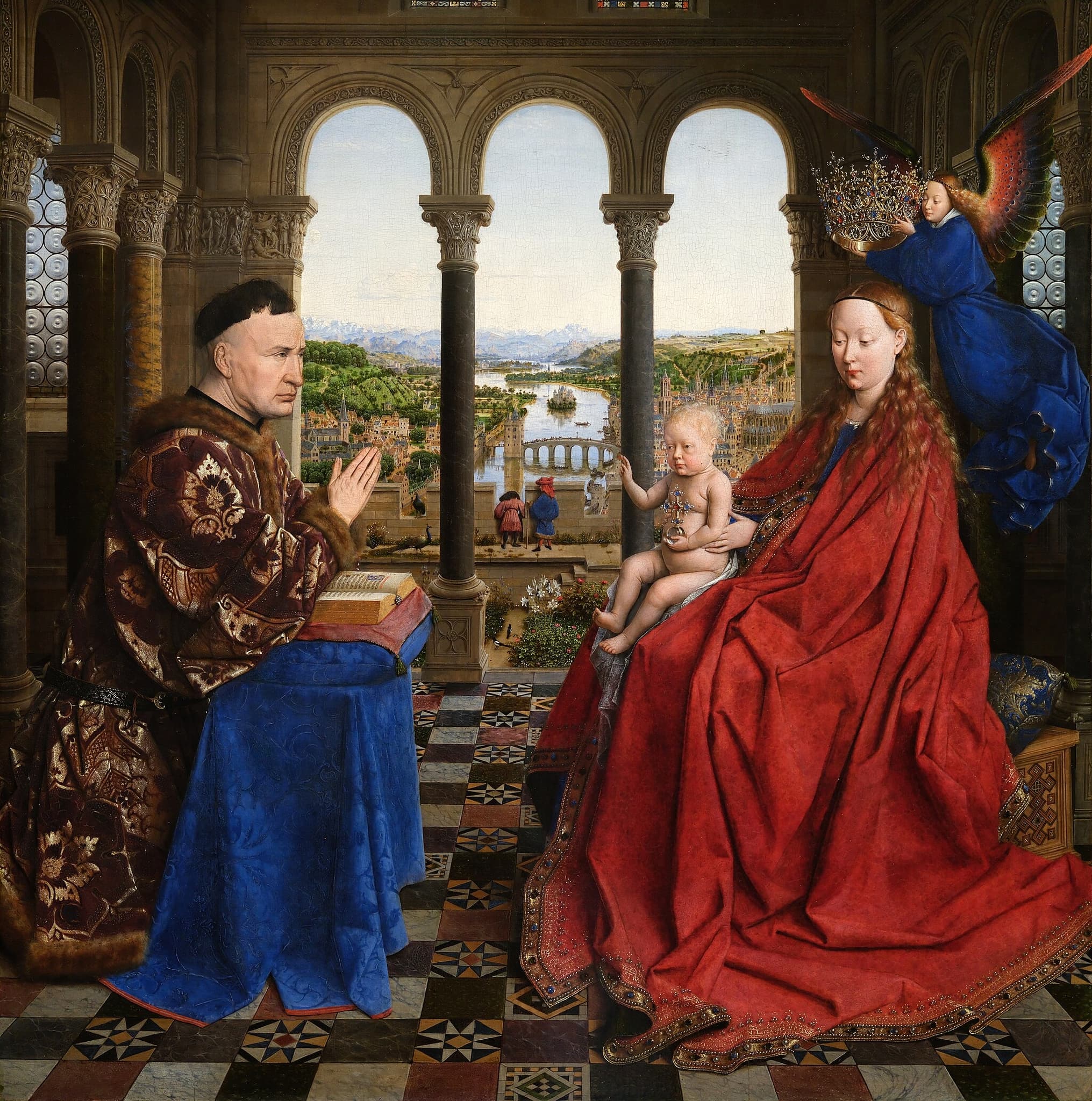
Madonna of Chancellor Rolin (Virgin and Child with Chancellor Rolin)
Jan van Eyck • Oil on panel
View more by Jan van Eyck →Valuation Analysis
Overview. The Madonna of Chancellor Rolin is a canonical, museum‑held Jan van Eyck panel in the Musée du Louvre and has no recorded modern public sale, so any monetary figure is hypothetical and contingent on transferability and market circumstances [1]. Using trophy Old Master precedents and institutional purchase mechanics as anchors, the plausible notional range if the work were ever legitimately sellable is roughly USD 250 million–600 million. This estimate presumes an uncontested autograph attribution, sound condition and legal permissibility.
Why this band. The low end of the range reflects a negotiated private treaty or single‑institution acquisition with limited bidders; the high end reflects a once‑in‑a‑generation, highly public auction or competitive private sale to sovereign/state actors or mega‑collectors, analogous in market mechanics (though not in authorship) to the Salvator Mundi outcome which set a modern Old Master ceiling [2]. The Rembrandt pendent portraits purchase by national institutions provides a second precedent for museum‑level private acquisitions in the low hundreds of millions and demonstrates how public institutions value irreplaceable works above normal market multiples [3].
Constraints that widen the band. The primary limiting factor on realizable price is legal and institutional: the panel has been in French state custody since the Revolution and is subject to heritage protections and museum inalienability provisions that make bona fide sale extremely difficult absent exceptional political decisions or declassification [4]. Condition and technical dossier quality (infrared, x‑ray, dendrochronology, conservation history) also materially affect value; recent Louvre conservation and technical study work raises the painting's scholarly profile but does not remove legal obstacles to sale [5].
Practical interpretation. The figure should be read as a notional market ceiling and floor for an otherwise transferable, museum‑quality Jan van Eyck panel under optimal bidding conditions. In practice, because of ownership and patrimony restrictions, the painting’s replacement or insurance valuation—if ever disclosed by the Louvre—could differ substantially and would likely be used instead of a hypothetical market auction price. For any formal appraisal, the next required steps are access to the Louvre’s conservation/technical reports, a legal review of export and deaccession rules, and an opinion‑of‑value from a major Old Master department to model auction vs private treaty scenarios.
Key Valuation Factors
Art Historical Significance
High ImpactMadonna of Chancellor Rolin is one of Jan van Eyck's principal single‑panel devotional works and central to scholarship on Early Netherlandish painting. Its compositional complexity, iconography and technical finesse make it a reference piece in catalogues raisonnés and museum displays. Such cultural prominence carries an intrinsic premium because the painting is considered irreplaceable in national and academic terms; that premium feeds both insurance/replacement thinking and the theoretical trophy market value. As a signature work by a foundational master, it commands value not solely on aesthetics but on cultural and scholarly capital.
Rarity & Scarcity of Artist Autographs
High ImpactSecurely attributed van Eyck autographs are extraordinarily scarce and almost entirely museum‑bound. With only a small corpus of accepted panels worldwide, supply on the open market is effectively zero; scarcity elevates theoretical price because buyers seeking canonical works have very few alternatives. However, scarcity also creates valuation uncertainty because there are no recent auction anchors for genuine van Eyck panels. The absence of a liquid price series forces reliance on high‑profile Old Master precedents and institutional comparables to model value, increasing the estimate range.
Ownership & Legal/Political Constraints
High ImpactThe painting has been in French public custody since the Revolutionary period and is treated under French patrimony and museum inalienability frameworks. Transferring ownership would require exceptional administrative and political processes, export licenses and likely national debate. That legal insulation both raises replacement/insurance valuations (because of cultural importance) and simultaneously makes a legitimate market sale improbable. A work that cannot be freely transferred to private hands will remain theoretical for market valuation purposes, and the legal barrier is the strongest single driver widening the estimated band.
Condition & Attribution Certainty
Medium ImpactTechnical condition, conservation history, and attribution certainty are determinative for top‑tier outcomes. A flawless technical dossier (infrared reflectography, x‑rays, dendrochronology, conservation reports) and recent scholarly endorsement materially increase buyer confidence and price potential. Conversely, any significant restoration, unstable panel condition, or attribution debate would sharply reduce marketability and value. The Louvre's recent conservation studies and exhibition engagement improve attribution and transparency, but reported technical findings would need to be reviewed by prospective buyers or insurers before any transaction.
Market Demand & Trophy Buyer Dynamics
Medium ImpactDemand for museum‑quality Old Masters is concentrated among a small set of sovereigns, major museums and ultra‑high‑net‑worth collectors. When a canonical work is saleable, competitive dynamics can produce very high prices (see headline trophy sales). That upside depends on a convergence of buyer appetite, political permissibility, reputational considerations and available capital. Buyers are cautious and require exhaustive due diligence; reputational risk and potential public backlash can suppress willingness to bid aggressively. These dynamics create a wide practical range between conservative settlement and peak competitive bidding.
Sale History
Madonna of Chancellor Rolin (Virgin and Child with Chancellor Rolin) has never been sold at public auction.
Jan van Eyck's Market
Jan van Eyck is a foundational figure of the Early Northern Renaissance. Securely attributed autograph panels by van Eyck are extremely rare and remain almost entirely in institutional collections, which means there is effectively no modern auction price series for his autograph work. The combination of canonical status and zero market supply elevates hypothetical valuations but reduces market liquidity and transparency. When market models are built for van Eyck, they rely on trophy Old Master sales and institutional purchase precedents rather than direct artist comparables, and buyers demand full provenance and technical dossiers before transacting.
Comparable Sales
Salvator Mundi
Leonardo da Vinci
Headline modern auction for a canonical, pre‑1600 religious masterpiece. Salvator Mundi is the primary market ceiling example used for trophy Old Master pricing—comparable because both are unique, museum‑quality, pre‑1600 religious works that would drive intense competitive bidding if sellable.
$450.3M
2017, Christie's New York (Evening Sale)
~$563.0M adjusted
Portraits of Maerten Soolmans and Oopjen Coppit (pendant portraits)
Rembrandt van Rijn
Large, museum‑level private purchase of canonical Old Master paintings by national museums. Comparable on the basis of institutional buyer appetite, premium for irreplaceable works, and the mechanics of high‑value private/museum transactions (joint acquisitions, political/institutional constraints).
$180.0M
2016, Private sale / joint acquisition by the Rijksmuseum and the Louvre (announced May 2016)
~$234.0M adjusted
Saunders Collection (single‑owner Old Masters sale, part I)
Various Old Masters (Saunders Collection)
Recent single‑owner Old Masters sale demonstrating market appetite for curated, museum‑quality Old Masters and the variability of results even in trophy contexts. Useful as a market‑mechanics comparable (single‑owner, museum provenance, specialist sale) though individual lot prices are far below a top‑tier van Eyck panel.
$53.8M
2025, Sotheby's (single‑owner Old Masters sale — Saunders Collection, May 2025)
Current Market Trends
The Old Masters market is supply constrained and selective: high‑quality, well documented works still command competitive interest, but buyers require full technical reports and provenance. Recent institutional exhibitions and conservation projects have heightened scholarly and public interest in Early Netherlandish painting, reinforcing prestige but not creating liquid supply. Trophy sales remain possible under exceptional conditions, yet legal/ reputational concerns and concentrated buyer pools keep outcomes variable and heavily case dependent.
Sources
- Musée du Louvre collections entry — La Vierge du chancelier Rolin
- Christie’s — Leonardo da Vinci, Salvator Mundi (2017 sale coverage)
- New York Times — Rembrandt portraits bought by the Louvre and Rijksmuseum (2016 coverage)
- French heritage law / Code du patrimoine (inquiring on inalienability and museum collections)
- Louvre exhibition and conservation materials — A New Look at Jan van Eyck: The Madonna of Chancellor Rolin (2024)