How Much Is Madonna of Chancellor Rolin Worth?
Last updated: July 3, 2026
Quick Facts
- Methodology
- comparable analysis
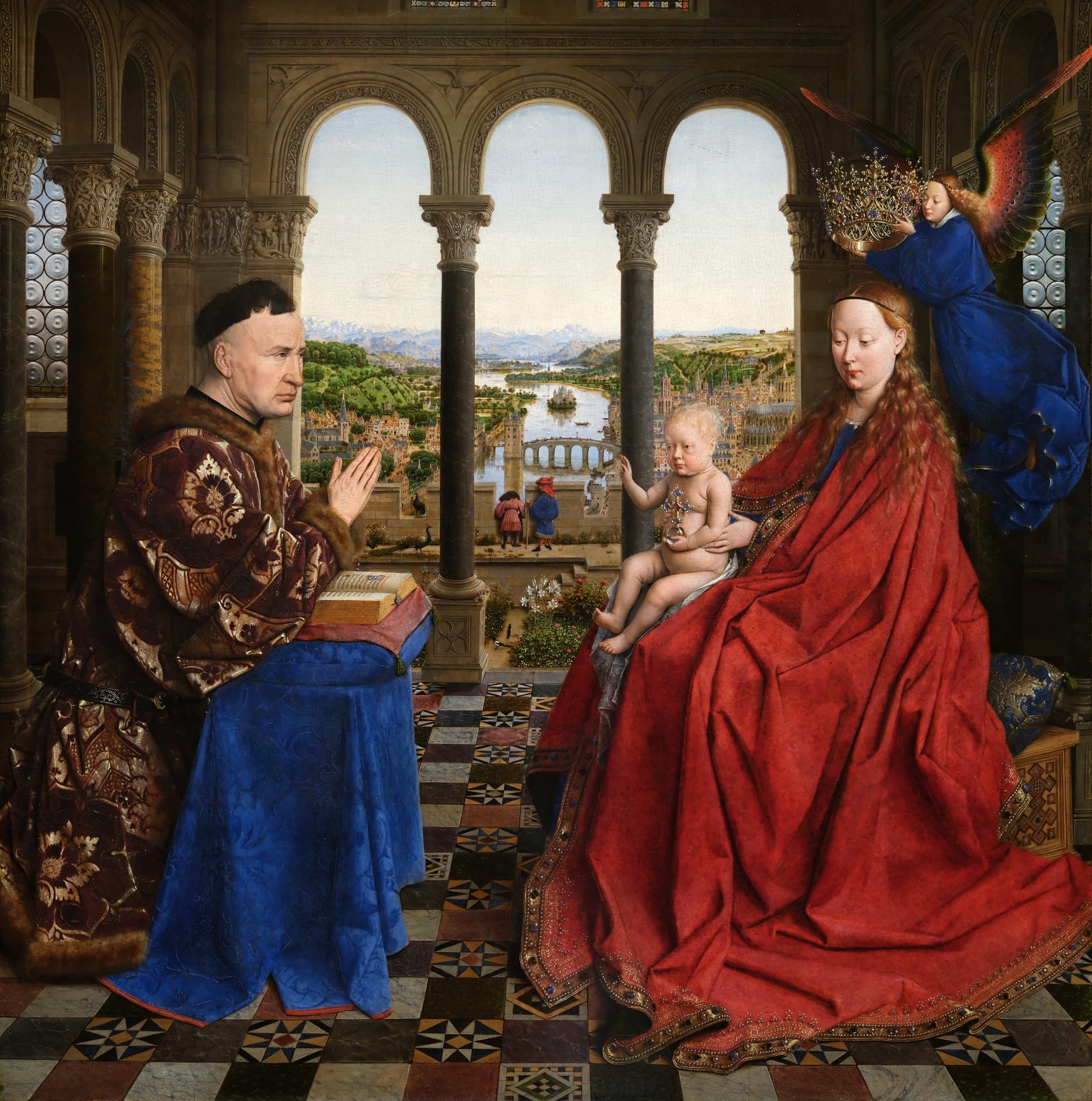
Jan van Eyck’s Madonna of Chancellor Rolin is a canonical masterpiece of the Northern Renaissance, held by the Louvre and inalienable under French law. In a hypothetical, unconstrained sale, its extreme rarity, art-historical primacy, and condition following recent conservation support a valuation of $250–450 million. This range is anchored by top Old Master benchmarks including Leonardo’s $450.3m auction record and recent nine-figure Rembrandt state acquisitions.
Valuation Analysis
Work and context. Jan van Eyck’s Madonna of Chancellor Rolin (c.1435; oil on oak, 66 × 62 cm) is a cornerstone of the Northern Renaissance and among the artist’s most intensively studied paintings. Commissioned by Nicolas Rolin and in the Louvre since 1800, the work is part of France’s inalienable public patrimony and does not trade on the open market [1][2]. The painting’s technical sophistication, donor portrait, architectural space, and jewel-like finish place it at the apex of van Eyck’s oeuvre, beside the Ghent Altarpiece and the Arnolfini Portrait.
Market evidence and scarcity. No securely autograph van Eyck painting has sold at public auction in modern times. Consequently, valuation must be inferred from adjacent Old Master trophies and institutional private-treaty acquisitions. The current public-sale ceiling for a Western Old Master is Leonardo da Vinci’s Salvator Mundi at $450.3 million (with premium) in 2017 [3]. Recent state-backed acquisitions of canonical masterpieces—Rembrandt’s The Standard Bearer at €175 million (~$199m at the time) [4] and the Louvre/Rijksmuseum’s €160 million pair of Rembrandt portraits—demonstrate museum willingness to pay in the high nine figures for irreplaceable works.
Comparative positioning. Within Renaissance benchmarks, Botticelli’s Portrait of a Young Man Holding a Roundel achieved $92.2 million in 2021, while prime rediscoveries such as Titian’s Rest on the Flight into Egypt realized ~£17.56m in 2024; in the Northern school specifically, the Getty secured Quentin Metsys’s Madonna of the Cherries for £10.6m the same season [5][6]. Van Eyck sits categorically above these comparables in rarity, authorship certainty, and art-historical weight. With fewer than two dozen accepted paintings, predominantly in museums, a prime, unimpeachable van Eyck of this caliber would command pricing at the very top of the Old Masters spectrum.
Estimate rationale. The proposed $250–450 million range reflects: (i) van Eyck’s foundational status and the painting’s canonical importance; (ii) the near-total absence of supply, which intensifies competition; (iii) recent conservation and high scholarly visibility via the Louvre’s 2024 focus exhibition, confirming condition and authorship; and (iv) alignment with the market’s demonstrated capacity for nine-figure Old Master acquisitions. The lower bound is informed by recent Rembrandt treaty prices; the upper bound recognizes the Leonardo auction apex and the possibility that a full, unconstrained global contest for a “museum-defining” van Eyck could press toward that ceiling [3][4].
Legal note and condition. While the work is inalienable under current French law, this valuation models a hypothetical, unrestricted sale scenario for insurance and strategic benchmarking. The 2021–2024 conservation campaign and subsequent exhibition materially enhance confidence in the panel’s stability and presentation, supporting a top-tier valuation [1].
Key Valuation Factors
Art Historical Significance
High ImpactMadonna of Chancellor Rolin is a benchmark of Early Netherlandish painting and a quintessential statement of van Eyck’s innovations in oil technique, light, and pictorial space. Its sophisticated donor portrait, panoramic urban landscape, and meticulously rendered architecture make it one of the most analyzed works in Northern Renaissance scholarship. Often bracketed with the Ghent Altarpiece and the Arnolfini Portrait, it is cited in survey texts, exhibitions, and technical literature as a keystone of 15th‑century painting. This canonically important status materially elevates value relative to even leading contemporaries and ensures intense interest from major institutions and the most advanced private collectors.
Rarity and Market Supply
High ImpactVan Eyck’s autograph corpus is exceptionally small—fewer than two dozen accepted paintings—and is overwhelmingly held by museums. There is effectively no modern public-auction record for a securely autograph van Eyck, and high-quality workshop pieces are scarce. This extreme scarcity creates a supply imbalance: any fully accepted, prime-quality van Eyck would be a once-in-a-generation opportunity. Such conditions typically produce outsized competitive pressure, particularly from institutions and patrons seeking to anchor national or foundation collections with a singular Renaissance masterpiece, thereby justifying values at the very top of the Old Masters market.
Condition and Conservation
High ImpactThe Louvre’s recent multi‑year conservation and 2024 focus exhibition have refreshed the painting’s surface, stabilized the support, and clarified readings of color and detail, all under rigorous technical scrutiny. For 15th‑century panels, condition and panel stability are central to value; a clean conservation dossier and exemplary presentation substantially de‑risk a transaction. While the work does not leave the Louvre, the newly published technical insights provide an authoritative baseline for authenticity, attribution, and state of preservation—key factors that underpin a premier valuation and buyer confidence at the nine‑figure level.
Comparative Pricing Benchmarks
High ImpactWith no modern van Eyck auction comparables, valuation is interpolated from top Old Master results. Leonardo’s Salvator Mundi at $450.3m sets the category ceiling at public auction, while state-level Rembrandt acquisitions have transacted near $180–$200m. Recent Renaissance best-in-class works—Botticelli at $92.2m and Titian’s rediscovery above $20m—illustrate robust demand but occupy lower rungs of rarity and canonical status. Against these benchmarks, a prime, unimpeachable van Eyck should rationally sit between the Rembrandt treaty prices and the Leonardo apex, supporting a $250–450m value range.
Legal/Marketability Constraints
Medium ImpactAs property of the French state in a national museum collection, the painting is legally inalienable under the Code du patrimoine. That status precludes ordinary market testing and keeps price discovery hypothetical. In practice, if deaccession were ever enabled, preemption and export controls could shape the buyer pool and format (likely a treaty sale to a major institution), potentially moderating the realized price versus a fully global, guarantee‑backed auction. The valuation presented here models an unconstrained, international context to establish a strategic benchmark for insurance and comparative purposes.
Sale History
Madonna of Chancellor Rolin has never been sold at public auction.
Jan van Eyck's Market
Jan van Eyck is among the rarest and most coveted names in the Old Masters field. Fewer than two dozen paintings are widely accepted as autograph, and nearly all reside in museums, resulting in virtually no modern auction supply. There is no meaningful public auction record for a securely autograph van Eyck; notable historical transactions occurred in the early 1930s, when the Soviet Union sold masterpieces to Western buyers. In today’s market, collectors and institutions prize van Eyck for his foundational role in oil painting and for the extraordinary technical and optical qualities of his panels. This scarcity, coupled with unrivaled art-historical stature, places any prime autograph van Eyck in the very top pricing tier of pre‑Modern art.
Comparable Sales
Salvator Mundi
Leonardo da Vinci
Market ceiling for a Renaissance panel; small devotional subject and trophy dynamics analogous to a prime van Eyck.
$450.3M
2017, Christie's New York
~$598.0M adjusted
The Standard Bearer
Rembrandt van Rijn
Top-tier Old Master masterpiece acquired by a national museum; sets recent private-treaty benchmark near $200m for canonical works.
$198.9M
2022, Private sale to the Dutch State/Rijksmuseum
~$220.0M adjusted
Pendant Portraits of Maerten Soolmans and Oopjen Coppit
Rembrandt van Rijn
Landmark joint museum purchase of irreplaceable Old Masters; demonstrates institutional willingness to pay ≈$180m+ for canonical works.
$179.0M
2016, Private sale (Christie's Private Sales) to the Louvre and Rijksmuseum
~$244.0M adjusted
Portrait of a Young Man Holding a Roundel
Sandro Botticelli
Marquee Early Renaissance painting at auction; evidences deep demand for blue-chip 15th‑century masters.
$92.2M
2021, Sotheby's New York
~$110.2M adjusted
Rest on the Flight into Egypt
Titian
Religious Renaissance panel with Holy Family subject; strong recent auction benchmark for a prime, museum-caliber rediscovery.
$22.2M
2024, Christie's London
~$22.8M adjusted
The Madonna of the Cherries
Quinten (Quentin) Metsys
Closest recent subject/period analogue: Northern Renaissance Madonna and Child panel; confirms strong institutional appetite in the category.
$13.5M
2024, Christie's London (to the J. Paul Getty Museum)
~$13.9M adjusted
Current Market Trends
The Old Masters market remains selective but strong at the top: overall auction volumes have fluctuated, yet masterpiece‑level works continue to outperform. Record and near‑record outcomes for Renaissance and Baroque trophies—ranging from the Botticelli portrait at $92.2m to high nine‑figure Rembrandt state acquisitions—confirm deep institutional and UHNW demand for canonical works. Recent rediscoveries by Titian and key Northern Renaissance acquisitions by museums (e.g., the Getty’s Metsys) show robust appetite when quality, freshness, and scholarship align. In this context, a museum‑defining van Eyck would command competition at the highest end of the category.
Sources
- Louvre Collections – Madonna of Chancellor Rolin
- Code du patrimoine (France), art. L451-5 – Inalienability of public collections
- Christie’s – Leonardo da Vinci, Salvator Mundi (2017)
- Guinness World Records – Most expensive Rembrandt (private sale, 2022)
- Sotheby’s – Botticelli portrait achieves $92.2m (2021)
- The Art Newspaper – Getty buys Quentin Metsys ‘Madonna of the Cherries’ (2024)