How Much Is Madonna of Jan Vos (Virgin and Child with Saints and Donor) Worth?
Last updated: April 29, 2026
Quick Facts
- Methodology
- comparable analysis
Catalogued by the Frick Collection as 'Jan van Eyck and workshop' (c.1441–43), the panel's market value today is estimated at approximately $20–75 million. The low end assumes a predominantly workshop attribution; the high end requires convincing technical evidence of substantial van Eyck autograph contribution or interest from a motivated institutional/private buyer.
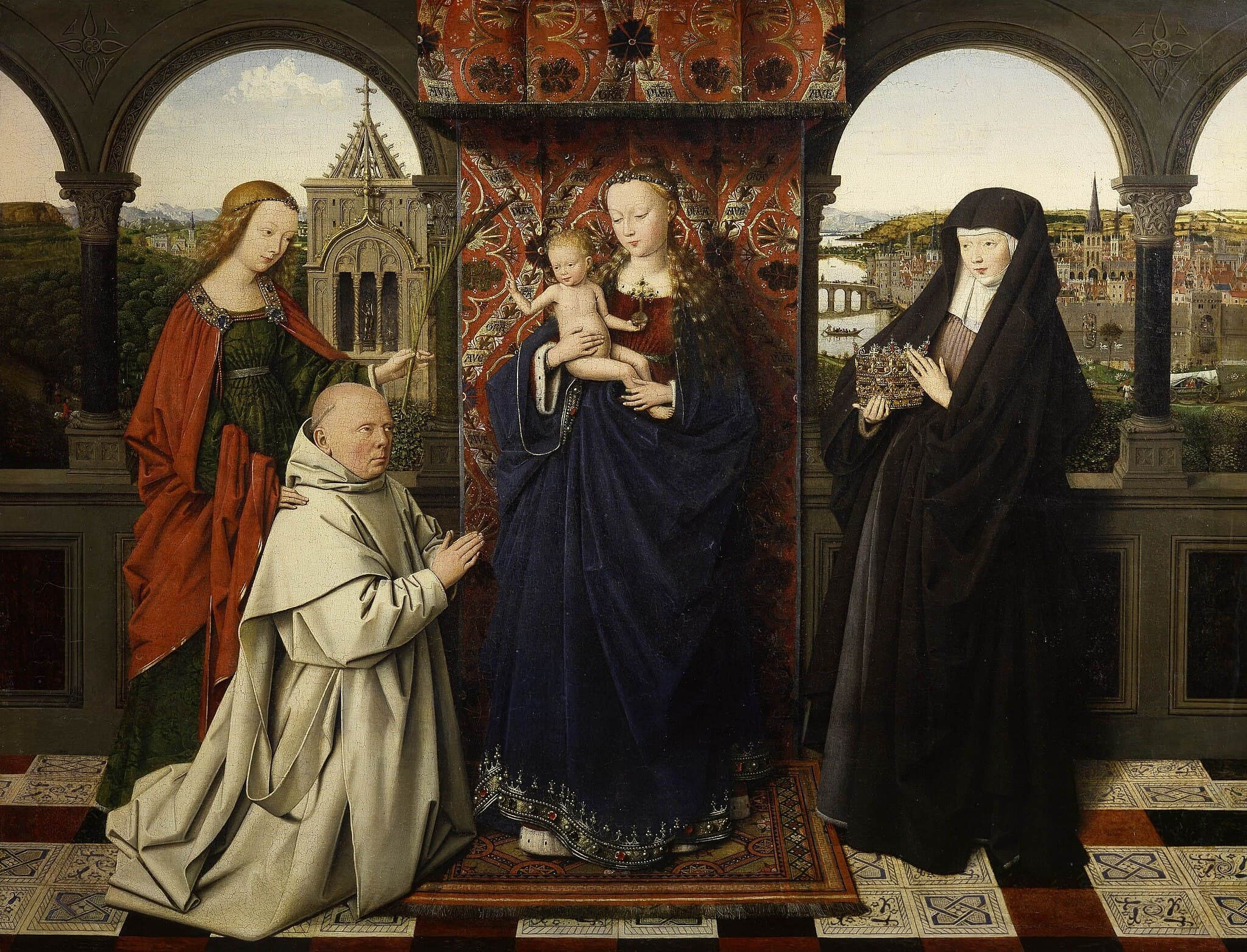
Madonna of Jan Vos (Virgin and Child with Saints and Donor)
Jan van Eyck • Oil on panel
View more by Jan van Eyck →Valuation Analysis
Valuation conclusion: Based on comparative market evidence, institutional purchase anchors, and the Frick Collection’s provenance, a reasonable market range today for the Madonna of Jan Vos (Virgin and Child with Saints and Donor) is approximately $20–75 million. The Frick’s catalogue entry and long stewardship make this a museum‑quality Northern Renaissance panel, but the prevailing attribution as “Jan van Eyck and workshop” produces wide valuation dispersion because full autograph status is not universally accepted [1].
Why this range: The range reflects two plausible sale scenarios. At the lower bound (≈$20M) the market treats the picture as a high‑quality workshop composition with attractive provenance and good scholarly interest. At the upper bound (≈$75M) the market recognizes substantial autograph input by Jan van Eyck (for example, significant original paint and characteristic underdrawing visible in IRR), or a private/institutional buyer pays a premium for the composition’s rarity and association with van Eyck. If the panel were to be proved a wholly autograph, historically pivotal van Eyck, market ceilings for such unique works can rise well above this band (see extreme comparables) [2][3].
Comparables and market logic: Direct public‑auction precedents for secure van Eyck paintings are effectively non‑existent, so price discovery draws on top‑end Renaissance trophies (Leonardo’s Salvator Mundi; Botticelli nine‑figure results) and on more directly relevant institutional purchases or exceptional Old Master drawings that traded in the $20–30M range. A reported recent museum purchase of a Netherlandish altarpiece for ~ $20M provides a practical institutional anchor for museum‑grade Northern Renaissance material; together these data points show that institutions will commit mid‑eight‑figure sums for rare works with strong attribution and provenance, while workshop pieces typically trade far lower in the market [2][3][4].
Transaction mechanics and caveats: A sale would almost certainly be negotiated privately (museum‑to‑museum sale or private treaty with guarantees), not as an open public auction lot. Key value drivers that could move the object outside the stated band are: conclusive technical evidence of autograph van Eyck (IRR, dendrochronology, pigment/binder analysis), newly discovered high‑quality provenance, or conversely, evidence of significant restoration/overpainting that reduces original surface and scholarly confidence. Absent new technical/provenance findings, the market will treat the Frick panel as a high‑value workshop/atelier piece rather than a trophy autograph, which is reflected in the range above [1][4].
Recommendation: To tighten the valuation, obtain the Frick acquisition file, full technical studies (IRR, X‑radiography, dendrochronology, pigment/binder analysis) and formal written opinions from leading van Eyck specialists. Those steps are decisive: they will either validate a premium autograph valuation or justify a conservative selling expectation in the lower part of the band.
Key Valuation Factors
Art Historical Significance
High ImpactThe Madonna of Jan Vos is a notable Early Netherlandish devotional composition tied to a named donor (Jan Vos, a Carthusian). While it is not as universally iconic as the Ghent Altarpiece or Arnolfini portrait, any credible autograph involvement from Jan van Eyck would elevate its scholarly and market importance substantially. The subject and donor connection provide clear provenance and iconographic interest, and a confirmed van Eyck contribution would make the panel a rare surviving example from one of the most important painters of the fifteenth century, a factor that strongly supports the upper valuation band.
Attribution & Technical Evidence
High ImpactAttribution is the single most decisive financial factor. The Frick now catalogues the work as begun by Jan van Eyck and finished by workshop hands; technical tests (infrared reflectography showing underdrawing style, dendrochronology dating of the oak panel, pigment and binder analysis consistent with early‑15th‑century practice) could confirm significant autograph intervention. Positive technical and stylistic alignment with accepted van Eyck panels would re‑rate the picture toward the high end of the band; failure to demonstrate autograph traits would anchor value at the lower end, consistent with high‑quality workshop material.
Provenance & Museum Holding
High ImpactThe panel’s long residency in the Frick Collection (acquired 1954) is a major positive: institutional provenance increases buyer confidence and typically supports higher valuations. Conversely, museum ownership reduces the likelihood of a market offering and therefore limits public comparables. If archival research revealed a continuous, well‑documented chain of ownership predating the Frick, that would further strengthen the valuation; unresolved gaps or contested provenance would materially depress market interest.
Condition & Conservation History
Medium ImpactThe extent and quality of restoration materially affect value. Panels with extensive overpainting, major retouching or structural instability (split panels, heavy filling) sell for less than well‑preserved originals. The Frick’s conservation practice is strong, which supports value, but specific condition reports are required. If significant original paint survives in critical autograph areas (faces, hands, underdrawing), values hold; if those areas are heavily restored, the market will discount accordingly.
Market Scarcity & Demand
High ImpactSecure autograph van Eyck panels are exceptionally scarce and largely museum‑held, creating intense but selective demand. When a credible autograph van Eyck appears (or is demonstrated), competition is typically institutional and private‑consortium driven, pushing prices sharply upward. However, the scarcity also means valuation is highly sensitive to attribution certainty and sale channel (private treaty with museums vs public auction); market appetite is strong but concentrated among a small set of high‑capacity buyers.
Sale History
Madonna of Jan Vos (Virgin and Child with Saints and Donor) has never been sold at public auction.
Jan van Eyck's Market
Jan van Eyck is one of the foundational figures of Early Netherlandish painting; his securely attributed painted corpus is very small and primarily museum‑held. Because of that scarcity, when attribution is secure works receive extraordinary attention and can command institutional competition and private‑consortia bids. There is effectively no modern public‑auction liquidity for undisputed van Eyck panels; valuations are driven by scholarly consensus, technical verification and institutional demand. The market is therefore dominated by private treaty arrangements and museum purchases rather than open auction comparables.
Comparable Sales
Salvator Mundi
Leonardo da Vinci
Record public sale for an ultra‑rare Renaissance masterpiece; sets the extreme top‑end market ceiling for unique 15th/16th‑century panels and shows scale of bidding for singular works.
$450.3M
2017, Christie's New York
~$587.2M adjusted
Portrait of a Young Man Holding a Roundel
Sandro Botticelli
Rare 15th‑century panel that achieved a nine‑figure price; a realistic high‑end comparable for a small/medium, securely attributed, historically important Renaissance panel.
$92.2M
2021, Sotheby's New York
~$108.9M adjusted
Netherlandish altarpiece (reported National Gallery purchase)
Anonymous / Netherlandish
Contemporary institutional purchase (~$20M) of a Netherlandish work; useful as a practical museum‑purchase anchor showing institutions will pay tens of millions for high‑quality Northern Renaissance objects.
$20.0M
2025, National Gallery (private purchase reported)
After Rogier van der Weyden (workshop/follower)
Follower of Rogier van der Weyden
Example of a high‑quality workshop/follower Northern Renaissance panel achieving low‑six‑figure results — a practical lower‑end comparable if the Frick panel is regarded as workshop/follower.
$258K
2024, Bonhams (New Bond Street)
~$264K adjusted
Small 'after Jan van Eyck' panel (regional sale example)
Workshop / after Jan van Eyck
Illustrates the market floor for copies/after works: small regional lots labelled 'after Jan van Eyck' commonly sell for hundreds to low thousands — useful to bound the low end.
$4K
2024, Chiswick Auctions (regional sale example)
~$4K adjusted
Current Market Trends
As of 2024–26 the Old Masters market is showing selective resilience: institutions remain active buyers, private treaty sales and guarantees are common for high‑value works, and major exhibitions (notably the National Gallery’s van Eyck show) increase scholarly and buyer attention. Attribution certainty and technical dossiers are decisive for price; scarcity of autograph Northern Renaissance panels keeps potential valuations high but concentrate bidders among museums and well‑funded private buyers.
Sources
- Frick Collection / Google Arts & Culture — Virgin and Child, with Saints and Donor (Madonna of Jan Vos)
- Salvator Mundi (Leonardo da Vinci) — 2017 Christie's sale (summary)
- Sotheby's reportage — Botticelli Portrait sale (2021) / Marquee Masters review
- The Art Newspaper — National Gallery reported purchase of a Netherlandish altarpiece (institutional anchor for pricing)