How Much Is Portrait of a Man (Self Portrait?) Worth?
Last updated: July 3, 2026
Quick Facts
- Methodology
- comparable analysis
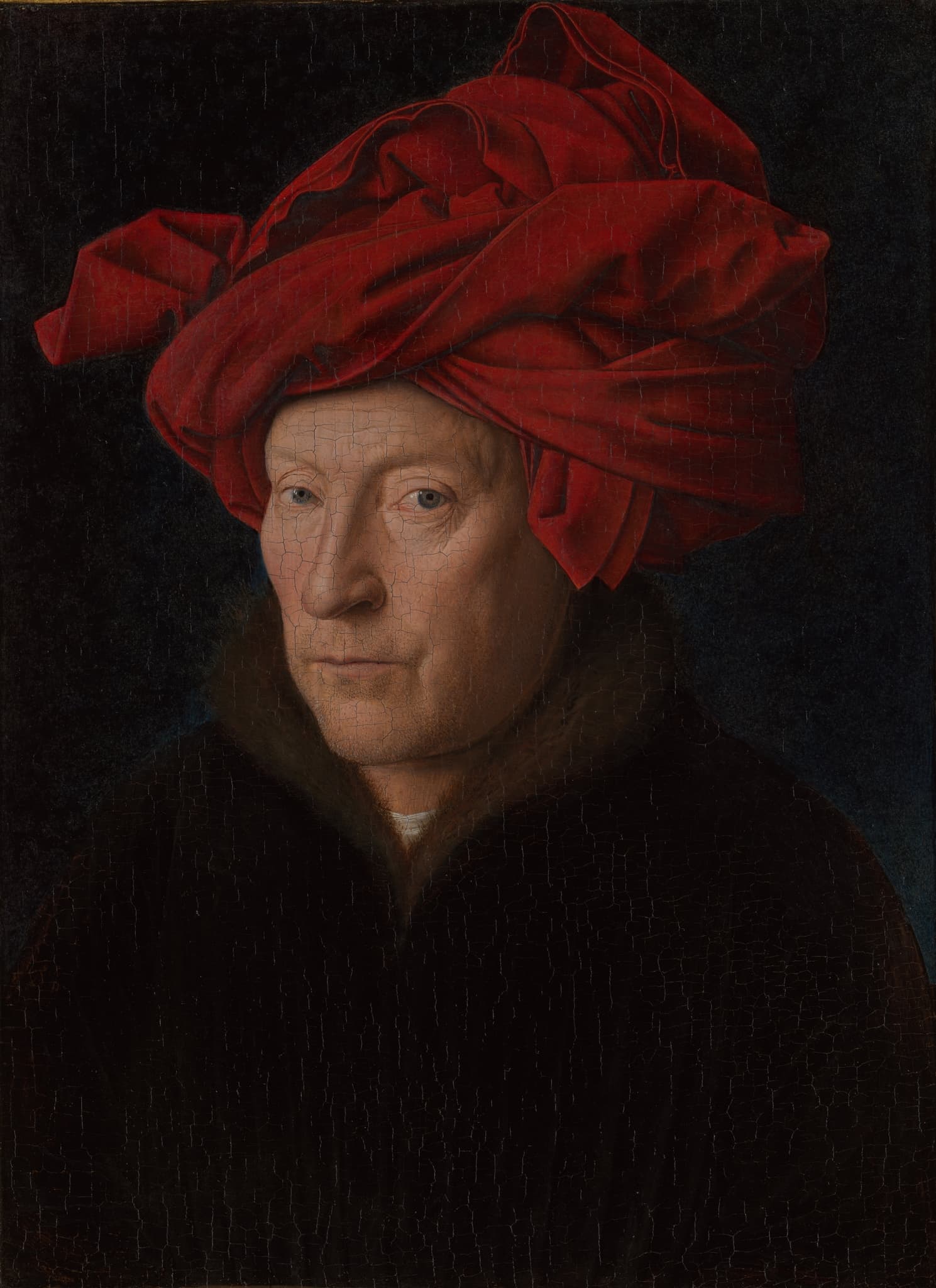
Estimated open-market value: $250–400 million. This signed and dated 1433 panel—long proposed as Jan van Eyck’s self-portrait and retaining its original frame and motto—is a canonical image of early Netherlandish art with no modern market analogue. Using top-tier Renaissance/Old Master benchmarks (Leonardo at $450.3m; Rembrandt pendants at €160m; Botticelli portrait at $92.2m), the range reflects absolute rarity, art-historical primacy, and trophy-level demand.
Valuation Analysis
Object: Jan van Eyck, Portrait of a Man (Self Portrait?), 1433, oil on oak, National Gallery, London (NG222). The integral frame bears the artist’s motto and a full signature with exact date, underscoring unassailable authorship and exceptional art-historical importance. It is widely regarded as a touchstone of early Netherlandish portraiture and a seminal moment in the formation of the independent portrait in oil [1].
Scarcity and institutional priority: Fewer than a couple of dozen autograph van Eycks are generally accepted, and virtually all reside in public collections. Loans of top-tier works are rare and tightly controlled, reflecting both fragility and institutional priority. The largescale 2020 Ghent exhibition was notable precisely because such loans are exceptional—clear evidence of near-zero market liquidity for autograph van Eyck paintings [2]. This structural scarcity necessitates valuation by analogy rather than direct price history.
Comparable benchmarks: We anchor the high end with Leonardo da Vinci’s Salvator Mundi at $450.3m (2017), which set the modern ceiling for a rare Renaissance masterwork in panel format [3]. For Northern portraits, the joint acquisition of Rembrandt’s pendant portraits by the Rijksmuseum and the Louvre at €160m (2016) demonstrates pricing for canonical, museum-caliber portraiture in a context of institutional competition [4]. Botticelli’s Portrait of a Young Man Holding a Roundel achieved $92.2m (2021), establishing a recent public benchmark for a best-of-category early Renaissance portrait at intimate scale [5]. Against these markers, an undisputed, signed-and-dated van Eyck portrait with original frame and potential self-portrait status merits a substantial premium over Botticelli and sits credibly between the Rembrandt pendants and the Leonardo record.
Market conditions and positioning: After a weaker 2024, Old Masters rebounded in 2025 with the category the only one to grow mid-year, signaling renewed confidence for top historical material even as contemporary cooled [6]. Within that context, this picture’s irreplaceability, canonical status, and cross-institutional appeal support a theoretical open-market valuation of $250–400 million. The lower bound reflects disciplined bidding under private-treaty or institutionally sensitive scenarios; the upper bound contemplates trophy-lot dynamics at public auction or sovereign-level competition. In either channel, the work’s art-historical primacy and absolute scarcity justify a valuation near the apex of the Old Masters market.
Key Valuation Factors
Art Historical Significance
High ImpactPortrait of a Man (Self Portrait?) is among the most celebrated images of early Netherlandish art. It is signed and precisely dated 21 October 1433 and retains its original frame inscribed with van Eyck’s personal motto—features that uniquely reinforce its authorship and documentary value. The panel is widely treated as a foundational milestone in the emergence of the independent portrait in oil, combining psychological presence with technical finesse that defined Northern Renaissance naturalism. Its likely self-portrait status adds biographical resonance and makes it a cornerstone of van Eyck’s oeuvre, comparable in fame to the Arnolfini Portrait and closely aligned with the innovations around the Ghent Altarpiece. This level of canonicity materially elevates demand and pricing power for any theoretical market event.
Extreme Rarity and Market Liquidity
High ImpactAutograph paintings by Jan van Eyck are exceptionally scarce—only a small corpus is generally accepted, almost entirely in museums or church collections. There is effectively no modern public-auction record for an undisputed van Eyck panel, and major loans are rare, underscoring institutional priority and the fragility of surviving works. This creates a structural scarcity premium: collectors and institutions have no close substitutes at any price, and the absence of a price series forces valuation by extrapolation from a handful of high-level Old Master trophies. Rarity of this order reliably compresses time-to-decision for qualified buyers and supports competitive bidding under both private and public scenarios, pushing values toward the very top of the Old Masters market spectrum.
Condition, Original Frame, and Technical Merit
High ImpactThe work’s small scale, exquisite finish, and survival with its integral, inscribed frame dramatically enhance its scholarly and market value. Van Eyck’s oil technique—minute detail, controlled glazing, and lifelike modeling—translates into a best-in-class microcosm of his practice. The signed-and-dated frame functions as a period document, amplifying authenticity and historical resonance. While many early panels face inherent fragility and strict loan constraints, the retained original context here offsets typical concerns by adding uniqueness and completeness rarely found in 15th-century portraits. In valuation, such technical and contextual integrity supports positioning above otherwise comparable Renaissance portraits, and narrows buyer risk around attribution, dating, and condition—a critical advantage in trophy-level transactions.
Comparable Benchmarks and Trophy Dynamics
Medium-high ImpactPrice discovery must reference top-tier Old Master trophies: Leonardo’s Salvator Mundi at $450.3m provides the modern ceiling for rare Renaissance panels; Rembrandt’s pendant portraits at €160m reflect museum-level pricing for canonical Northern portraiture; and Botticelli’s $92.2m portrait anchors the best recent public result for an early Renaissance portrait on panel. Against this matrix, van Eyck’s signed 1433 portrait—arguably the most iconic Northern Renaissance portrait in private imagination after the Arnolfini—warrants valuation well above Botticelli and plausibly approaching or exceeding the Rembrandt pendants when institutional or sovereign buyers are engaged. Auction-based trophy dynamics, marketing scale, and geopolitical demand could skew outcomes to the top of the indicated range.
Sale History
Portrait of a Man (Self Portrait?) has never been sold at public auction.
Jan van Eyck's Market
Jan van Eyck occupies an apex position in Old Masters collecting: foundational to Northern Renaissance painting, with an extremely limited number of autograph works surviving and virtually none in private hands. There is effectively no modern auction record for an undisputed van Eyck panel, making conventional comparables impossible. The market does see workshop, follower, and ‘after van Eyck’ works, but these trade in the low-to-mid seven figures and are not price-informative for autograph masterpieces. Consequently, valuations are derived by extrapolating from rare, top-tier Renaissance and Baroque trophies (e.g., Leonardo, Rembrandt, Botticelli) and by factoring absolute scarcity, institutional competition, and art-historical primacy. In any appearance, attribution certainty, condition, and exportability would be decisive and likely resolved via private treaty with museum involvement.
Comparable Sales
Salvator Mundi
Leonardo da Vinci
Trophy-level Renaissance panel by a foundational master; establishes the top end for rare, museum-caliber early masters. While not a portrait, it benchmarks scarcity premiums and sovereign/institutional appetite.
$450.3M
2017, Christie's New York
~$562.9M adjusted
Pendant Portraits of Maerten Soolmans and Oopjen Coppit
Rembrandt van Rijn
Once-in-a-generation Old Master portrait pair acquired by top museums; demonstrates pricing for canonical, museum-grade portraits where supply is effectively zero.
$180.0M
2016, Private treaty via Christie's (to Rijksmuseum and Louvre)
~$234.0M adjusted
Portrait of a Young Man Holding a Roundel
Sandro Botticelli
Quattrocento male portrait on panel of intimate scale; the closest recent public benchmark for a best-of-category early Renaissance portrait.
$92.2M
2021, Sotheby's New York
~$110.6M adjusted
The Man of Sorrows
Sandro Botticelli
Late Botticelli devotional bust-length panel, small format; evidences current appetite and pricing for rare 15th/early-16th century Florentine panels at the top end.
$45.4M
2022, Sotheby's New York
~$50.4M adjusted
Lot and His Daughters
Peter Paul Rubens
Record-level Baroque Flemish master sale; not a portrait, but a key trophy benchmark showing depth of demand for canonical Northern European painters.
$58.2M
2016, Sotheby's London
~$75.6M adjusted
Portrait of a Man, Half-Length, with His Arms Akimbo
Rembrandt van Rijn
High-profile Old Master male portrait at auction; later period and larger scale, but provides a portrait-specific market anchor within Northern traditions.
$33.2M
2009, Christie's London
~$48.2M adjusted
Current Market Trends
Old Masters experienced a soft 2024 but rebounded in 2025, with the category uniquely showing year-over-year growth mid-year and regaining share at the top end. Sell-through rates improved in London’s summer season and key single-owner sales demonstrated resilient demand for best-in-class material. Institutional buying remained strong, further constraining supply. While the category remains a fraction of the size of Modern and Post-War/Contemporary, the bid for canonical, museum-grade works has deepened as some contemporary segments cooled. In this climate, a singular, irreplaceable van Eyck would likely trigger cross-institutional and sovereign-level interest, supporting a price near the apex of the Old Masters spectrum and competitive with the rarest Renaissance trophies.
Sources
- National Gallery, London – Jan van Eyck, Portrait of a Man (Self Portrait?)
- The Art Newspaper – Rare loans bolster biggest ever Jan van Eyck show
- The Guardian – Leonardo da Vinci’s Salvator Mundi sells for $450m
- Christie’s – Two Rembrandt masterpieces (Soolmans/Coppit) acquired by Rijksmuseum and Louvre
- Sotheby’s – Botticelli Portrait of a Young Man Holding a Roundel achieves $92.2m
- Artnet Intelligence Report (Mid-Year 2025) – Category performance and market share