How Much Is Virgin and Child with Canon Joris van der Paele Worth?
Last updated: April 29, 2026
Quick Facts
- Methodology
- extrapolation
Hypothetical market band for Jan van Eyck’s Virgin and Child with Canon Joris van der Paele is estimated at USD 200–600 million. This is a reasoned, conditional extrapolation based on trophy Old Master precedents, the painting’s canonical status and exceptional rarity; it assumes secure attribution, good condition and an extraordinary (and largely theoretical) sale environment.
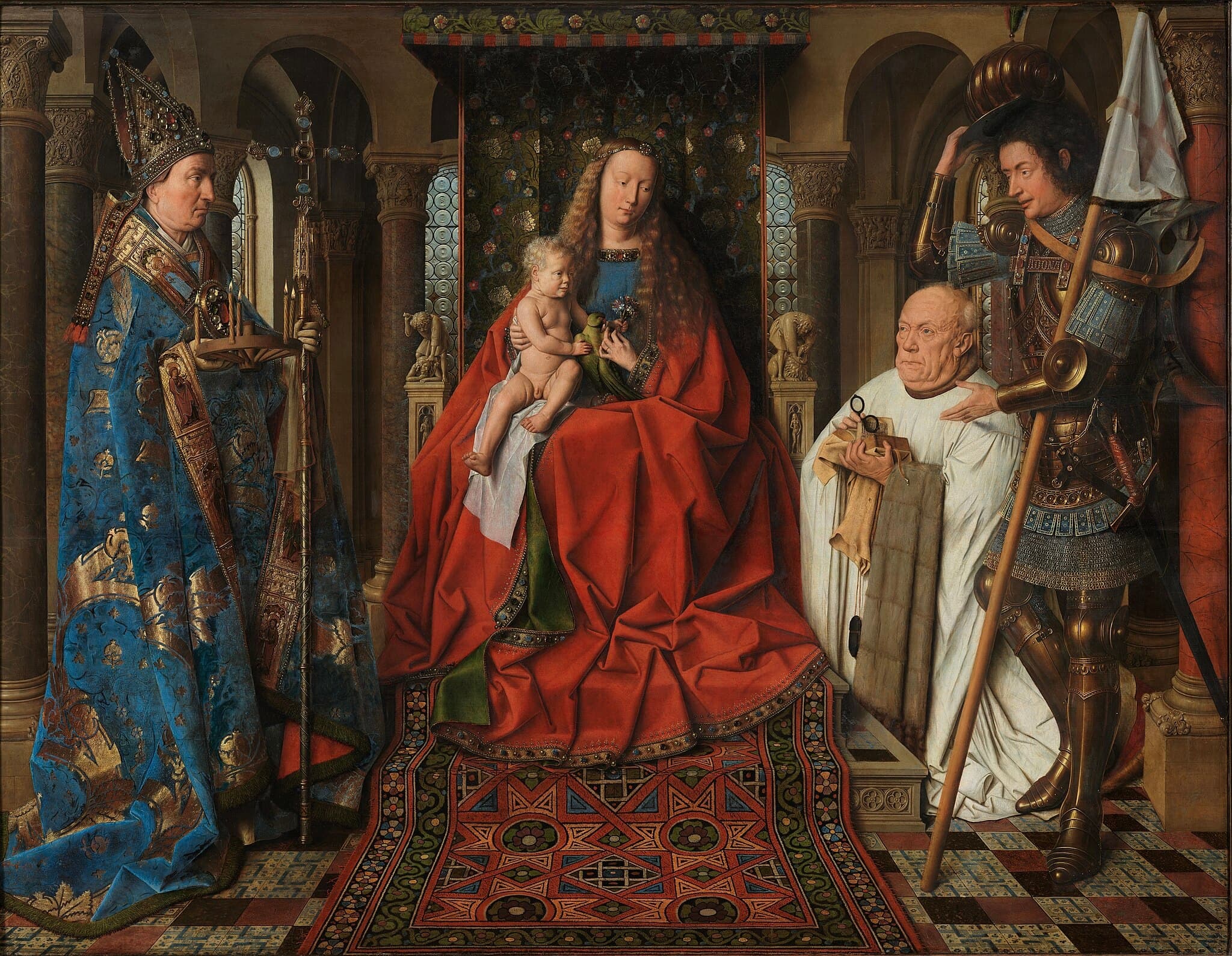
Virgin and Child with Canon Joris van der Paele
Jan van Eyck • Oil on oak panel
View more by Jan van Eyck →Valuation Analysis
Valuation conclusion: On a hypothetical open‑market basis, the Virgin and Child with Canon Joris van der Paele (Groeninge Museum, Bruges) is valued at approximately USD 200–600 million. This band is intentionally wide because no modern public sale of a securely attributed Jan van Eyck panel provides direct price discovery and because the object is museum‑held and culturally protected [1].
Why the band spans this range: the low end (≈USD 200M) reflects an institutional or consortial acquisition scenario in which a deaccession or exceptional government sale allowed transfer to another public museum or sovereign buyer; this assumes a competitive but constrained buyer pool. The high end (≈USD 600M) represents a trophy‑purchase scenario in which legal barriers were overcome, attribution and condition were beyond dispute, and a small set of ultra‑high‑net‑worth or state buyers competed aggressively — a scenario analogous to the market shock produced by the Leonardo Salvator Mundi auction record in 2017, which establishes the realistic upper anchor for a single, unique Old Master masterpiece [2].
Key inputs and sensitivities: the estimate is driven by four principal inputs: the painting’s canonical art‑historical status and cultural importance; the effectively zero supply of autograph van Eyck panels in the private market; institutional ownership and legal/regulatory restrictions that greatly reduce sale likelihood; and precedent trophy sales of benchmark Old Masters (private institutional purchases and exceptional auction results) used to scale expected outcomes. Small changes in any of these inputs — especially attribution confidence, conservation condition, or the legal ability to export/alienate the work — produce very large changes in value.
Practical caveats: this figure is not an insured valuation or a formal appraisal. The painting is part of the Groeninge collection and has been subject to technical study and public‑collection protections; many jurisdictions treat works of this type as inalienable or export‑restricted, making an actual market transaction unlikely or subject to unique political and legal conditions [1]. For a formal, actionable valuation you should obtain the museum’s full conservation reports, confirm current legal and cultural‑heritage status, and engage Old Masters specialists at major houses or an independent appraiser to test market appetite under a defined disposal scenario.
Key Valuation Factors
Art Historical Significance
High ImpactJan van Eyck’s Virgin and Child with Canon Joris van der Paele is a principal work in the small surviving corpus of one of northern Europe’s foundational painters. Its art‑historical importance as a devotional portrait/altarpiece, its role in scholarship on Early Netherlandish painting, and its frequent citation in technical and iconographic literature amplify its cultural and monetary value. Works of demonstrable primary‑hand quality by van Eyck are treated by museums and scholars as irreplaceable national treasures; that status drives institutional willingness to pay and also places a premium on the few occasions when transfer is even contemplated.
Rarity & Scarcity
High ImpactThe surviving autograph oeuvre of Jan van Eyck is extremely small and almost entirely held in public collections. The effective absence of comparable autograph van Eyck panels from the open market creates a severe supply constraint, which in turn supports outsized valuations if one of these works were to be offered. Scarcity means price discovery is primarily extrapolative from other trophy Old Masters rather than based on a reliable series of like‑for‑like sales.
Condition & Attribution Certainty
High ImpactCondition, technical integrity and unambiguous attribution are essential drivers of value. A securely attributed, well‑conserved panel with favorable technical reports (dendrochronology, MA‑XRF imaging, pigment analysis) will attract institutional and private bidders at the top of the range. Any substantial restoration needs, overpainting, or credible scholarly dispute over autograph status would materially depress value, potentially by orders of magnitude compared to an undisputed masterpiece.
Legal & Cultural‑Heritage Constraints
High ImpactBelgian and Flemish cultural‑heritage protections, export controls and the moral/institutional resistance to deaccessioning works of major national importance sharply reduce marketability. Even where deaccessioning is legally possible, political, ethical and public relations barriers make unconditional sales to private foreign buyers unlikely. These constraints lower the practical probability of an open competitive sale and therefore reduce the reliability of any high‑value price forecast.
Market Demand & Buyer Pool
Medium ImpactBuyers for a canonical van Eyck would be extremely limited: national museums, sovereign collectors, a tiny set of private collectors with museum ambitions, or consortia. Demand is strong but concentrated; a motivated institutional buyer can pay a premium to keep a work public, while private buyers face reputational and logistical barriers. The narrow buyer pool increases volatility: when competition is present, prices spike; otherwise, sale opportunities may not materialize.
Sale History
Virgin and Child with Canon Joris van der Paele has never been sold at public auction.
Jan van Eyck's Market
Jan van Eyck occupies the highest tier of the Early Netherlandish market. His surviving autograph works are few, heavily studied and almost entirely museum‑held, which means they seldom if ever appear at public auction. Because of this, market valuation relies on extrapolation from exceptional Old Master trophy sales and institutional purchases rather than a robust auction series; attribution, conservation data and institutional contexts therefore dominate any price outcome.
Comparable Sales
Salvator Mundi
Leonardo da Vinci
Record public auction for a unique, canonical Old Master — establishes the upper bound for what buyers will pay for a single, museum‑quality, universally attributed masterpiece.
$450.3M
2017, Christie's New York (auction)
~$556.1M adjusted
Portraits of Marten Soolmans and Oopjen Coppit (pair)
Rembrandt van Rijn
Major institutional purchase of two canonical 17th‑century portraits; analogous to a van Eyck panel in that public institutions paid a premium to secure culturally important Old Masters and keep them public.
$180.0M
2016, Joint acquisition by the Rijksmuseum (Amsterdam) and the Musée du Louvre (Paris) (private/national purchase)
~$226.8M adjusted
16th‑century Netherlandish/French altarpiece (private acquisition reported; placed on display at National Gallery 2025)
Unknown / workshop (16th-century Netherlandish/French)
Recent museum acquisition of a rare early Northern European religious work — useful as a lower‑end institutional comparable showing the multi‑million price band for significant but less‑canonical pre‑1600 religious panels.
$22.1M
2025, Private sale to the National Gallery, London (reported)
Current Market Trends
The Old Masters sector has shown renewed institutional buying and dealer interest in recent years, with museums willing to pay premium sums for rare, well‑documented works. Technical scholarship and high‑profile conservation projects have increased attention to attribution issues, which can both raise and reduce market appetite. Supply remains the binding constraint; exceptional works that do appear draw intense, concentrated bidding.
Sources
- Musea Brugge — Groeninge Museum collection entry for Madonna with Canon Joris van der Paele
- Coverage of the Christie's sale of Leonardo's Salvator Mundi (2017) — euronews
- The Art Basel and UBS Global Art Market Report — sector context (Old Masters rebound)
- Reporting on the joint acquisition of Rembrandt's portraits by Rijksmuseum and the Louvre (2016)
- Musée du Louvre — 'A New Look at Jan van Eyck. The Madonna of Chancellor Rolin' (exhibition/technical attention)