How Much Is Blueberry Worth?
Last updated: July 5, 2026
Quick Facts
- Last Sale
- $16.6M (2018, Christie's New York)
- Insurance Value
- $33.0M (Advisory recommendation (replacement value), based on 2018–2026 Mitchell comparables and current marquee-sale conditions)
- Methodology
- comparable analysis
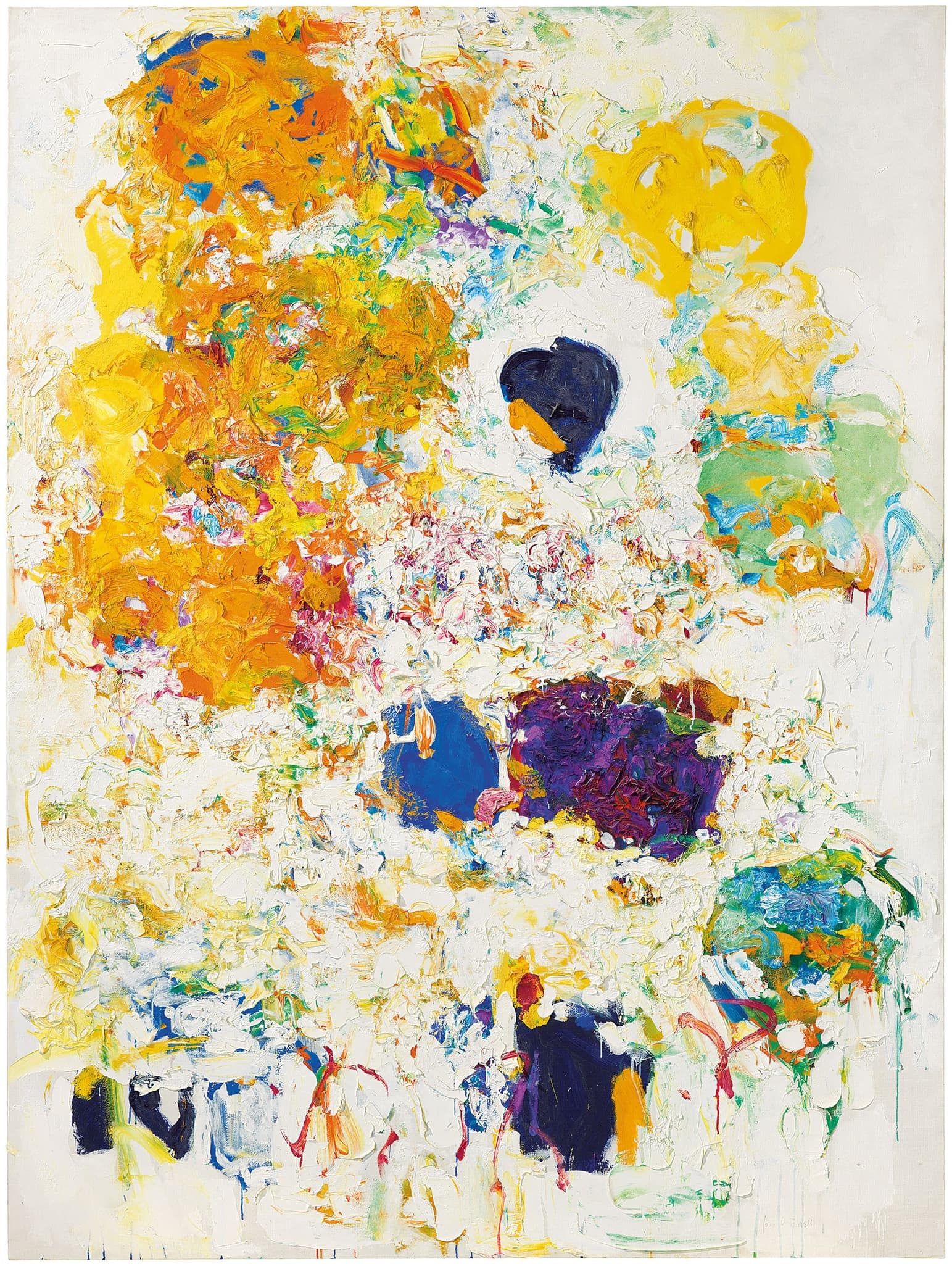
Fair-market value for Joan Mitchell’s Blueberry (1969) is $24–28 million. This range is anchored to the work’s $16.625 million result in 2018 and recent prime-period comparables, notably Noon (c.1969) at $22.6 million (2024) and the artist’s 2023 record at $29.16 million.
Valuation Analysis
Conclusion: Fair-market value for Joan Mitchell’s Blueberry (1969, oil on canvas, 78 7/8 x 59 in) is estimated at $24–28 million. This synthesis anchors to the work’s own $16.625 million result at Christie’s New York on May 17, 2018, and calibrates against recent late-1960s single-canvas benchmarks and the artist’s current auction record ceiling [1][2][3][4].
Key anchors and comparables: Blueberry is a prime-period, large single-canvas from 1969 with distinguished provenance and exhibition history (Martha Jackson Gallery; Henry and Elsie Hillman collection; Carnegie International 1970–71; Whitney 1974) [1][2]. Since Blueberry’s 2018 sale, the closest peer is Noon (c.1969), a like-format canvas that realized $22.615 million with premium at Sotheby’s New York (May 13, 2024) [3]. Additional context includes Sunflower V (1969) at $16.735 million (Christie’s, Nov 17, 2025), which defines a recent conservative floor for strong 1969 singles, and the artist’s auction record of $29.16 million for an earlier, museum-caliber Untitled (c.1959) (Christie’s, Nov 9, 2023), which establishes a realistic ceiling Blueberry should not be expected to exceed absent extraordinary competitive dynamics [4][5].
Why the mid-to-high $20m band now: Market depth for Mitchell at the top end has remained robust, with multiple seven- and eight-figure results and sustained global demand for blue-chip postwar material. The 2018 Blueberry price adjusted for current conditions, combined with the 2024 Noon benchmark, supports a mid– to high–$20 million today, particularly given Blueberry’s scale, prime date, and marquee exhibition pedigree [2][3]. The broader high-end market has also re-accelerated, with a clear flight to quality and renewed confidence among top-tier buyers, conditions that typically favor canonical AbEx figures like Mitchell [6].
Positioning and sensitivities: The high end of the range ($27–28m) presumes excellent condition, compelling color orchestration and brushwork relative to elite late-1960s Mitchells, and active competition (or strong pre-sale interest/guarantee) in a marquee New York setting. The low end ($24–25m) captures normal liquidity for a prime 1969 single-canvas with solid—but not extraordinary—compositional or literature advantages. Downward adjustments would stem from condition or conservation issues, weaker composition, or suboptimal sale timing; upside would require pristine condition, standout aesthetic quality, and strong pre-sale engagement.
Bottom line: Against the same-work 2018 result, the 2024 Noon comp, and the 2023 artist record as an upper bound, a $24–28 million fair-market range best reflects Blueberry’s standing within Mitchell’s oeuvre and today’s selective but deep high-end market [2][3][4][5][6].
Key Valuation Factors
Prime Period and Scale
High ImpactBlueberry dates to 1969, a prime Vétheuil-era period widely regarded as one of Joan Mitchell’s most sought-after phases. At 78 7/8 x 59 in (200.4 x 149.9 cm), it sits firmly within the large single-canvas format that drives top-tier demand and pricing. Works of this date and scale, such as Noon (c.1969), have recently achieved results in the low-to-mid $20m range, confirming strong liquidity for comparable material. The combination of mature gesture, orchestrated color, and physical presence characteristic of the late 1960s is precisely what major collectors and institutions target, positioning Blueberry competitively within Mitchell’s A-lane and supporting a mid– to high–$20m fair-market valuation.
Provenance and Exhibition History
High ImpactBlueberry’s early placement with Martha Jackson Gallery, acquisition by Henry and Elsie Hillman in 1970, and its inclusion in major exhibitions—Carnegie International (1970–71), Everson Museum (1972), and the Whitney Museum (1974)—create a distinguished, institutionally validated trajectory. Such provenance reduces risk and enhances desirability, while a documented exhibition record broadens literature visibility and curatorial familiarity. The 2018 sale to benefit the Hillman Family Foundation further underscores a clean passage to market. Together, these factors elevate confidence among bidders and private buyers, typically translating into stronger competition at auction and tighter private-sale spreads—key contributors to the upper half of the proposed range.
Market Benchmarks and Liquidity
High ImpactThe painting’s own $16.625m (2018) result provides a robust anchor, while the most comparable recent benchmark—Noon (c.1969) at $22.615m in 2024—defines current market depth for large, prime-period singles. The artist’s auction record of $29.16m (2023) sets an upper bound for single-canvas Mitchells in today’s climate. Recent sales like Sunflower V (1969) at $16.735m reinforce a conservative floor for strong works from this year. In parallel, the broader high-end market has re-strengthened, with a clear flight to quality. These datapoints collectively support a mid– to high–$20m valuation for Blueberry, contingent on condition, compositional strength, and effective placement in a marquee sale or well-orchestrated private process.
Sale History
Christie's New York
Post-War & Contemporary Art Evening Sale, Lot 6B; sold to benefit the Hillman Family Foundation; artist auction record at the time.
Joan Mitchell's Market
Joan Mitchell is a top-tier postwar Abstract Expressionist whose market exhibits sustained global demand and reliable liquidity at the high end. Her current auction record stands at $29.16 million (Christie’s, Nov 2023) for an earlier, museum-level Untitled (c.1959). Since then, multiple results have clustered from the mid-teens to the low-$20 millions for major canvases, with Noon (c.1969) achieving $22.6 million at Sotheby’s in May 2024. Late-career works can also reach the high-$20 millions when monumental and exceptional. Institutions continue to foreground Mitchell in exhibitions and acquisitions, and collectors prize her large-scale, mature-period paintings, particularly from the late 1960s and early 1970s. Top examples attract deep bidding pools and consistent third-party interest.
Comparable Sales
Noon (c. 1969)
Joan Mitchell
Prime 1969 single-canvas of near-identical period/format to Blueberry; current benchmark for late-’60s Mitchell.
$22.6M
2024, Sotheby's New York
~$23.1M adjusted
Sunflower V (1969)
Joan Mitchell
Same 1969 year and large single-canvas; closely tracks pricing for strong late-’60s works.
$16.7M
2025, Christie's New York
Sunflowers (1990–91)
Joan Mitchell
Monumental late-period canvas; indicates upper demand for major Mitchells though later than Blueberry’s prime period.
$27.9M
2023, Sotheby's New York
~$29.3M adjusted
Untitled (c. 1959)
Joan Mitchell
Artist’s auction record; museum-caliber earlier work that sets a realistic ceiling for single-canvas Mitchells.
$29.2M
2023, Christie's New York
~$30.6M adjusted
Untitled (1989)
Joan Mitchell
Large late-period single canvas; helpful lower-bound datapoint relative to prime 1960s works.
$14.1M
2022, Christie's New York
~$15.5M adjusted
$16.6M
2018, Christie's New York
~$21.2M adjusted
Current Market Trends
The high end of the postwar and Abstract Expressionist market has reasserted strength, characterized by a pronounced flight to quality and competitive bidding for canonical, fresh-to-market works. Recent marquee weeks set new artist records and delivered strong totals, signaling renewed buyer confidence. Within this context, Mitchell’s prime-period large canvases continue to perform at the top of their historical bands, while later or smaller works transact at healthy but more selective levels. Guarantees and well-curated sales remain effective in catalyzing outcomes. Overall, conditions favor historically central artists like Mitchell, particularly when provenance, exhibition history, scale, and condition align to present museum-caliber opportunities.
Study print
Study this painting as a print
Pair the full artwork with a museum-style study sheet focused on one meaningful detail.
Sources
- Joan Mitchell Foundation – Blueberry (1969) work entry
- Christie’s – Post-War & Contemporary Art Evening Sale results (May 17, 2018) and lot page
- Sotheby’s – New York Sales: May 2024 highlights (includes Noon, c.1969 at $22.6m)
- Christie’s – 20th Century Evening Sale (Nov 9, 2023) press release; Mitchell record $29.16m
- Christie’s – 20th/21st Century New York, November 2025 results (includes Sunflower V, 1969 at $16.735m)
- UBS and Art Basel – The Art Market Report 2026