Blueberry

by Joan Mitchell

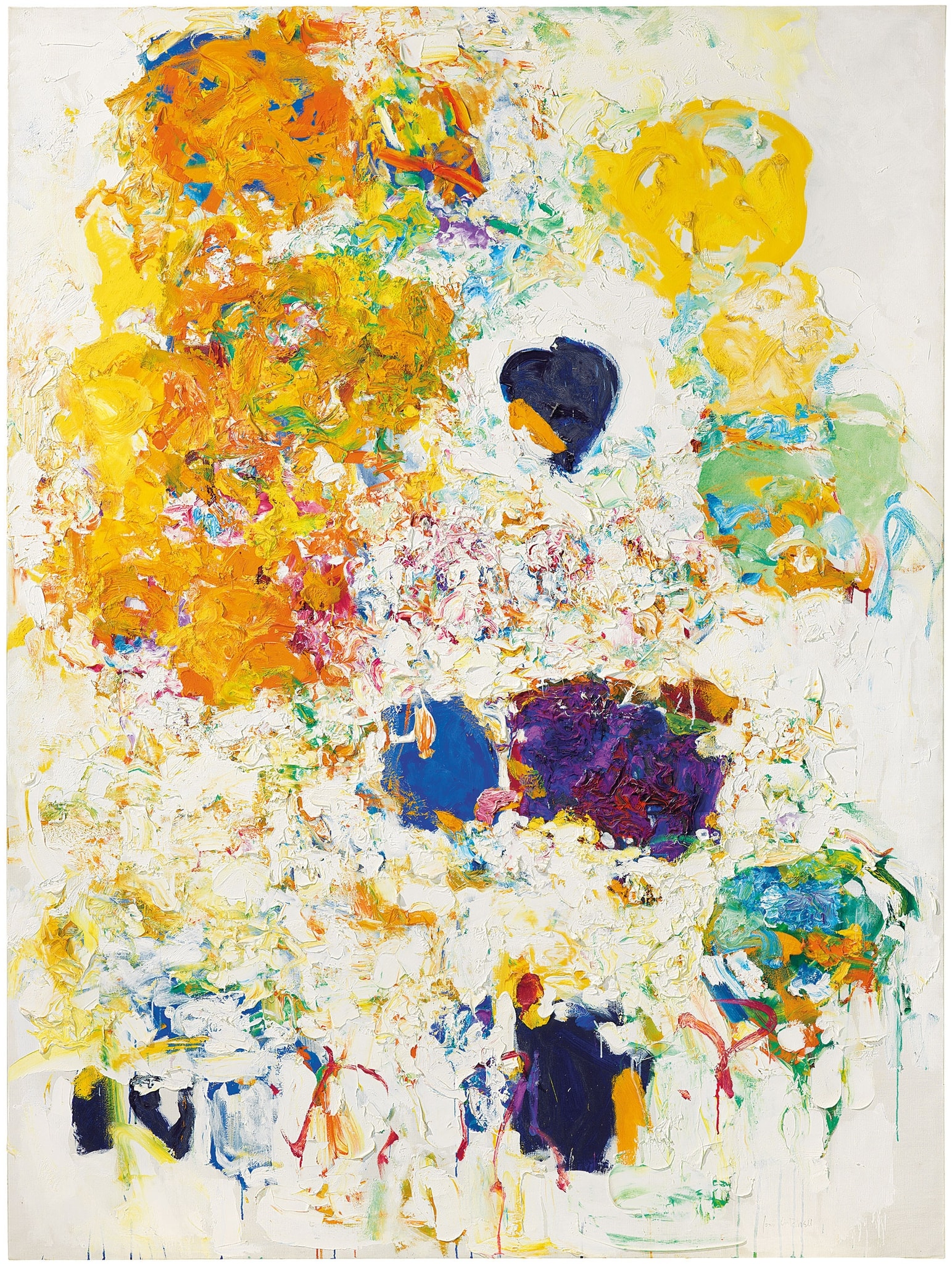
Joan Mitchell’s Blueberry (1969) stages a clustering storm of color within a wide, breathing field of white. Thick blue-violet cores press against ochre and lemon swaths, while scraped light and drips open pockets of air, turning memory into weathered sensation [1][3][2].

Study Print Studio

Create a personal study print

Build a companion study sheet around the part of this painting that speaks to you most. Choose a detail, shape an interpretation, and walk away with something personal and display-worthy.

Fast Facts

Year
1969
Medium
Oil on canvas
Dimensions
200.4 x 149.9 cm
Location
Private collection
Blueberry by Joan Mitchell (1969) featuring Blue‑violet orbs, Lemon–ochre swaths, White impasto clouds, Vertical drips and filaments

Click on any numbered symbol to learn more about its meaning

Meaning & Symbolism

Blueberry organizes sensation as a rising column of energy bracketed by light. Across a ground of creamy white, Mitchell lays down lemon and ochre swaths at the upper left that feel sunstruck and aerated; against them, she sets compact orbs of ultramarine and blue‑violet in the middle and lower register. These dark cores carry palpable weight, their rims nicked by orange, emerald, and magenta shards, while skeins of white impasto knit and unknit the surface. The paint moves in gusts—wet scoops, smeared knots, sudden scrapes—so that passages alternately thicken and thin, opening breathing spaces before slamming shut. Drips and filament-like trails distill vertical pull at the bottom edge, where blue and black touches pool like shade. The composition reads, in Harold Rosenberg’s phrase, as a clustering formation—a gathered pressure of strokes that cohere without hard outline 3. What registers first as “berries” resolves, on sustained looking, into calibrated encounters of temperature, value, and pressure: sweetness and astringency converted into chromatic fact. Mitchell’s titles cue memory rather than dictate image; she chose them after the painting answered her back 5. Accordingly, Blueberry does not depict fruit so much as condense the memory of ripeness into painterly structure: the blue‑violet masses feel just past peak, their bruise edged by tangy yellows and acidic greens, while clouds of white keep the sensations from congealing. This is the ethics of her abstraction—“I paint from remembered landscapes … I certainly never mirror [nature]”—made legible in the push‑pull of opacity and light 5. The work marks a pivotal moment soon after her move to Vétheuil, where generous studio space and the surrounding landscape amplified her scale and luminosity; the canvas’s vertical spread and airy intervals echo that expansion while resisting any postcard of place 14. Within the Abstract Expressionist lineage, Blueberry demonstrates how Mitchell retooled action painting into precision by intuition: bodily, yes, but exacting in its tuned relations of density to openness, chorded color to pause, attack to rest 23. Its importance also registers historically: singled out in period criticism, revisited in recent retrospectives for its synthesis of landscape, memory, and music-like rhythm, and later achieving a record price that acknowledged its status within her oeuvre 3246. In Blueberry, meaning is not hidden behind symbol; it is built into the grammar of paint. The result is an image that flickers between abundance and dissolution—the quick fullness of summer held, and already slipping, in the pressure of Mitchell’s hand 25.

Explore Deeper with AI

Ask questions about Blueberry

Popular questions:

Powered by AI • Get instant insights about this artwork

💬 Ask questions about this artwork!

Interpretations

Temporal Poetics: Ripeness and Fade

The painting’s blues sit at the edge of bruise while lemon and acidic green flare, staging a hinge between plenitude and ebb. This is not symbol so much as temporal poetics: season felt as pressure, then release. SFMOMA’s retrospective frames Mitchell’s abstractions as drawing on landscape, memory, and music—useful coordinates for reading Blueberry’s alternation of thickened chords and thinning drips as a score of passing time. What seems abundant in one register already thins in another, a painterly memento of summer’s quick fullness, held and slipping at once 23.

Source: SFMOMA; The New Yorker (Harold Rosenberg)

Historical Context: Vétheuil’s Scale and Air

Soon after relocating to Vétheuil (1968), Mitchell gained the studio space that enabled larger canvases and more aerated interval—conditions audible in Blueberry’s vertical spread and breathing whites. Rather than painting the village, she internalized its amplitude, converting landscape into structural openness and luminous chords. Curators and the artist’s estate link these late‑1960s works to a turn toward heightened light and scale, a shift that reframes Abstract Expressionist gesture as measured spaciousness. In this sense, Blueberry functions as an architecture of air—an achieved expanse made from stops and starts, rather than a view—marking a pivotal French-period recalibration of her New York School training 214.

Source: SFMOMA; Joan Mitchell Foundation; Christie’s

Formal Analysis: Clustering and Breath

Harold Rosenberg famously noted Blueberry as a “clustering formation,” where strokes compress without hard outline. That clustering is not chaos: it resolves into precisely intuited harmonies of warm/cool, dense/void, and attack/rest. The impasto’s skeins, drips, and scrapes regulate pressure and release, staging a bodily tempo across the surface. Here, meaning travels via structural oppositions—density vs. transparency, chromatic heat vs. chill—rather than iconography. The result is an image that “breathes,” opening and closing spatially like phrasing in music or poetry, a hallmark of Mitchell’s retooling of action painting toward calibrated sensation 32.

Source: Harold Rosenberg, The New Yorker; SFMOMA

Titles and Memory: Ethics of Evocation

Mitchell titled works only after the painting “answered her back,” using language as a memory trigger rather than assignment of subject. Her oft‑quoted stance—“I paint from remembered landscapes … I certainly never mirror [nature]”—clarifies Blueberry: the canvas does not depict berries; it condenses the sensation of ripeness and bruise into chroma, weight, and light. This ethic resists illustration. It privileges the painting’s internal relations—temperature, value, opacity—as the truthful record of feeling. The title, then, orients reception toward season, taste, and time but keeps seeing anchored in the grammar of paint, not in emblem or motif 51.

Source: Marcia Tucker (Whitney, 1974) via Cheim & Read; Joan Mitchell Foundation

Transatlantic Lineage: Landscape Without View

Critics have read the Vétheuil period through a European lens—Monet’s locality, Matisse’s color, Cézanne’s structure—yet Blueberry refuses mimesis. Instead, it metabolizes that lineage into luminous intervals and chorded blues/yellows that evoke landscape’s afterimage. Auction scholarship, citing Albers and Tucker, underscores Mitchell’s aim to paint what nature leaves her with, not nature itself. In Blueberry, the French landscape becomes a set of painterly problems—weight vs. lift, glare vs. shade—solved in an action‑based but exacting syntax, bridging New York School energies with European coloristic intelligence 42.

Source: Christie’s (citing Albers, Tucker); SFMOMA

Reception and Value: From Whitney to Record Sale

Blueberry’s critical arc tracks from early institutional visibility to market canonization. It appeared in major venues around 1970–74 and was singled out by Rosenberg in The New Yorker, securing a place within discussions of post‑war abstraction. Decades later, its 2018 sale at Christie’s set a then‑record for Mitchell, consolidating scholarly consensus around the work’s synthesis of landscape, memory, and rhythm with public valuation. While prices are not measures of quality, this trajectory shows how period criticism, retrospective framing, and provenance histories coalesce into durable art‑historical standing 436.

Source: Christie’s; The New Yorker (Harold Rosenberg); The Art Newspaper

Related Themes

About Joan Mitchell

Joan Mitchell (1925–1992) emerged among the second generation of Abstract Expressionists in 1950s New York and developed a lifelong practice between the U.S. and France. Drawing on memory, landscape, poetry, and music, she forged a distinctive language of dense chromatic centers and breathing peripheries; by the late 1960s she was based in Vétheuil, working at ambitious scales and in lyrical series [3][4].
View all works by Joan Mitchell