How Much Is Christ in the House of His Parents (The Carpenter's Shop) Worth?
Last updated: May 11, 2026
Quick Facts
- Methodology
- comparable analysis
If the Tate‑held original were to appear on the open market, a reasoned auction estimate is approximately USD 4,000,000–15,000,000. This range balances the painting’s canonical Pre‑Raphaelite importance against the practical constraints of museum ownership, UK export/deaccession rules and Millais’s observed auction performance.
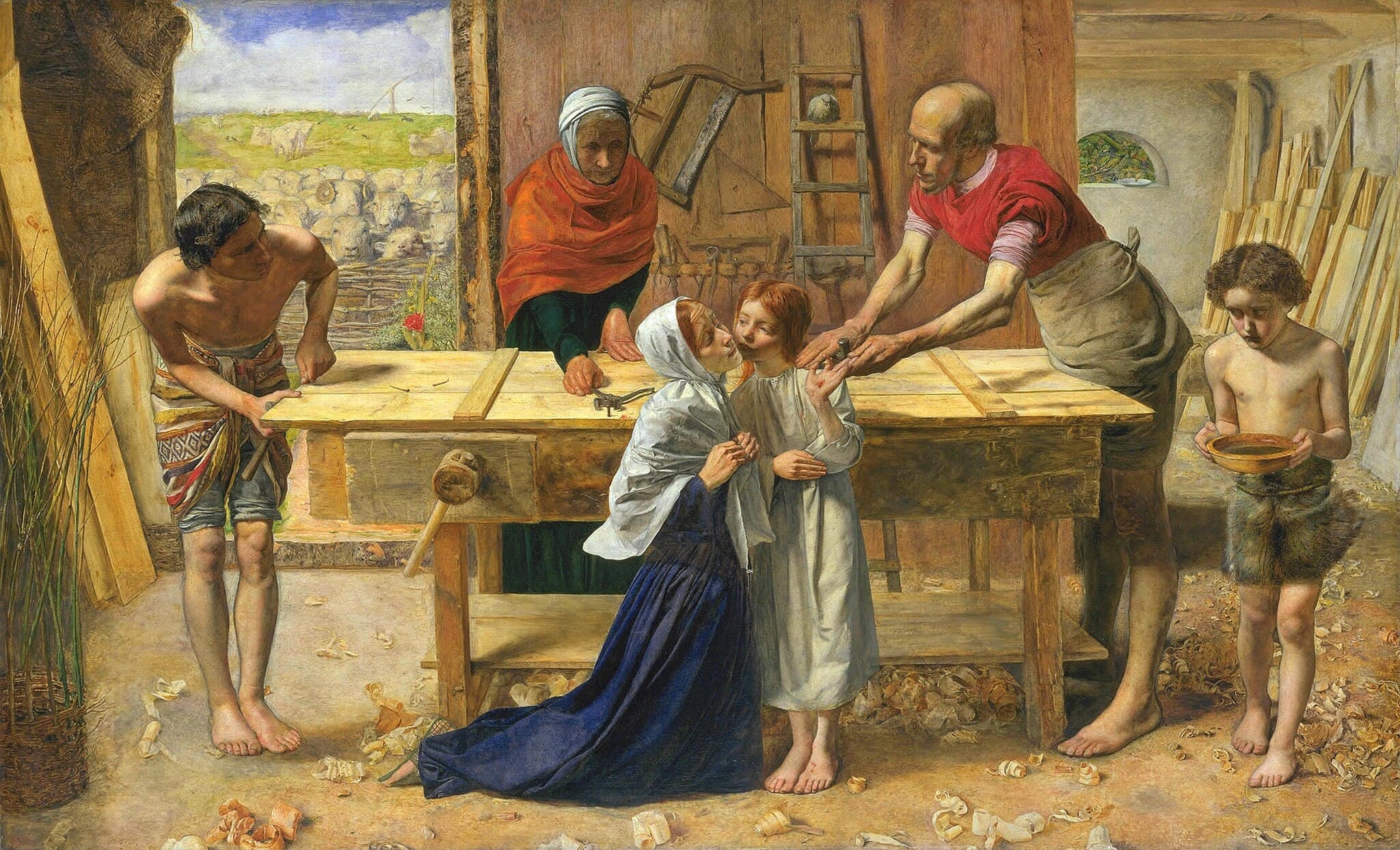
Christ in the House of His Parents (The Carpenter's Shop)
John Everett Millais, 1850 • Oil on canvas
View more by John Everett Millais →Valuation Analysis
Valuation summary: If the Tate‑held original of John Everett Millais’s "Christ in the House of His Parents (The Carpenter’s Shop)" were to come to the open market, a reasoned auction estimate is approximately USD 4,000,000–15,000,000. This range reflects Millais’s observed auction performance, the painting’s exceptional art‑historical significance, and material market frictions associated with museum ownership.
The work is a cornerstone Pre‑Raphaelite canvas and is in institutional hands at Tate Britain, which acquired the picture in 1921; it has not circulated on the modern auction market and is effectively non‑commercial under normal circumstances [1]. Long‑term public provenance increases the scholarly and institutional premium but also substantially reduces liquidity. Any hypothetical sale would therefore be atypical and likely attract concentrated interest from national museums and a small group of private trophy collectors.
Empirical signaling from the auction market places a practical lower anchor on the estimate: Millais’s modern auction high ('Sisters', Christie’s London, 2013) demonstrates that strong museum‑quality Millais canvases have achieved multi‑million results under competitive conditions [2]. More routine Millais offerings in recent seasons have realized mid‑six‑figure totals at major salerooms, while movement peers have produced higher headline records — evidence that the Pre‑Raphaelite top market exists but is concentrated by artist and rarity.
Key upward drivers for this painting are its canonical status, large scale and exhibition history; these attributes attract institutional premium and could create exceptional buyer competition. Key downward or capping factors are the specialist nature of the Victorian market, the political and legal impediments to deaccession and export, the small pool of credible buyers for a UK national treasure, and uncertainty about condition and restoration history if offered publicly. Together these factors compress probable outcomes toward the low‑to‑mid single‑digit millions while leaving room for an outlier buyer to push the price toward the stated upper bound.
Methodology: a comparable‑analysis approach was used, anchoring the low estimate to observed Millais auction results and mid‑market sales, and framing the high estimate as an exceptional trophy outcome reflecting institutional competition, scarcity and historical importance. The estimate assumes museum‑grade condition; a formal condition report, full provenance file and independent auction house pre‑sale opinion would be required to refine the band materially.
Confidence: moderate–low. Because the picture is museum‑held and has not traded in the modern market, any price is inherently speculative and contingent on legal and conservation factors. Recommended next steps to improve accuracy: obtain Tate’s accession and conservation files, instruct a major auction‑house specialist for a pre‑sale opinion, and confirm any insurance/replacement valuations held by the owner.
Key Valuation Factors
Art Historical Significance
High ImpactMillais’s 'Christ in the House of His Parents' is a foundational Pre‑Raphaelite canvas that established his early reputation and provoked sustained contemporary debate. As a canonical work from the movement’s formative moment, it commands an outsized qualitative premium in academic and curatorial contexts: museums and major collectors prize items that directly shaped an art‑historical narrative. That premium increases the theoretical market ceiling because institutions value such works for exhibition and scholarship. However, historical significance also makes the picture politically and publicly sensitive to transfer, which can reduce market liquidity. In short, significance raises desirability and theoretical value while simultaneously complicating practical saleability.
Comparable Sales & Auction Record
Medium-high ImpactMillais’s publicly observed auction performance is uneven. The artist’s modern auction high (Christie’s, 2013) provides an empirical anchor in the low single‑digit millions, while many good‑quality Millais canvases realized mid‑six‑figure prices in recent seasons at major houses. The broader Pre‑Raphaelite category has produced higher apex results for select artists, indicating that movement‑wide demand exists but is concentrated. For valuation purposes, direct Millais comparables anchor the low estimate; the upper estimate depends on exceptional cross‑market competition and institutional urgency that have produced outlier prices for other movement masters.
Rarity & Provenance (Museum Ownership)
High ImpactThe painting’s long tenure in Tate Britain (acquired 1921) makes it effectively non‑circulating and rare in the commercial sense. Museum provenance enhances exhibition, lending and publication opportunities and therefore increases prestige and the hypothetical market value. Conversely, institutional ownership materially reduces the probability of a market appearance and concentrates likely buyers to institutions or well‑capitalized private collectors able to negotiate politically sensitive purchases. Rarity thus multiplies theoretical demand but also constrains real‑world transaction dynamics, a net effect that supports a premium while limiting liquidity.
Condition & Conservation
Medium ImpactNo public, current condition report for the Tate canvas is available in source material reviewed here. Condition is a critical quantitative determinant of value; structural issues, heavy overpainting, relining or unstable varnish can materially reduce price and deter institutional buyers. Conversely, demonstrably excellent conservation history and technical authentication (X‑ray, IRR, pigment analysis) increase buyer confidence and can unlock the full premium for historical importance. A professional, up‑to‑date conservation report is therefore essential to refine any estimate beyond the present speculative band.
Legal / Export Controls & Deaccession Risk
High ImpactUK heritage protections (export‑licensing, Reviewing Committee on the Export of Works of Art) and museum deaccession protocols create significant procedural and reputational barriers to the sale of nationally important works. If offered to a foreign buyer, an export licence could be delayed or blocked while UK institutions are given the opportunity to raise matching funds. Donor and public scrutiny of deaccessioning also depresses the pool of prospective purchasers. These legal and ethical constraints tend to lower the practical open‑market ceiling for a high‑profile British masterpiece despite its scholarly value.
Sale History
Christ in the House of His Parents (The Carpenter's Shop) has never been sold at public auction.
John Everett Millais's Market
Sir John Everett Millais is the leading figure of the Pre‑Raphaelite Brotherhood and remains highly collectible within the 19th‑century British market. His top‑quality, well‑provenanced canvases attract museum and private interest, but the auction market for Millais is more specialized and shallower than for Old Master, Impressionist or Modern blue‑chip works. In recent seasons many Millais oils have realized mid‑six‑figure totals at major salerooms, while an isolated modern auction high in the low millions provides the empirical anchor for trophy pricing. Overall, Millais is a reliable but niche market presence: strong for museum‑quality examples, selective for secondary works.
Comparable Sales
Sisters
Sir John Everett Millais
Same artist; high‑quality, museum‑scale Millais canvas that set the artist's modern auction record—useful as an observed market ceiling for Millais works offered openly.
$3.5M
2013, Christie's, London (Important Victorian & British Impressionist Art sale)
~$4.8M adjusted
Forget‑Me‑Not (1883)
Sir John Everett Millais
Same artist and period; a finished oil offered recently at a major saleroom—represents market for good‑quality Millais pictures (mid‑six‑figure outcome).
$373K
2023, Bonhams, London
~$391K adjusted
Il Penseroso
Sir John Everett Millais
Same artist; recent sale from a single‑owner Victorian collection—useful for understanding typical realized prices for middle‑tier Millais oils in 2024–25.
$241K
2025, Bonhams (The Guy Bailey Collection of Victorian Art), online
Original sketch for an illustration (study for 'Violet', 1860)
Sir John Everett Millais
Same artist but a small study/graphic work—illustrates the long tail of lower‑value Millais material and market segmentation between studies and major canvases.
$5K
2024, Bonhams Knightsbridge
~$5K adjusted
Current Market Trends
The Pre‑Raphaelite and high‑quality Victorian market has seen renewed top‑end interest driven by institutional buying, landmark sales and major exhibitions. Demand is concentrated at the summit (museum‑quality, well‑documented pictures) while the broader mid‑market remains price‑sensitive and uneven. Legal protections for national heritage and a relatively small pool of global bidders for British masterpieces moderate realized prices. In short, the sector is resurgent among institutions and trophy collectors but remains segmented and selective.