How Much Is Black Cross Worth?
Last updated: May 18, 2026
Quick Facts
- Methodology
- comparable analysis
Assuming the work is an authenticated, primary Suprematist Black Cross (c.1915–1920) in good condition with clear provenance, the estimated market range is $15,000,000–$50,000,000. This band is anchored to recent high‑end Suprematist comparables (Sotheby’s Mystic Suprematism $37.77M, Christie’s 2018 Suprematist Composition $85.81M) and adjusted for rarity, provenance strength, condition and market liquidity.
Valuation Analysis
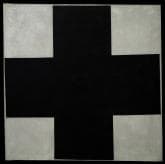
Valuation assumption: This estimate assumes the painting in question is an original, authenticated Kazimir Malevich Suprematist Black Cross dating to the primary breakthrough period (c.1915–1920), executed on original canvas, in good‑to‑excellent condition, and with defensible provenance. If any of those conditions are not met—uncertain attribution, significant restoration, or incomplete provenance—the market value will be substantially lower.
I estimate the market value for such a canonical Black Cross at $15,000,000–$50,000,000. The range is derived by mapping the work to recent high‑end Suprematist sale results: Sotheby’s 2015 Mystic Suprematism (Black Cross on Red Oval) realized $37.77M, which functions as a direct cross‑motif comparable and a mid‑range anchor [1]. Christie’s 2018 sale of a major Suprematist Composition realized $85.81M and establishes the market ceiling for exceptionally rare, museum‑quality canvases by Malevich; the top end of this estimate reflects that a top‑tier Black Cross could approach but is more likely to sit below that peak unless it is uniquely significant to scholarship or provenance [2].
Supply constraints and institutional holdings materially support high valuations. Several canonical Black Cross and related Suprematist canvases are in major public collections (e.g., Centre Pompidou and the State Russian Museum), which keeps truly fresh‑to‑market examples rare and in high demand among museums and deep‑pocketed private collectors [3]. Rarity of comparable lots means that when a well‑provenanced Black Cross does appear publicly, competitive bidding from specialist collectors and institutions can drive prices into the tens of millions.
Key risks and price drivers: Authentication, condition and provenance are decisive. Technical analysis—pigment and binder testing, infrared reflectography, X‑radiography, canvas‑weave analysis, and dendrochronology (if panel)—and independent expert attribution are prerequisites for evening‑sale level pricing. Provenance holes, modern restorations, or the presence of non‑period materials reduce both buyer confidence and realized value; conversely, clear early exhibition history, catalogue raisonné inclusion, and supportive technical reports can add a premium.
To be explicit about sensitivities: if technical study confirms a primary 1915 dating, original materials and an exhibition history linking the work to early Suprematist shows, the estimate is likely to cluster toward the upper half of the stated band and could exceed $50M in the exceptional case of unique provenance or scholarship. If the painting is a later variant, a studio work, or lacks documentary provenance, expect pricing to fall into the mid‑market ($1M–$8M) or below. Given the known frequency of disputed attributions in the Russian avant‑garde, buyers and houses typically require a full due‑diligence package before underwriting or guaranteeing a lot.
For sale, the optimal strategy is an evening‑sale consignment to a major house, accompanied by a full technical dossier, scholarly support and pre‑sale institutional outreach; guarantees or third‑party underwriting are common for works at this level. Immediate actionable steps: supply high‑resolution photographs (detailed shots of edges, reverse, labels), exact dimensions, and any ownership records; commission pigment/binder testing and a conservator’s condition report; where possible obtain canvas‑weave matches to known Malevich canvases. With that material I will assemble a tighter comparable set and a recommended sales plan.
Key Valuation Factors
Art Historical Significance
High ImpactMalevich’s Black Cross compositions occupy an important position within Suprematism as explorations of pure geometric form and spiritual abstraction. While not as iconically recognized as Black Square, a primary c.1915 Black Cross represents a formative moment in his exploration of orthogonal relations and spatial tension and is highly prized by scholars and collectors. Institutional recognition — inclusion in early Suprematist exhibitions, citation in catalogues raisonnés, or placement in leading modern art museums — elevates a canvas from an academic example to a museum‑quality masterpiece. Because documented early Suprematist crosses are scarce and intensively studied, art‑historical importance is a major positive driver of market value.
Provenance & Exhibition History
High ImpactProvenance is decisive in pricing Malevich. A continuous, well‑documented chain of ownership from an early collector or recognized institution, supported by exhibition history and catalogue raisonné entries, markedly increases market confidence and price. Conversely, gaps—especially Soviet‑era transfers, unclear wartime custody, or undocumented private holdings—raise red flags, invite lengthy due diligence and depress realizations. Institutional exhibition loans (major museums, retrospective inclusion) function as endorsements that can elevate a work from mid‑market to evening‑sale status. For a Black Cross, documented early exhibition links or inclusion in major scholarship will very likely add a premium; absence of such evidence will materially reduce value.
Condition & Technical Authenticity
High ImpactTechnical authentication and condition equally determine marketability. Confirmation that pigments, ground, canvas and supports are consistent with c.1915 Russian materials via X‑ray, infrared, pigment analysis and canvas‑weave matching is essential; modern pigments, inconsistent grounds, or later overpainting will reduce value sharply or negate attribution. Condition issues—tear, extensive restoration, relining or heavy abrasion—diminish aesthetic and collectability and can cut realizations by tens of percent. Published consensus from recognized Malevich experts amplifies buyer confidence and can command premium pricing. Independent technical reports by conservation scientists and qualified scholars are standard requisites for evening‑sale consignments.
Market Liquidity & Comparables
Medium ImpactLiquidity for a canonical Black Cross is limited but strong when an example is museum‑quality and cleanly authenticated. Comparable evening‑sale results—Mystic Suprematism at Sotheby’s for $37.77M [1] and the 2018 Christie's Suprematist Composition at $85.81M [2]—show top Suprematist works can reach high tens of millions to artist‑record levels. However, a bifurcated market persists: exceptional masterpieces command premiums while studies, later variants and doubtful attributions sell in lower tiers. Best outcomes typically require major‑house evening sales, robust cataloguing, institutional outreach and financial guarantees or third‑party underwriting.
Size, Support & Physical Attributes
Medium ImpactPhysical dimensions and execution materially affect value. Large, museum‑scale canvases on original linen with period grounds attract higher buyer interest and can reach evening‑sale brackets; small studies, panels, or works on paper generally sit in the low‑to‑mid market. The presence of original stretcher edges, period nailed stretchers, or artist inscriptions can corroborate dating and provenance. Conversely, relining, modern stretchers, heavy inpainting or non‑period materials complicate attribution and lead to discounts. Size and visible period construction details are therefore practical determinants of top‑tier candidacy.
Sale History
Sotheby's New York
Christie's New York
Sotheby's New York
Sotheby's New York
Kazimir Malevich's Market
Kasimir Malevich occupies a blue‑chip position within twentieth‑century modernism thanks to his foundational role in Suprematism. Auction records show exceptional highs—Christie’s 2018 Suprematist Composition set an artist record—while many other Malevich lots (works on paper, later variants) trade at modest levels. Institutional ownership of key Suprematist canvases constrains supply and supports strong realizations when a fresh, well‑provenanced masterpiece appears. However, authentication controversies and provenance complexities, particularly around Soviet‑era histories, have made major houses cautious. Overall, Malevich is highly collectible, but outcomes hinge on attribution, condition and provenance.
Comparable Sales
Suprematist Composition (1916)
Kazimir Malevich
Canonical early Suprematist work by Malevich (c.1916); artist's auction record and sets the market ceiling for major Black Cross–type canvases.
$85.8M
2018, Christie's New York
~$106.6M adjusted
Mystic Suprematism (Black Cross on Red Oval)
Kazimir Malevich
Directly cross‑motif comparable; same artist and composition type; strong evening‑sale result useful as a mid‑market anchor for a major 'Black Cross'.
$37.8M
2015, Sotheby's New York
~$49.7M adjusted
Suprematist Composition (1916)
Kazimir Malevich
Major early Suprematist sale prior to the 2018 peak; demonstrates historical high valuations for works of this type and provides an upper‑bound precedent.
$60.0M
2008, Sotheby's New York
~$87.0M adjusted
Suprematist Composition with Plane in Projection (1915)
Kazimir Malevich
Same early Suprematist period (c.1915) and a relatively spare geometric composition; useful as a lower‑tier benchmark for authenticated but less prominent canvases.
$21.2M
2017, Sotheby's New York
~$26.9M adjusted
Current Market Trends
Demand for genuinely fresh, authenticated Suprematist masterpieces remains solid, but the ultra‑high end has cooled since the 2018 record. Authentication disputes and geopolitical/provenance sensitivities have increased due‑diligence requirements, reducing liquidity for works lacking documentation. Mid‑market segments remain resilient. Sellers should target major‑house evening sales with a full technical dossier and institutional outreach; buyers should expect premiums for thoroughly vetted, museum‑quality canvases.
Sources
- Sotheby's — Mystic Suprematism (Black Cross on Red Oval), lot page (2015)
- Christie's — May 2018 Impressionist & Modern Evening Sale report (Suprematist Composition record)
- Centre Pompidou — Focus on Black Cross by Kazimir Malevich (collection/exhibition reference)
- Sotheby's / PR coverage — example Suprematist sale reference (2017)