How Much Is Suprematist Composition: Airplane Flying Worth?
Last updated: May 16, 2026
Quick Facts
- Methodology
- extrapolation
Suprematist Composition: Airplane Flying (1915) is a canonical Malevich held by MoMA with no public sale history. Benchmarking against the artist’s $85.8m auction record for a 1916 Suprematist canvas and adjusting upward for the work’s earlier date, fame, and museum-caliber status supports a current estimate of $120–180 million.
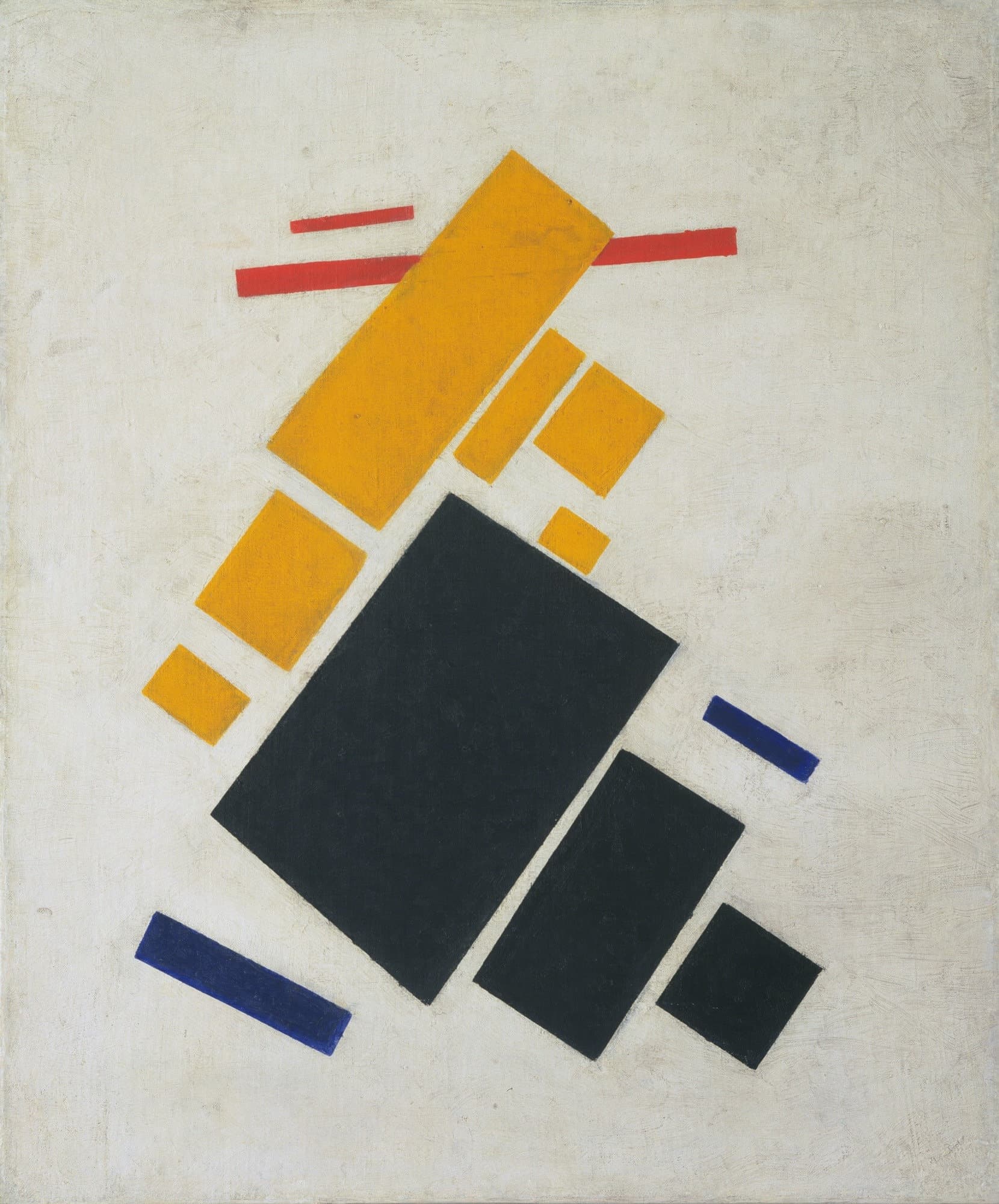
Suprematist Composition: Airplane Flying
Kazimir Malevich, 1915 • Oil on canvas
View more by Kazimir Malevich →Valuation Analysis
Conclusion: Suprematist Composition: Airplane Flying (1915) is a museum‑held, canonical Malevich from the breakthrough Suprematist year. Using the artist’s 2018 auction record for a comparable 1916 canvas as a primary benchmark and extrapolating upward for earlier date, cultural prominence, and institutional stature, a present‑day expectation in a private or exceptional auction context is $120–180 million [2].
Method and benchmarks: The best public proxy is the 2018 Christie’s New York sale of Suprematist Composition (1916) at $85,812,500 (premium‑inclusive), which reset the Malevich and Russian‑art records [2]. A second, well‑known anchor is the 2017 Sotheby’s New York result of $21.2m for a 1915 Suprematist painting—demonstrating the steep price gradient within this narrow period based on composition, size, and renown [3]. Given Airplane Flying’s 1915 date, iconic status, and sustained scholarly and public visibility, it commands a premium over most 1916 works.
Why this painting prices at the top: Created in the year of the “0.10” exhibition, Airplane Flying is among the touchstone images of early abstraction and is widely reproduced in the literature. Its long tenure and visibility at the Museum of Modern Art, New York, further cement its stature [1]. Within Malevich’s oeuvre it sits just below the singular cultural force of Black Square, and alongside his most celebrated Suprematist canvases. That combination—breakthrough year, canonical image, and institutional endorsement—places it in the absolute top tier of early 20th‑century abstraction.
Market context: The trophy segment for blue‑chip Modern art has remained robust at the very top, as underlined by Sotheby’s 2025 Klimt result at $236.4m—a clear indicator that buyers will stretch for museum‑caliber masterpieces with unimpeachable provenance [5]. At the same time, Western auction houses suspended dedicated Russian Art sales in 2022, adding compliance and logistics frictions for Russian avant‑garde material [4]. For a work of this unimpeachable pedigree and fame, however, global cross‑category demand should outweigh category‑specific headwinds.
Estimate rationale: Starting from the $85.8m 2018 record [2], we account for (i) the earlier, 1915 “breakthrough” date and the painting’s exceptional cultural recognition; (ii) extreme scarcity—no comparable museum‑caliber Suprematist oils have surfaced publicly since 2018; and (iii) renewed top‑of‑market appetite demonstrated by recent Modern trophies [5]. Together these justify an estimate comfortably above the inflation‑adjusted 2018 benchmark, yielding a present range of $120–180 million. Final price would depend on venue, timing, condition, and the ability to mobilize global, cross‑category bidders.
Collection status: The work is in MoMA’s collection; no public sale history exists and deaccession is unlikely [1]. The valuation here represents a hypothetical private‑sale or extraordinary auction expectation.
Key Valuation Factors
Art Historical Significance
High ImpactPainted in 1915, the breakthrough year of Suprematism and the “0.10” exhibition, Airplane Flying is one of the most reproduced and discussed Malevich canvases. It encapsulates the movement’s radical reduction and dynamic spatial logic while also signaling modernity through its titular reference to flight. In the artist’s canon it sits just below Black Square and alongside the most revered Suprematist Compositions. This level of art‑historical importance reliably commands premiums from cross‑category collectors who prioritize cultural capital, wall‑power, and scholarly consensus. Works of similar centrality within early abstraction are scarce and, when available, have historically re‑rated the artist’s market upward.
Rarity and Supply Dynamics
High ImpactTop‑tier Suprematist oils from 1915–16 are exceptionally rare, with many held by leading institutions. Since 2018, no museum‑caliber Malevich Suprematist painting has appeared in marquee evening sales, and supply has been effectively nil. That scarcity is structural, not cyclical: the corpus of true, scholarship‑accepted masterworks is small, and most are in museums. For prize‑seeking buyers with Modern, Contemporary, and cross‑category budgets, scarcity drives competitive bidding and large jumps between price tiers. Airplane Flying’s availability—if ever offered—would be a once‑in‑a‑generation event, warranting a premium over past records to clear pent‑up global demand.
Institutional Provenance and Visibility
High ImpactMoMA ownership and continuous museum visibility amplify the work’s cultural resonance and buyer confidence. Institutional pedigree reduces concerns about authenticity, title, and conservation history—factors that can weigh on Russian avant‑garde works in private hands. The painting’s comprehensive provenance and literature presence heighten desirability for private buyers who value museum‑level validation. Although deaccession is unlikely, that very fact reinforces the picture’s perceived irreplaceability, a quality that translates directly into willingness‑to‑pay in rare private‑treaty scenarios or, hypothetically, a special‑catalogue auction event.
Market Benchmarks and Trophy Demand
High ImpactThe key benchmark is the 2018 record of $85.8m for a 1916 Suprematist Composition. Airplane Flying’s earlier date and greater fame merit a premium above that watermark. Moreover, the uppermost segment of the Modern market remains capable of generating nine‑figure prices for museum‑grade masterpieces, as shown by the 2025 Klimt result above $200m. Together these data points support extrapolating above the 2018 Malevich record to a $120–180m expectation, assuming ironclad provenance, excellent condition, and a venue capable of mobilizing global, cross‑category bidding.
Geopolitical and Compliance Environment
Medium ImpactSince 2022, major houses paused dedicated Russian Art sales, and sanctions/compliance considerations have complicated some transactions involving Russian‑related material. While these frictions can narrow the bidder pool for mid‑tier works, they are less determinative at the very top, where cross‑category buyers compete for blue‑chip Modern trophies. Airplane Flying’s MoMA provenance, consensus scholarship, and global art‑historical importance mitigate typical category risks. The net effect likely trims participation at the margins but does not fundamentally impair top‑end price formation for a work of this caliber.
Sale History
Suprematist Composition: Airplane Flying has never been sold at public auction.
Kazimir Malevich's Market
Kazimir Malevich is a foundational figure of 20th‑century abstraction and one of the most tightly supplied markets in Modern art. The artist’s auction record stands at $85.8 million for Suprematist Composition (1916), achieved at Christie’s New York in 2018, with earlier benchmarks at $60.0 million (2008) and strong seven‑ and eight‑figure results for quality works on paper. Supply of prime 1915–16 Suprematist oils is effectively museum‑bound, and no comparable paintings have surfaced at marquee auctions since 2018. Demand is global and cross‑category, driven by institutions, connoisseur collectors, and trophy buyers seeking historically secure, seminal abstractions with watertight provenance.
Comparable Sales
Suprematist Composition (1916)
Kazimir Malevich
Best public benchmark for a prime Suprematist oil on canvas by Malevich; same series and near‑identical period, museum‑caliber trophy.
$85.8M
2018, Christie's New York
~$111.4M adjusted
Suprematism, 18th Construction (1915)
Kazimir Malevich
Same artist and same breakthrough year (1915) as Airplane Flying; core Suprematist oil on canvas showing period pricing for top material.
$33.8M
2015, Sotheby's London
~$46.5M adjusted
Suprematist Composition with Plane in Projection (1915)
Kazimir Malevich
Same artist, same 1915 Suprematist moment, oil on canvas; even references a plane in the title, making the subject linkage especially close.
$21.2M
2017, Sotheby's New York
~$28.2M adjusted
Suprematist Composition (1916)
Kazimir Malevich
Earlier record‑setting sale for a prime 1916 Suprematist oil on canvas; directly comparable in series, period, and caliber.
$60.0M
2008, Sotheby's New York
~$90.8M adjusted
Current Market Trends
The top end of the Modern category continues to demonstrate depth for museum‑caliber masterpieces, even as broader auction markets reset post‑2024. Trophy results like the 2025 Klimt underscore a willingness to pay nine figures for works with unimpeachable provenance and art‑historical significance. Conversely, Russian‑avant‑garde material faces category‑specific frictions due to sanctions and compliance screening since 2022, limiting dedicated sale channels. For blue‑chip, institutionally validated Malevich paintings, however, scarcity and cross‑category appeal dominate: with no major supply since 2018, any credible opportunity would likely ignite global competition, supporting a $120–180 million expectation for a canonical 1915 canvas.
Sources
- MoMA Collection: Suprematist Composition: Airplane Flying (1915)
- Christie’s: May 2018 Evening Sale Report (Malevich record at $85,812,500)
- Sotheby’s: Suprematist Masterwork Leads Impressionist & Modern Evening Sale (2017)
- The Art Newspaper: Sotheby’s and Christie’s call off Russian art auctions in London (2022)
- Sotheby’s: The New York Sales, November 2025 — Breuer Results (Klimt $236.4m)