How Much Is Suprematist Composition (with Eight Red Rectangles) Worth?
Last updated: May 18, 2026
Quick Facts
- Methodology
- comparable analysis
Assuming an authenticated 1915 oil on canvas in sound condition with clear provenance and exhibition history, I estimate fair‑market value at approximately $12,000,000–$35,000,000. If the work is the Stedelijk Museum holding it is not market‑available; comparable auction results and technical/provenance criteria drive the valuation range provided.
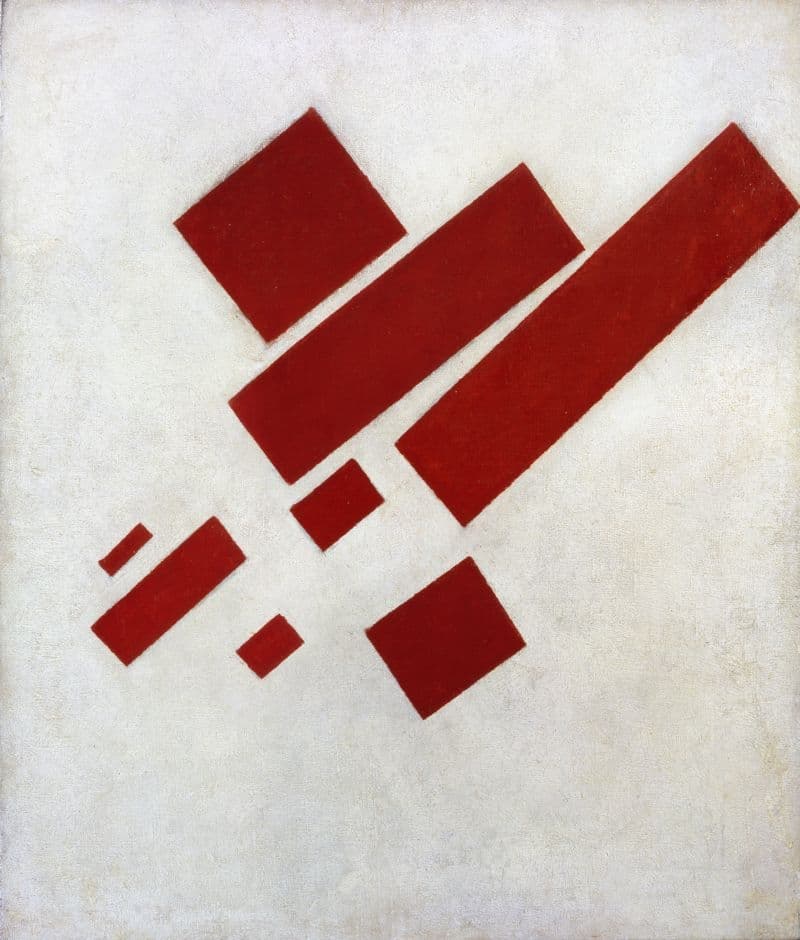
Suprematist Composition (with Eight Red Rectangles)
Kazimir Malevich, 1915 • Oil on canvas
View more by Kazimir Malevich →Valuation Analysis
Using a comparables‑driven approach, I value an authenticated 1915 "Suprematist Composition (with Eight Red Rectangles)" at $12,000,000–$35,000,000 (USD). This band assumes the object is an original oil on canvas from Malevich’s 1915 Suprematist period, is in sound condition, and is supported by clear provenance and publication/exhibition history. The lower bound reflects smaller/less documented variants or those with conservation issues; the upper bound anticipates a well‑provenanced, published canvas with corroborating technical analysis.
Market anchors and comparables define the range. The artist’s auction ceiling is the 1916 Suprematist Composition sold at Christie’s New York in 2018 for $85.8M (including premium), which serves as the trophy benchmark for museum‑quality canvases [2]. A closer analogue by date and scale is the 1915 Suprematist canvas sold at Sotheby’s in 2017 for $21.2M, a useful mid‑market reference for well‑provenanced 1915 canvases of moderate scale [3]. Those realized prices illustrate the dispersion of outcomes depending on scale, documentary support, and scholarly acceptance.
Importantly, the titled work you referenced corresponds to an object recorded in the Stedelijk Museum’s collection and therefore is not market‑available; institutional ownership confirms its significance but removes it from active comparables [1]. The Stedelijk example (roughly 57×48 cm) is of a size that typically places it below the largest trophy canvases; similarly sized private examples would be expected to trade in the low‑to‑mid tens of millions when fully authenticated and well documented.
Value is highly sensitive to authentication, condition and provenance. Technical confirmation (pigment and binder analysis, infrared/X‑ray imaging, canvas weave or loom‑match) is essential to substantiate an early 1915 date and to exclude studio copies or later interventions. Conservation history (extent of restoration, relining, retouching) materially affects buyer confidence. A painting that clears all technical and provenance checks will approach the upper bound; unresolved questions or heavy interventions can reduce realizations substantially.
Market context also matters. Since 2022 heightened provenance scrutiny and geopolitical considerations have increased due diligence requirements and transaction friction, favoring major houses and negotiated private sales over speculative auction listings. This dynamic lengthens sale timelines but does not eliminate strong demand for canonical, well‑documented Malevich canvases — it simply raises the evidentiary threshold buyers will insist upon [4].
Recommendation: to narrow this provisional range, obtain high‑resolution recto/verso photography, precise dimensions, a complete provenance and exhibition record, and a conservation/technical report. With those materials a major auction house or a specialist appraisal can provide a tightened pre‑sale estimate and sale strategy.
Key Valuation Factors
Art Historical Significance
High ImpactMalevich’s Suprematism is foundational to 20th‑century abstraction, and canvases from 1915 occupy a formative stage in that development. While the 'Black Square' is his most famous motif, studies and variant Suprematist canvases that explore color, plane and spatial relationships are treated by scholars as primary evidence of the movement’s evolution. Institutional recognition, inclusion in exhibitions and citation in catalogue raisonnés elevate a work’s art‑historical importance and place it squarely in the buyer pool targeted by museums and deep‑pocketed private collectors. For valuation this creates a high impact: art‑historical significance translates directly into collector and institutional demand and can justify multi‑million dollar premiums when documentation and condition align.
Provenance & Exhibition History
High ImpactProvenance is frequently the decisive factor for Malevich material. A continuous ownership record that includes reputable dealers, named collectors, or museum loans significantly increases market confidence and value. Exhibition history — especially inclusion in early or major retrospective shows — and citation in scholarship or a catalogue raisonné materially lift a lot into a higher market tier. Gaps, wartime movements, or contested title issues introduce legal and reputational risks that depress marketability and realized prices. Consequently, provenance and exhibition documentation are high‑impact determinants that often distinguish mid‑market outcomes from trophy‑level results.
Condition & Technical Authenticity
High ImpactPhysical condition and the results of technical authentication are critical. Buyers require a conservation dossier detailing original paint layers, restorations, varnish changes and any structural treatments. Technical tests — pigment and binder analysis, infrared reflectography, X‑ray imaging and canvas/loom‑match analysis — are necessary to confirm an early 1915 date and to exclude later studio or copy attributions. The Russian avant‑garde market has experienced attribution controversies, so unambiguous technical support substantially increases a painting’s market value while ambiguous or unfavorable findings can reduce realizations by large margins. Condition issues that affect surface reading or structural integrity also suppress prices.
Size/Scale & Visual Importance
Medium ImpactScale is a direct price multiplier in Malevich’s market: large, monumentally presented canvases are more likely to be labeled 'trophy' works and command institutional attention and higher prices. Smaller canvases and studies, while historically relevant, typically sell for significantly less because they lack the same gallery presence. That said, compositional decisiveness and documented importance can allow modestly sized works to outperform larger but less significant variants. Overall, size and visual presence exert a medium‑to‑high impact, interacting closely with provenance and technical certainty to set final prices.
Market Liquidity & Legal/Compliance Risk
Medium ImpactThe Russian avant‑garde market is bifurcated: scarcity supports very high prices for canonical canvases but liquidity is constrained and transaction costs are elevated. Since 2022 increased provenance scrutiny, sanctions‑related sensitivities and high‑profile forgery/provenance scandals have raised documentation requirements, favoring negotiated private sales or major‑house placements. Legal claims or restitution issues can materially depress a work’s marketability. Practical consequences: even important canvases must clear legal and provenance hurdles before reaching competitive auctions, which can lengthen sale timelines and shift buyer appetite — a medium impact that nevertheless can be decisive in real outcomes.
Sale History
Suprematist Composition (with Eight Red Rectangles) has never been sold at public auction.
Kazimir Malevich's Market
Kazimir Malevich is a canonical modernist and the founder of Suprematism; his early 1910s–1920s canvases are among the most important works of Russian avant‑garde art. Market demand for authenticated, early Suprematist canvases is strong but exceptionally selective: institutions and blue‑chip private collectors compete for the rare, museum‑quality paintings that appear. The 2018 Christie’s sale ($85.8M) demonstrates the ceiling, but most Malevich material offered is smaller or less documented and trades at substantially lower levels. Limited supply of top works sustains high prices when provenance and technical certainty align.
Comparable Sales
Suprematist Composition
Kazimir Malevich
Artist, period and scale: the 1916 Suprematist Composition is the auction record for Malevich and functions as the top-market benchmark for museum-quality Suprematist canvases.
$85.8M
2018, Christie's New York
~$110.2M adjusted
Suprematist Composition
Kazimir Malevich
Earlier sale of the same (or closely related) 1916 Suprematist Composition that later set the 2018 record; shows prior market level and provenance/price trajectory.
$60.0M
2008, Sotheby's New York
~$89.9M adjusted
Suprematist Composition with Plane in Projection
Kazimir Malevich
Same artist and immediate period (1915); lower realized price than the 1916 trophy work — useful mid-market comparable for 1915 Suprematist canvases of strong provenance.
$21.2M
2017, Sotheby's New York
~$27.9M adjusted
Current Market Trends
The market for Russian avant‑garde/Suprematism is currently selective and compliance‑driven. Top‑tier, well‑provenanced canvases remain highly sought, but heightened provenance scrutiny, technical authentication demands and geopolitical sensitivities introduced since 2022 have reduced liquidity for works lacking iron‑clad documentation. Auction activity for major Malevich canvases is infrequent and concentrated; buyers favor quality and certainty and will pay premiums for museum‑grade works, while ambiguous material faces slower sales and lower outcomes.
Sources
- Stedelijk Museum — collection entry: Kazimir Malevich, Suprematist Composition (with Eight Red Rectangles), 1915
- Christie’s — coverage: Suprematist Composition (1916) sale, Christie’s New York (2018)
- Sotheby’s / market reporting — Suprematist Composition with Plane in Projection (1915) sale (reported 2017)
- The Guardian — reporting on auction houses and Russian art market disruptions (March 2022)