How Much Is Cassis, Cap Lombard, Opus 196 Worth?
Last updated: August 5, 2026
Quick Facts
- Methodology
- comparable analysis
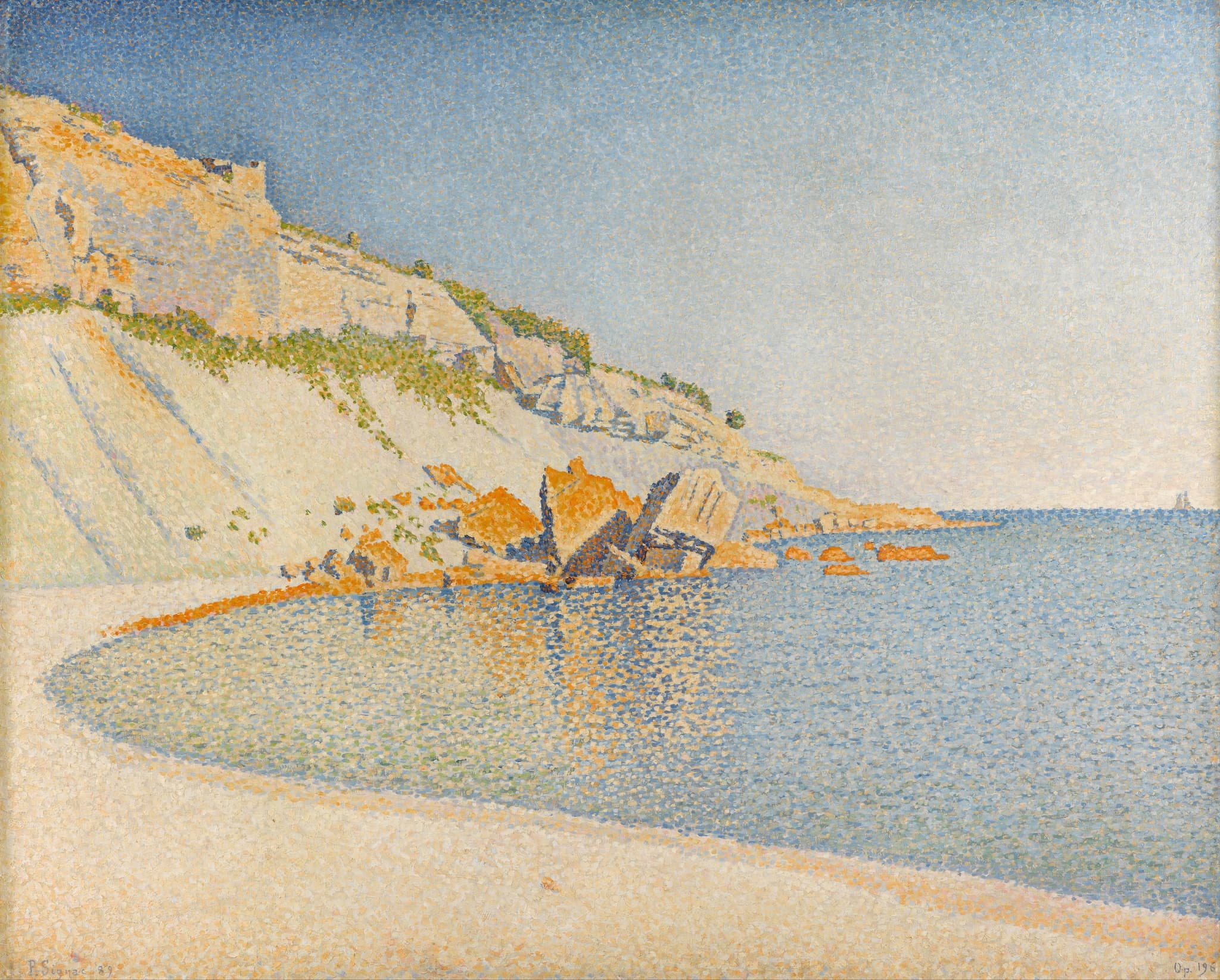
Cassis, Cap Lombard, Opus 196 (1889) is a canonical, prime-period Signac from the seminal Cassis campaign—held by Kunstmuseum Den Haag. Using top-tier Signac marine comps, including the 2022 $39.32m record and strong $9–10m results for later marines, a confident hypothetical fair-market estimate is $30–45 million. Scarcity of comparable 1886–1892 divisionist seascapes and the work’s museum-grade stature justify a range approaching the artist’s record.
Valuation Analysis
Work and status. Paul Signac’s Cassis, Cap Lombard, Opus 196 (1889, oil on canvas, 66 × 81 cm) is a cornerstone of the artist’s early divisionist practice and one of the celebrated Cassis canvases painted in spring 1889. It is held by Kunstmuseum Den Haag (formerly Gemeentemuseum Den Haag), which acquired the painting in 1956 and has extensively published it in collection literature [1].
Method and key comparables. This valuation uses direct, recent auction benchmarks for prime Signac marines. The artist’s record stands at $39.32 million for Concarneau, calme du matin (Opus 219, 1891) at Christie’s New York (Paul G. Allen Collection), a closely related, museum-grade divisionist port scene from just two years later [2]. Another prime-period Saint-Tropez canvas sold for $25.93 million at Christie’s London in 2019 [3]. In 2023–2024, high-quality Mediterranean marines from the mature and later phases repeatedly achieved roughly $9–10 million, including an 1896 Saint-Tropez at $10.1 million (Christie’s London, 2023) and Le rayon vert (Saint‑Tropez, 1906) at ~£7.7m (~$9.9m) at Sotheby’s London, 2024 [4][5].
Why this work prices at the top tier. Opus 196 sits in Signac’s most sought-after bracket: a luminous, divisionist marine from the crucial late‑1880s experimentation that codified his color-theory practice. The Cassis series is heavily cited in scholarship and exhibits a chromatic intensity and structural rigor that collectors prize. The painting’s entrenched institutional provenance (Kunstmuseum Den Haag, since 1956) and deep publication/exhibition footprint add a meaningful premium relative to otherwise comparable marines that surface from private hands [1][7]. Scarcity compounds the effect: closely comparable 1886–1892 seascapes are disproportionately locked in museums, and true like-for-like offerings are rare.
Range and positioning. Anchored by the $39.32m Concarneau record and the $25.9m Saint‑Tropez result, and cross-checked against the $9–10m corridor for later or less pivotal marines, a fair-market estimate for Cassis, Cap Lombard, Opus 196 is $30–45 million. The lower bound reflects robust demand for prime Signac divisionism even in selective markets; the upper bound recognizes the work’s art-historical centrality, scarcity, and institutional imprimatur, which together justify pricing proximate to the artist’s record under strong sale conditions (marquee evening context, guarantee support, optimal seasonality) [2][3][4][5].
Market context. While 2024 saw softer headline auction volumes and a shift toward private sales, quality polarization favored blue-chip, well-provenanced works in Modern and Impressionist categories. In that environment, top Signac marines continued to clear decisively, albeit with fewer trophy consignments on the block [6]. Cassis, Cap Lombard, Opus 196, as a canonical work of the oeuvre, would present as an absolute trophy should it ever be deaccessioned, with competitive depth among best-in-class Neo‑Impressionist buyers.
Key Valuation Factors
Art Historical Significance
High ImpactPainted in 1889, Cassis, Cap Lombard, Opus 196 belongs to Signac’s defining Cassis campaign, where his divisionist method matured into a fully coherent system of chromatic structure. Works from 1886–1892 form the keystone of his oeuvre and of Neo‑Impressionism’s legacy after Seurat. This canvas is widely reproduced and discussed in scholarship, reinforcing its status as a canonical example of Signac’s synthesis of color theory and maritime subject. Because the market consistently rewards works that illuminate the artist’s breakthrough period, the painting’s historical centrality exerts a strong, positive effect on value.
Period, Subject, and Quality
High ImpactMarine subjects—ports, capes, and bays—are the most commercially desirable Signac oils. Here, the Cassis coastline delivers an archetypal, high-chroma seascape executed in small, regular touches that read as a luminous tessellation at scale. The 1889 date places it at the apex of collector demand, and the composition’s clarity, palette, and facture align with the characteristics that underpin top prices for the artist. Compared with later or secondary subjects, a prime-period divisionist Cassis ranks among the very strongest multipliers in the Signac market, directly supporting an estimate near the artist’s top auction results.
Provenance, Publication, and Exhibition
High ImpactThe painting has been in the Kunstmuseum Den Haag (formerly Gemeentemuseum) since 1956 and has accrued extensive cataloging and institutional exposure. Museum-held status confers a double premium: deep publication history and the implicit endorsement of long-term institutional stewardship. For comparable blue-chip works, literature and exhibition density measurably widen bidder pools and compress perceived risk. In a field where many top Signacs are already in museums, such provenance also signals scarcity to buyers, enhancing competitive tension and justifying pricing close to the upper end of the artist’s observed range.
Scarcity and Market Liquidity
High ImpactTrue like-for-like comparables—large, luminous divisionist seascapes from 1886–1892—rarely come to market. Recent public benchmarks concentrate in two bands: roughly $9–10 million for later marines and into the $25–40 million zone for prime-period, canonical works. This bifurcation underscores a pronounced scarcity premium for early divisionist trophies. In auctions, limited supply of masterpieces tends to attract guarantees and global underwriting interest, suppressing downside and encouraging aggressive bidding. As a textbook example of the top tier, Cassis, Cap Lombard, Opus 196 benefits directly from this scarcity dynamic.
Sale History
Cassis, Cap Lombard, Opus 196 has never been sold at public auction.
Paul Signac's Market
Paul Signac is a blue-chip Neo‑Impressionist whose best marine oils anchor a deep international market. The artist’s auction record is $39.32 million for an 1891 Concarneau port view (Christie’s, 2022), set in a marquee single-owner sale. Other prime-period marines have achieved mid‑to‑high eight figures, including a Saint‑Tropez canvas at $25.93 million in 2019. In recent seasons, strong but less pivotal marines from the 1890s–1910s have traded consistently around $9–10 million in London and New York evening sales. Works on paper remain liquid at five figures, while major oils with distinguished provenance and exhibition histories draw the broadest, most competitive bidder pools.
Comparable Sales
Concarneau, calme du matin (Opus no. 219, larghetto)
Paul Signac
Same artist; prime divisionist period (1891) within two years of Cassis (1889); major, canonical port/marine subject and museum-grade status—closest benchmark for a top-tier Signac marine.
$39.3M
2022, Christie's New York
~$42.9M adjusted
Le Port au soleil couchant, Opus 236 (Saint-Tropez)
Paul Signac
Same artist; prime-period 1892 Saint‑Tropez marine in fully developed pointillist technique; very close in date, subject and ambition to Cassis.
$25.9M
2019, Christie's London
~$31.6M adjusted
Calanque des Canoubiers (Pointe de Bamer), Saint‑Tropez
Paul Signac
Same artist; mature 1896 Mediterranean coastline/harbor subject in pointillist style; solid recent benchmark for major Saint‑Tropez marines.
$10.1M
2023, Christie's London
~$10.7M adjusted
Le rayon vert (Saint‑Tropez)
Paul Signac
Same artist; luminous Saint‑Tropez marine (1906) showing sustained demand around the $10m level for strong, later pointillist marines.
$9.9M
2024, Sotheby's London
~$10.2M adjusted
Antibes. La Pointe de Bacon
Paul Signac
Same artist; Mediterranean coastal subject (1917) in high-chroma divisionist manner; a fresh late-period marine establishing the recent ~$10m corridor.
$9.9M
2024, Sotheby's New York
~$10.2M adjusted
L’Arc‑en‑ciel (Venise)
Paul Signac
Same artist; major marine/lagoon subject (1905) in pointillist technique; shows price step for non‑French harbor subjects and later works.
$6.6M
2025, Christie's London
Current Market Trends
The 2024 auction landscape was selective, with global fine‑art auction sales contracting and private sales gaining share. Within this context, quality polarization favored blue‑chip, well‑provenanced Impressionist and Post‑Impressionist material. For Signac, supply—not demand—has been the key constraint: trophy marines from the late 1880s–early 1890s are scarce, so when strong examples surface, they attract committed international interest and decisive pricing. Recent results in the $9–10 million band for mature marines confirm steady depth, while the 2022 record underscores the headroom for canonical, prime-period divisionist seascapes offered under optimal, high-visibility conditions.
Sources
- Kunstmuseum Den Haag – Collection entry: Cassis, Cap Lombard, Opus 196
- Christie’s – Paul G. Allen Collection press release (includes Signac record)
- Artprice – Global Art Market H1 2019 (reports Signac Saint‑Tropez at $25.93m)
- Artnet News – Christie’s London June 2023 sales coverage (Signac at £8,015,000)
- Artnet News – Sotheby’s London March 2024 evening sale (Signac to £7.7m)
- Art Basel & UBS – The Art Market 2025 (market volumes and private sales trends)
- Christie’s – Lot essay: Cassis. Cap Canaille (Opus 200) (series scholarship noting Opus 196 in The Hague)