How Much Is Gasometers at Clichy Worth?
Last updated: August 5, 2026
Quick Facts
- Insurance Value
- $19.2M (Advisor estimate (comparable-sales replacement cost))
- Methodology
- comparable analysis
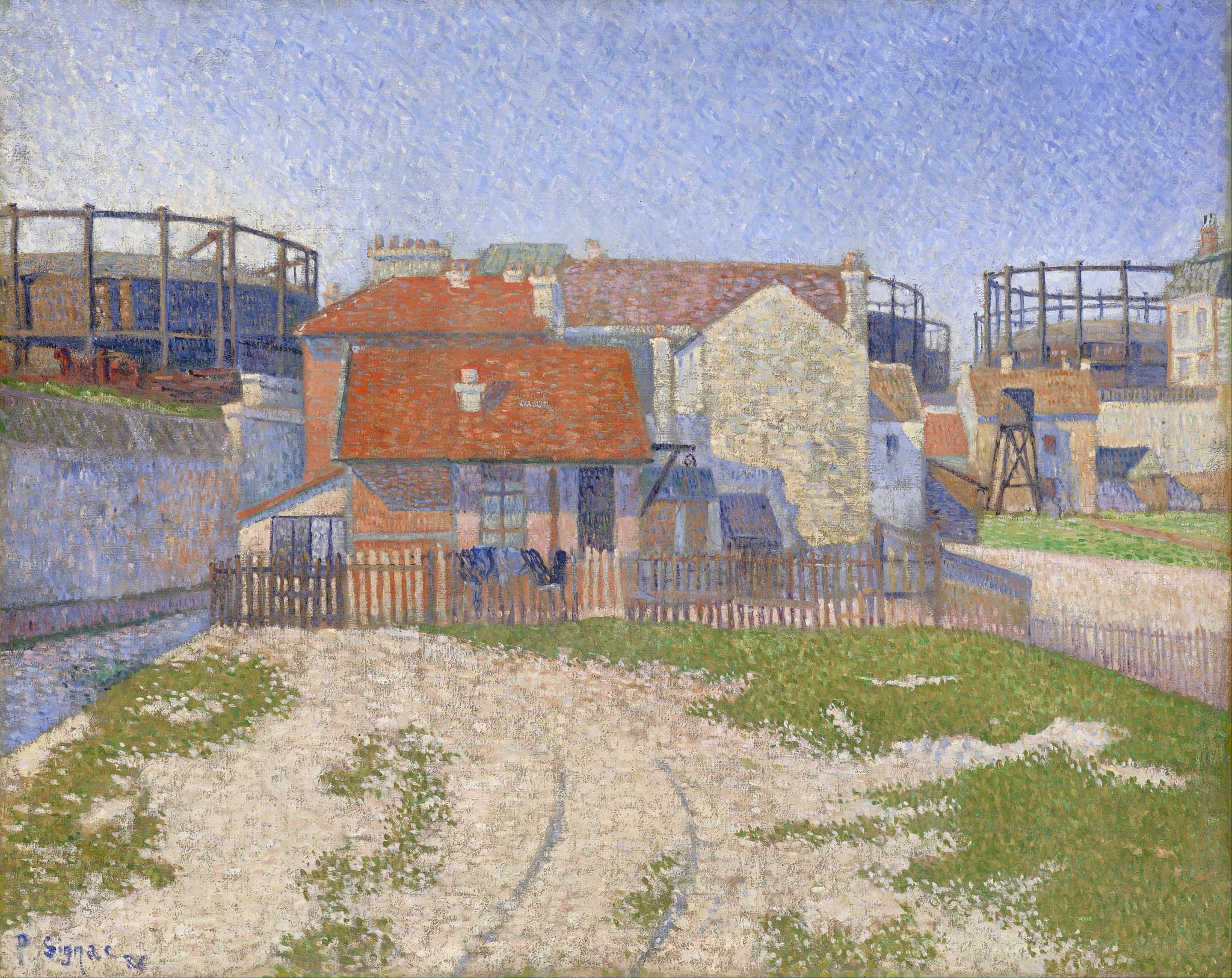
Gasometers at Clichy (1886) is a prime early Neo‑Impressionist oil by Paul Signac, held by the National Gallery of Victoria and recognized as a landmark in his adoption of Divisionism. Based on recent prices for major Signac oils and the painting’s period significance, a fair‑market estimate is $10–16 million, with insurance set higher to reflect rarity.
Valuation Analysis
Overview. Gasometers at Clichy (Les Gazomètres, Clichy), 1886, oil on canvas, 65 × 81 cm, is a museum‑held masterwork in the National Gallery of Victoria, Melbourne, acquired via the Felton Bequest in 1948. It is widely cited as one of Signac’s earliest fully Neo‑Impressionist canvases, marking his rigorous adoption of Divisionist technique in the mid‑1880s [1]. While the NGV picture has no public sale record, its date, scale, and scholarly standing position it near the apex of Signac’s early output.
How this estimate was derived. The $10–16 million range is anchored to recent, like‑for‑like market evidence for major Signac oils. Top‑tier, high‑chroma seascapes have realized $6–10 million in the last few seasons, including a 1896 Saint‑Tropez canvas at £8,015,000 (~$10.17m) at Christie’s London (June 28, 2023) [3] and a 1917 Antibes view at $9.9m at Sotheby’s New York (Nov 18, 2024) [5]. The artist’s record remains the 1891 Breton harbor masterpiece at $39.32m (Christie’s, 2022), which calibrates the category’s upper bound without being the direct comp here [2]. Relative to these, the 1886 Clichy subject commands a premium for period rarity and academic significance but carries a modest discount for its industrial motif versus more traditionally decorative Mediterranean ports.
Subject, period, and rarity. Signac’s Paris‑region industrial views from 1886–87 are scarce and art‑historically pivotal, linking him to Seurat’s modern‑life concerns. Importantly, smaller or less resolved early Clichy oils have been guided far lower (e.g., a 46 × 65.5 cm 1887 Clichy work carried a £600k–£800k estimate at Sotheby’s London) [4]. By contrast, the NGV painting is a large, fully realized Divisionist canvas from 1886 with institutional pedigree, justifying a substantial step‑up into the eight figures.
Market positioning. The estimate sits above the recent $6–10m band for mature Mediterranean subjects due to the NGV work’s earlier date, scale, and scholarly weight, yet well below the $39.32m outlier record reserved for once‑in‑a‑generation coastal masterpieces [2][3][5]. This places Gasometers at Clichy in a high‑single to mid‑teen million bracket consistent with current demand for blue‑chip Neo‑Impressionism.
Insurance guidance. For replacement coverage, a prudent setting is ~20% above the high estimate to reflect uniqueness and illiquidity of a museum‑grade 1886 Divisionist canvas, implying approximately $19.2 million as an insurance value benchmark [1][3][5].
Key Valuation Factors
Art Historical Significance
High ImpactPainted in 1886, Gasometers at Clichy is recognized as one of Signac’s first rigorously Divisionist canvases, capturing the pivotal moment of his full commitment to Neo‑Impressionism. The industrial Clichy motif aligns Signac with Seurat’s modern‑life concerns and broadens the narrative beyond picturesque ports. Works from this exact juncture—large, resolved, and firmly dated—are few, highly cited, and institutionally collected. This level of scholarly importance drives competition from museums and advanced private collectors and supports a price premium over many later, albeit decorative, Mediterranean subjects.
Rarity and Period
High ImpactLarge, fully realized oils from Signac’s mid‑1880s Paris‑region period are scarce on the market. The 65 × 81 cm format is a classic grand canvas in his oeuvre, rare relative to the volume of later coastal views that appear more frequently. Early Divisionist masterpieces seldom trade publicly; when they do, freshness, literature, and scale materially elevate pricing. The subject’s rarity within the early industrial cycle, combined with the period’s centrality to Signac’s development, underpins an estimate in the low‑ to mid‑eight figures.
Subject Appeal vs. Market Taste
Medium ImpactThe industrial gasometers are less ‘decorative’ than sunlit harbors and Venetian scenes that dominate Signac’s top auction results. This introduces a taste‑based discount relative to his most commercial subjects. However, for connoisseurs and institutions, the industrial theme enhances significance, linking the work to modernity and urban transformation in the 1880s. Net effect: a modest discount versus Mediterranean peaks offset by an academic premium—supporting a valuation above many later oils but below the record‑setting coastal masterpieces.
Provenance and Institutional Standing
High ImpactHeld by the National Gallery of Victoria since 1948 (Felton Bequest), the painting benefits from impeccable provenance, scholarly visibility, and museum‑level conservation. Such pedigree greatly reduces attribution and condition risk in theoretical market value modeling and raises replacement‑cost benchmarks. Although deaccession is unlikely, the institutional context strengthens confidence around authenticity and literature history, both of which are key to buyer underwriting and to insurance valuations for a work of this rarity and period.
Sale History
Gasometers at Clichy has never been sold at public auction.
Paul Signac's Market
Paul Signac is a cornerstone of Neo‑Impressionism alongside Seurat, with a deep international market. His top prices concentrate in large, high‑chroma Divisionist oils of ports and Mediterranean subjects, which have fetched $6–10 million regularly in recent seasons, and a record of $39.32 million for Concarneau, calme du matin (Christie’s, 2022). Liquidity is strong for trophy oils with clear provenance and literature; secondary oils trade in the low‑ to mid‑seven figures depending on subject, date, and scale. Works on paper form a distinct, active segment, typically realizing from the mid‑five figures to low six figures, with exceptional sheets higher. Overall, Signac is viewed as a blue‑chip, historically secure name with resilient demand.
Current Market Trends
Impressionist and Post‑Impressionist art has enjoyed renewed relative strength as capital rotates toward blue‑chip stability. Recent evening sales confirm healthy demand for canonical late‑19th/early‑20th‑century masters, with Signac’s prime oils consistently achieving multi‑million‑dollar results. Market concentration favors top quality, fresh‑to‑market works with strong literature and exhibition history, while mid‑market segments remain selective. Institutional exhibitions and scholarship on Neo‑Impressionism continue to bolster interest, especially for works that exemplify core innovations of the movement—supporting firm pricing for major Divisionist canvases and a cautious premium for rare, academically pivotal early examples.
Sources
- National Gallery of Victoria: Gasometers at Clichy (1886)
- The Art Newspaper: Christie’s Paul G. Allen sale sets $1.5bn and Signac record
- Christie’s London: 20th/21st Century Evening Sale Results (28 June 2023)
- Sotheby’s London: Paul Signac, Quai de Clichy. Temps gris (1887), Lot details/estimate
- The Art Newspaper: Sotheby’s New York Modern Evening—$9.9m Signac Antibes