How Much Is Saint-Tropez. La Bouée rouge (The Red Buoy) Worth?
Last updated: August 5, 2026
Quick Facts
- Methodology
- comparable analysis
A prime autograph oil of Paul Signac’s Saint‑Tropez. La Bouée rouge motif from the mid‑1890s would likely command $18–28 million today. This estimate is anchored by recent $9–10 million results for top Saint‑Tropez oils and capped by Signac’s $39.32 million auction record for an early 1890s masterpiece.
Valuation Analysis
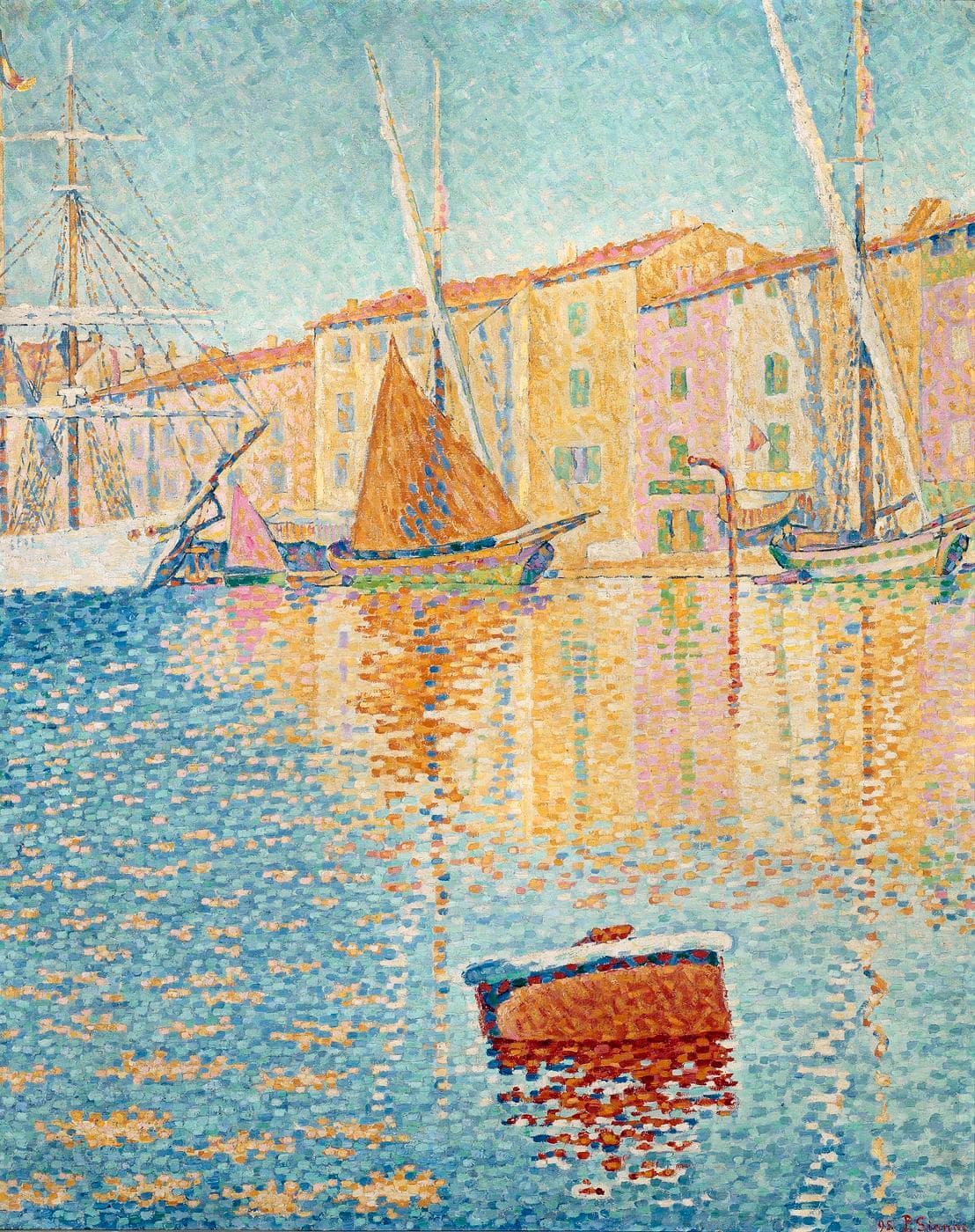
Opinion of value: $18–28 million for an autograph oil on canvas of Paul Signac’s Saint‑Tropez. La Bouée rouge (The Red Buoy) motif dating to the mid‑1890s, assuming museum‑quality condition, c. 65–85 cm scale, and strong provenance/literature. The benchmark 1895 canvas is held by the Musée d’Orsay (81.2 × 65 cm) and has not sold publicly [1]. Our estimate reflects what a like‑for‑like work would bring at auction today.
Comparables and price anchors: The active trading band for prime Signac harbor scenes is established by two recent Saint‑Tropez oils: Christie’s London (28 June 2023) achieved roughly $10.18 million with premium for Calanque des Canoubiers (Pointe de Bamer) [2], and Sotheby’s London (6 March 2024) realized about $9.83 million for Saint‑Tropez. Le rayon vert [3]. These evening‑sale results confirm robust global demand for late‑1890s to early‑1900s coastal views of exceptional color and condition.
Ceiling reference: At the top of the market, Signac’s auction record is $39.32 million for the early Divisionist masterpiece Concarneau, calme du matin (Opus no. 219), sold at Christie’s New York in 2022 (Paul G. Allen Collection) [4]. While La Bouée rouge is one of Signac’s most recognizable Saint‑Tropez subjects, its likely scale and the existence of closely related compositions place it below this absolute ceiling yet comfortably above the $8–10 million band achieved by strong but less iconic examples.
Key value drivers: The subject and period (Saint‑Tropez in the mid‑1890s) rank among the most coveted in Signac’s oeuvre, prized for their saturated Divisionist facture, crystalline light, and elegant marine geometry [1]. Condition and color preservation are pivotal; original surface and minimal intervention support the upper half of the range. Provenance and publication/exhibition history (e.g., early Bernheim‑Jeune/Durand‑Ruel handling, inclusion in authoritative literature) can further lift pricing into the mid‑ to high‑$20 millions.
Market context and breadth: Works on paper and prints are not direct comparables but illustrate depth of recognition for the motif; a color lithograph of the buoy/port realized $18,750 in 2024 [5]. In a selective but liquid market for late‑19th to early‑20th‑century masters, a fresh‑to‑market, museum‑quality Red Buoy oil should attract broad international bidding, justifying our $18–28 million estimate.
Key Valuation Factors
Art Historical Significance
High ImpactLa Bouée rouge is a signature motif from Signac’s mature Neo‑Impressionist period, crystallizing his Divisionist color theory and lifelong fascination with maritime light. The Saint‑Tropez canvases form a cornerstone of his oeuvre and of the Neo‑Impressionist canon, often reproduced and frequently requested for exhibitions. The Musée d’Orsay’s 1895 version anchors the subject’s scholarly standing, offering definitive validation of its importance. This level of recognition places any autograph, mid‑1890s Red Buoy oil among the artist’s most desirable works, enhancing both cultural cachet and market demand. High art‑historical significance typically tightens buyer pools to serious collectors and institutions, supporting aggressive bidding in marquee auctions.
Subject and Period Desirability
High ImpactCollectors prize Signac’s Saint‑Tropez harbor scenes from the 1890s–early 1900s for their radiant palette, crystalline atmosphere, and structured, pointillist touch. The Red Buoy composition adds a sharp, modern accent that heightens the graphic clarity of masts, facades, and reflections—qualities that translate powerfully in evening‑sale settings and large viewing rooms. Market evidence shows that Saint‑Tropez views consistently lead the artist’s results, often outperforming comparable themes from later decades. When combined with a mid‑1890s date—arguably the artist’s sweet spot—the subject’s desirability becomes a primary driver of value, positioning a prime Red Buoy oil squarely in the low‑ to mid‑eight‑figure range.
Provenance, Literature, and Exhibition History
High ImpactBlue‑chip early provenance (e.g., Bernheim‑Jeune, Durand‑Ruel), distinguished long‑term private ownership, or a clear, unbroken chain of custody meaningfully increases buyer confidence and competition. Inclusion in the catalogue raisonné, key monographs, and major exhibitions—particularly institutional surveys on Neo‑Impressionism—signals scholarly consensus and enhances liquidity. For an iconic motif like the Red Buoy, comprehensive literature and exhibition records can be decisive in pushing a work into the upper half of the estimate range. Conversely, gaps in documentation, export complications, or restitution risks can dampen appetite, widening bid‑ask spreads. Our valuation presumes tight documentation consistent with a museum‑quality example.
Scale, Composition, and Condition
Medium ImpactScale drives impact and pricing: mid‑size canvases around 65–85 cm—comparable to the Orsay example—are highly displayable and trade well internationally. Larger, compositionally resolved versions with vivid, intact color can stretch estimates. Condition is critical for Divisionist surfaces; stable support, unabraded impasto, and minimal retouch preserve the optical vibration central to Signac’s effect. A recent, reputable condition report noting original canvas, varnish history, and UV findings will be scrutinized by top bidders. Our range assumes excellent structural and cosmetic condition. Notable condition caveats, overcleaning, or significant restorations would compress the estimate toward (or below) the lower band.
Sale History
Saint-Tropez. La Bouée rouge (The Red Buoy) has never been sold at public auction.
Paul Signac's Market
Paul Signac’s market is deep and global, led by prime harbor scenes from the 1890s–early 1900s. The artist’s auction record stands at $39.32 million (Christie’s New York, 2022) for an 1891 Concarneau masterpiece, establishing the ceiling for museum‑grade Divisionist oils. Since 2023, strong Saint‑Tropez and Venetian subjects have transacted consistently around $9–10 million with premium in London evening sales, indicating robust demand for luminous coastal views of quality. While works on paper routinely bring low‑ to mid‑six figures and color lithographs mid‑five figures, the true market drivers are fresh‑to‑market oils with top provenance, strong condition, and exhibition/literature pedigree—especially the most recognizable motifs from the Saint‑Tropez years.
Comparable Sales
Calanque des Canoubiers (Pointe de Bamer), Saint‑Tropez
Paul Signac
Same artist; prime Saint‑Tropez subject; very close in date to the 1895 Red Buoy; comparable quality and likely scale; strong benchmark for late‑1890s Saint‑Tropez oils.
$10.2M
2023, Christie's London
~$10.8M adjusted
Saint‑Tropez. Le rayon vert
Paul Signac
Same artist; iconic Saint‑Tropez theme; later but closely related in subject and market demand to Red Buoy; evening‑sale, top‑tier quality.
$9.8M
2024, Sotheby's London
~$10.1M adjusted
Concarneau, calme du matin (Opus no. 219, larghetto)
Paul Signac
Same artist; museum‑caliber Neo‑Impressionist harbor scene from the early 1890s; current auction record; establishes the upper bound for masterpiece‑level Signac oils.
$39.3M
2022, Christie's New York
~$43.3M adjusted
Saint‑Georges. Couchant (Venise)
Paul Signac
Same artist; prime luminous harbor subject (Venice) and late‑1900s period; strong blue‑chip evening result that calibrates current appetite for top Signac seascapes.
$8.1M
2025, Sotheby's New York
Current Market Trends
The late‑19th to early‑20th‑century segment has remained a relative safe haven as collectors have rotated toward established blue‑chip names. Within this context, Neo‑Impressionist masters benefit from renewed curatorial interest and cross‑category demand for color‑driven, museum‑quality works. Recent evening‑sale results suggest selective strength: top‑tier Signacs with prime subjects and excellent condition clear readily, while lesser examples face more measured bidding. Currency dynamics and sale‑week supply influence momentum, but the core thesis holds—fresh, well‑documented Saint‑Tropez oils continue to command low‑ to mid‑eight‑figure prices, with upside for exceptional scale, provenance, and exhibition history.
Sources
- Musée d’Orsay – Saint‑Tropez. La Bouée rouge (1895) collection record
- Artnet News – By the Numbers: Christie’s London Evening Sales (June 28, 2023)
- Artnet News – By the Numbers: Sotheby’s London (March 6, 2024)
- Christie’s – The Paul G. Allen Collection totals $1.62B; Signac record $39.32M
- Swann Galleries – Paul Signac, La Bouée (Saint‑Tropez: Le Port), color lithograph (Apr 18, 2024)