How Much Is The Port at Sunset, Opus 236 (Saint‑Tropez) Worth?
Last updated: August 6, 2026
Quick Facts
- Last Sale
- $25.8M (2019, Christie's London)
- Methodology
- comparable analysis
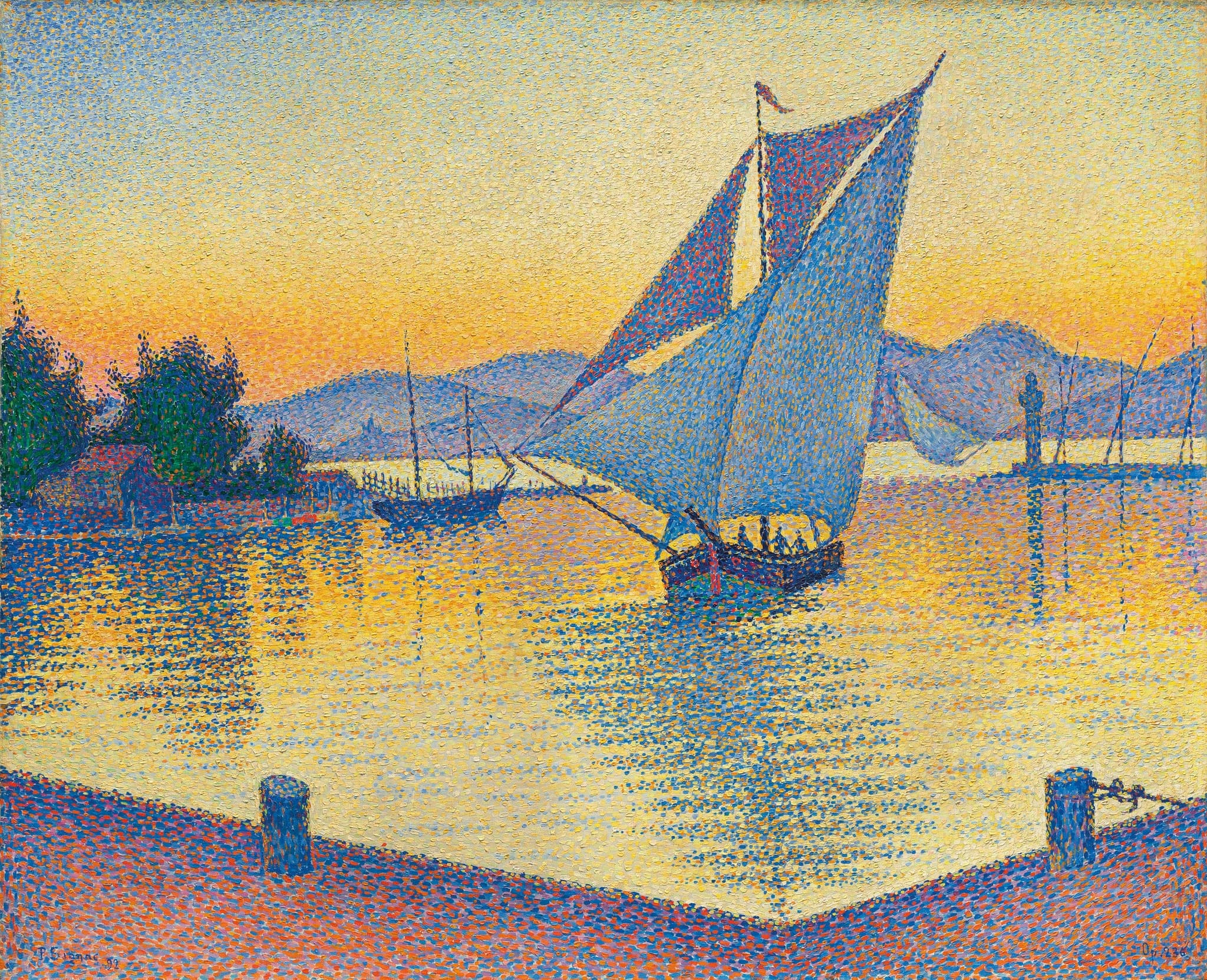
Based on the painting’s prime 1892 date, iconic Saint‑Tropez subject, impeccable provenance, and its £19.5m ($25.84m) auction result in 2019, we estimate current market value at $24–34 million. The 2022 Signac record at $39.32m provides clear headroom for masterpiece‑level Divisionist harbors while recent strong results for top marine views affirm depth of demand.
Valuation Analysis
Conclusion: Paul Signac’s The Port at Sunset, Opus 236 (Saint‑Tropez), 1892 (oil on canvas, 65 × 81.3 cm; CR 229), merits a current market estimate of $24–34 million. This range is anchored by the painting’s 2019 sale at Christie’s London for £19,501,250 (approximately $25,839,156 at the time) [1], its canonical status within Signac’s early Saint‑Tropez opus sequence, and supportive benchmarks among the artist’s top recent auction results.
Identity and significance: The work is catalogued as Le Port au soleil couchant, Opus 236 (Saint‑Tropez), signed and dated 1892, and today belongs to the Hasso Plattner Collection, on view at Museum Barberini, Potsdam, whose entry confirms the inscription “Op. 236,” CR number, and the 2019 Christie’s sale [2]. This date situates the canvas squarely in Signac’s prime Neo‑Impressionist period shortly after settling in Saint‑Tropez, when his Divisionist technique and chromatic orchestration were at their most rigorous and influential.
Market anchors and headroom: The exact painting set a then‑record in 2019 at £19.5m with fees ($25.84m) [1]. Since then, Signac’s category ceiling moved materially higher with the $39,320,000 record achieved by the 1891 Concarneau, calme du matin (Opus 219) from the Paul G. Allen Collection (Christie’s New York, 2022) [3]. While the broader market softened in 2024, top‑tier Signac marines have continued to see competitive bidding: a luminous 1896 Saint‑Tropez view made about $10 million in London in 2023 [4], and a major Antibes coastal scene realized $9.95 million in New York in late 2024 [5]. Together, these datapoints affirm robust demand for prime coastal subjects and sustain the rationale for an estimate above the work’s 2019 price.
Comparative positioning: Opus 236 combines a blue‑chip subject (Saint‑Tropez harbor at sunset), an early, fully Divisionist execution, and a highly legible composition—characteristics that place it in the top tier of Signac’s market. At 65 × 81.3 cm, it is an exhibition‑scale canvas typical of the artist’s most desirable 1890s harbors. Its continuous, distinguished provenance and prominent institutional display further enhance salability and price confidence [2]. Relative to the 2022 record (earlier date, larger/larghetto conception), Opus 236 sits just below the absolute apex but well above strong mid‑tier results, supporting a low‑to‑mid eight‑figure range.
Estimate rationale: The $24–34 million band reflects: (i) the painting’s demonstrated 2019 price; (ii) upward headroom created by the 2022 record; (iii) confirmed liquidity for A‑list marine views since 2023–2024; and (iv) a measured allowance for market selectivity in 2024 followed by stabilization in 2025–2026. Assuming normal aging and no material condition issues, a well‑staged sale with global outreach (and, ideally, a limited guarantee) should comfortably clear the 2019 benchmark and could approach the low‑$30Ms in competitive conditions.
Bottom line: This is a quintessential, early Saint‑Tropez Signac with museum‑grade credentials. In today’s market, it justifies a confident estimate of $24–34 million, with upside potential in a tightly curated evening sale setting.
Key Valuation Factors
Art Historical Significance
High ImpactPainted in 1892, shortly after Signac settled in Saint‑Tropez, Opus 236 epitomizes the artist’s fully developed Divisionist technique and chromatic orchestration. The opus‑numbered harbor views from this early Saint‑Tropez period are among the most sought in his oeuvre, synthesizing rigorous Neo‑Impressionist method with luminous Mediterranean subjects that influenced Fauvism and later modernism. The painting’s sunset tonality, clear planar structuring, and orchestral color harmonies make it a paradigmatic example for scholarship, exhibitions, and collecting, elevating it above later reprises or secondary locales in terms of both art‑historical weight and market desirability.
Provenance and Exhibition History
High ImpactThe work’s traceable public sale history (1980, 1993, 2019) and subsequent inclusion in the Hasso Plattner Collection, on view at Museum Barberini, confer exceptional credibility. Prominent institutional display and thorough literature/exhibition documentation materially reduce transactional risk and enhance buyer confidence. Works with this level of documentation are scarce in the Signac market and tend to outperform peers lacking comparable provenance. Visibility through a leading museum also sustains scholarly interest and demand among globally active collectors focused on museum‑quality holdings.
Medium, Date, and Condition
High ImpactAs a substantial oil on canvas from the early 1890s, Opus 236 occupies the most valuable tranche of Signac’s production. Divisionist surfaces are condition‑sensitive; assuming normal aging and no material restoration issues, the painting’s medium/date combination should support aggressive bidding. Oils of this caliber carry a persistent premium over watercolors/gouaches and later oils, reflecting both technical complexity and market depth. Any new conservation findings would be price‑relevant, but the work’s museum stewardship suggests professional care commensurate with its importance.
Market Comparables and Liquidity
Medium ImpactThe exact painting achieved $25.84m in 2019; the artist’s market ceiling rose to $39.32m in 2022 for an adjacent, masterpiece‑level harbor view, confirming additional headroom. Since then, high‑quality marine subjects have sold strongly around $10m, underscoring resilient demand for top Signac oils even amid selective conditions. Supply of early Saint‑Tropez opus works is thin, and buyer pools are global. Together, these factors justify a range above the 2019 price with scope toward the low‑$30Ms in a well‑orchestrated sale.
Sale History
Sotheby Parke Bernet, New York (The Garbisch Collection)
Lot 21; widely reported as a record for Signac at the time.
Sotheby's New York (Impressionist & Modern Art Evening Sale)
Lot 23; premium-inclusive total reported in contemporaneous coverage.
Christie's London (Impressionist & Modern Art Evening Sale)
Lot 26; hammer £17,000,000; with fees £19,501,250; Christie’s reported USD equivalent $25,839,156.
Paul Signac's Market
Paul Signac is a blue‑chip Post‑Impressionist whose best Divisionist oils—especially 1890s harbors in Saint‑Tropez, Concarneau, and Antibes—attract sustained global demand. The artist’s auction record stands at $39.32 million (Christie’s, 2022) for an 1891 Concarneau canvas, and prime marine views regularly command mid‑ to high‑seven or low‑eight‑figure results. While the broader market saw a pullback in 2024, Signac’s category retained liquidity for high‑quality coastal subjects with strong provenance, as evidenced by multiple results around $10 million in 2023–2024. Collectors range from major US and European buyers to expanding interest in Asia, with masterpieces often placed via evening sales and private transactions.
Comparable Sales
Concarneau, calme du matin (Opus no. 219, larghetto)
Paul Signac
Same artist; immediately adjacent period (1891) and prime Divisionist technique; landmark harbor view anchoring the top of Signac’s market.
$39.3M
2022, Christie's New York
~$43.9M adjusted
Calanque des Canoubiers (Pointe de Bamer), Saint‑Tropez
Paul Signac
Same artist; prime Saint‑Tropez subject from the 1890s (1896), closely related locale and period to Opus 236; strong benchmark for high‑quality 1890s Saint‑Tropez oils.
$10.1M
2023, Christie's London
~$10.8M adjusted
Antibes. La Pointe de Bacon
Paul Signac
Same artist; Mediterranean port subject with luminous Divisionist brushwork; later date (1917) but a key coastal view showing demand for major marine scenes.
$9.9M
2024, Sotheby's New York
~$10.2M adjusted
La Passerelle Debilly
Paul Signac
Same artist; substantial oil (1903) in mature Divisionist style; urban subject provides a mid‑range benchmark for important non‑Mediterranean works.
$4.9M
2025, Christie's Paris
Le Port au soleil couchant, Opus 236 (Saint‑Tropez)
Paul Signac
Exact same painting; definitive market anchor for an 1892 prime Divisionist Saint‑Tropez port view, establishing the work’s demonstrated price level.
$25.8M
2019, Christie's London
~$33.0M adjusted
Current Market Trends
Impressionist and Post‑Impressionist segments experienced a more selective, quality‑driven market in 2024, followed by stabilization and improved sell‑through in 2025–2026. Buyers have concentrated capital on historically secure names and trophy‑caliber works, often supported by targeted guarantees. Within this context, masterworks by Neo‑Impressionists have performed well, particularly those with museum‑grade provenance and prime subjects. For Signac, top coastal oils remain the most liquid and competitive, while mid‑tier works track broader caution. The result is a two‑speed market: conservatively priced offerings struggle, but rare, high‑impact paintings with strong narratives continue to clear ambitious estimates.
Sources
- Christie’s press release (27 Feb 2019): Impressionist & Modern Art and The Art of the Surreal sales results
- Museum Barberini Collection: Paul Signac, The Port at Sunset, Opus 236 (Saint‑Tropez)
- Christie’s press release (9 Nov 2022): The Paul G. Allen Collection totals $1.62 billion (Signac record $39.32m)
- Christie’s: June 2023 London sale results (Calanque des Canoubiers, Saint‑Tropez at £8,015,000)
- Artprice: The Art Market in 2024 (report; Signac Antibes at $9.95m, Nov 2024)