How Much Is The Port of Saint-Tropez Worth?
Last updated: August 5, 2026
Quick Facts
- Methodology
- comparable analysis
Hypothetical auction value for Paul Signac’s The Port of Saint‑Tropez (1901–02, oil on canvas, 131 x 161.5 cm; Cachin CR 359, National Museum of Western Art, Tokyo) is $20–32 million. The range is anchored by major Saint‑Tropez port comparables, notably the £19.5m/$25.8m Christie’s 2019 result, and bounded by Signac’s $39.32m artist record.
Valuation Analysis
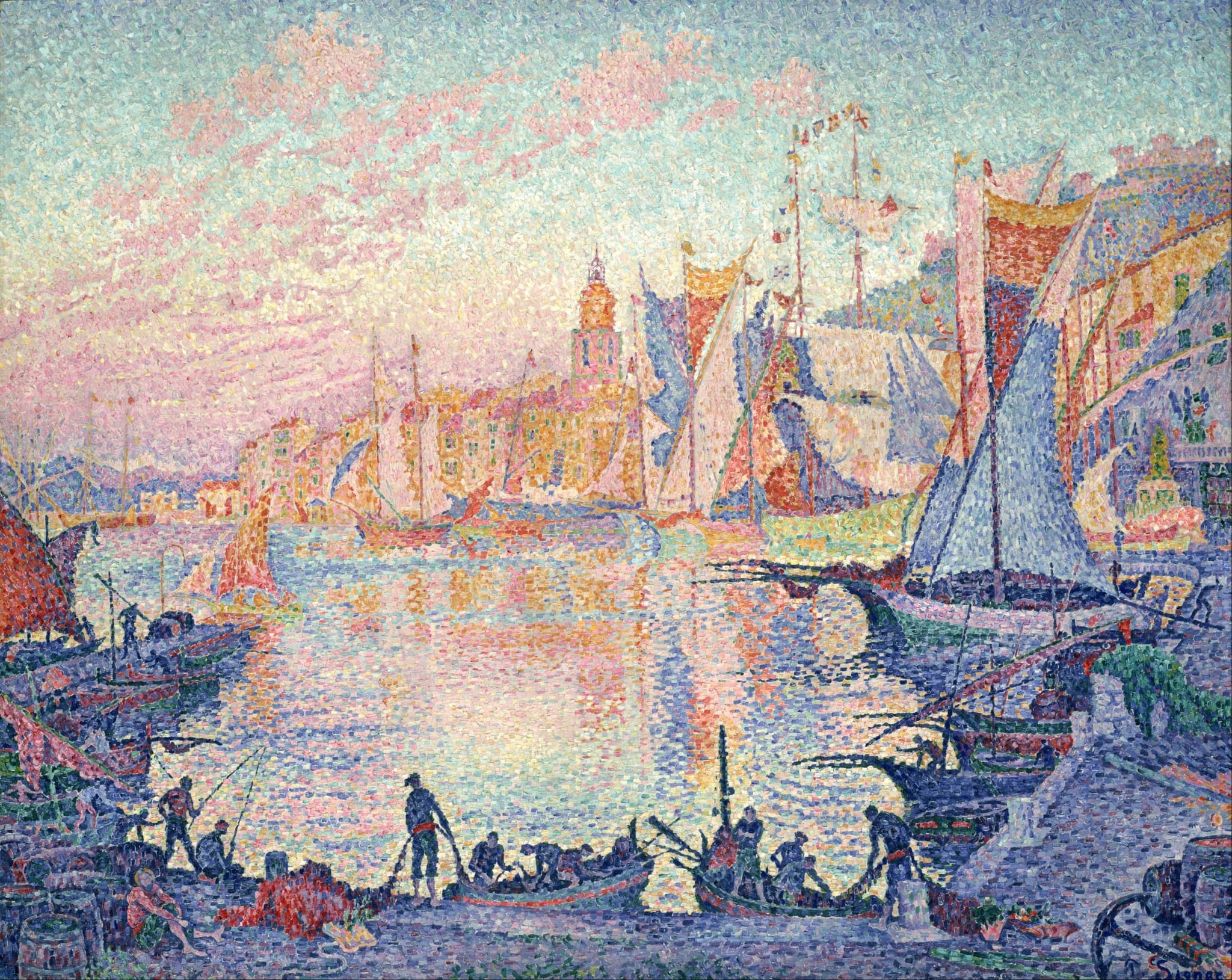
Work identified. The Port of Saint‑Tropez (1901–02), oil on canvas, 131 x 161.5 cm, catalogue raisonné (Cachin) no. 359, is held by the National Museum of Western Art, Tokyo. It is a monumental, canonically important view of the harbor that crystallizes Signac’s devotion to Saint‑Tropez after settling there in the early 1890s, and it carries blue‑chip provenance and literature. While museum-held and not for sale, a market-indicative valuation can be derived from close public comparables and the artist’s auction record [1].
Method and key comparables. We benchmark against best-in-class Saint‑Tropez marines sold publicly. A direct subject peer, Le Port au soleil couchant, Opus 236 (1892), realized £19,501,250 (≈$25.8m) at Christie’s London in 2019—one of the strongest Saint‑Tropez port canvases at auction [2]. Additional anchors include Maisons du port, Saint‑Tropez (1892) at $10.7m (Sotheby’s, 2016) [3], Calanque des Canoubiers, Saint‑Tropez (1896) at ≈$10.2m (Christie’s, 2023) [4], and the later but highly appealing Saint‑Tropez. Le rayon vert (1906) near $9.9m (Sotheby’s, 2024) [6]. Signac’s overall auction record—Concarneau, calme du matin (1891) at $39.32m (Christie’s, 2022)—sets a realistic ceiling for divisionist, museum-caliber marines [5].
Positioning this canvas. The Tokyo Port of Saint‑Tropez combines an A‑subject with a monumental format (131 x 161.5 cm), a scale rarely encountered among the 1890s–early 1900s Saint‑Tropez oils. While slightly later than the 1892 apex works, its size, fully worked divisionist surface, and canonical status in the oeuvre offset the date effect. On a like‑for‑like basis, these attributes place it above the $9–11m band typical for strong but smaller marines and within reach of the 2019 £19.5m comp, while remaining under the artist’s $39.32m record. Accordingly, a prudent current indication is $20–32 million.
Drivers and sensitivities. The estimate reflects: (1) preeminent subject matter—Saint‑Tropez harbor scenes are quintessential Signac and command a premium [2][3]; (2) exceptional scale and pictorial resolution versus common mid‑sizes [1]; (3) blue‑chip provenance and catalogue raisonné status [1]; and (4) recent market evidence showing sustained depth for luminous Neo‑Impressionist marines by Signac in the mid‑ to high‑single‑digit millions, with outliers at the top for landmark works [4][6]. As always, condition is a material swing factor; a clean surface with minimal retouching supports the upper band, while notable restoration or structural treatment would compress the result.
Conclusion. Calibrated to the strongest Saint‑Tropez port comparables (2016–2024) and the artist’s $39.32m ceiling, The Port of Saint‑Tropez (1901–02) would reasonably guide at $20–32 million in a well‑staged evening sale, subject to full due diligence on condition and release. Museums seldom deaccession such works; this figure is an evidence‑based market indication rather than an appraisal of a planned transaction [1][2][5].
Key Valuation Factors
Art Historical Significance
High ImpactSaint‑Tropez is the defining locus of Signac’s mature practice, and harbor views from the 1890s–early 1900s form the backbone of his Neo‑Impressionist legacy. The Tokyo canvas is not only an A‑subject but also a cornerstone in institutional narratives around Signac’s settlement and experimentation in the South. Its presence in the National Museum of Western Art and inclusion in the catalogue raisonné underscore its canonical status. Within Signac’s oeuvre, fully realized, large‑scale Saint‑Tropez port scenes are scarce relative to demand, and the market consistently rewards their chromatic complexity and divisionist facture. This confluence of subject centrality and scholarly validation materially elevates value.
Subject and Period Quality
High ImpactAlthough the 1892–96 Saint‑Tropez oils often set the pace at auction, works from 1901–02 can exhibit comparable divisionist rigor and atmosphere, reflecting Signac’s matured handling of color harmonies and light. The Port of Saint‑Tropez represents the city’s emblematic motif—the harbor basin, quays, masts, and façades—captured with a crystalline palette and structured brush‑dot system. Collectors prize this exact iconography, and its tight association with Signac’s identity often elevates it above other Mediterranean or fluvial subjects. The date aligns it with the artist’s high period, ensuring period‑correct technique and palette that meet market expectations for ‘prime’ Signac marines.
Scale and Aesthetic Resolution
High ImpactAt 131 x 161.5 cm, the painting is monumental by Signac standards. Larger canvases allow denser divisionist structuring, a broader orchestration of color chords, and an immersive viewing distance—qualities that consistently correlate with outperformance in evening sales. Unlike smaller or sketch‑like panels, this scale signals full studio commitment and exhibition intent. The composition’s balance of architecture, rigging, and reflections showcases Signac’s orchestration of verticals and horizontals against shimmering water, producing the ‘symphonic’ chromatic effects that collectors and museums target. Scale and pictorial finish together justify positioning above the $9–11m band typical for smaller yet attractive marines.
Provenance, Literature, and Exhibition History
High ImpactThe chain from Karl‑Ernst Osthaus to Museum Folkwang to Marlborough Fine Art, culminating in acquisition by the National Museum of Western Art (Tokyo), is as blue‑chip as Signac provenance gets. Catalogue raisonné inclusion (Cachin 359) and repeated institutional exhibition lend deep scholarly and public visibility. Works with this caliber of provenance and literature clearance reduce transactional friction and enhance bidder confidence, supporting aggressive competition in a hypothetical sale. Museum-held status also implies custodial care and a well‑documented history, factors that can lift the hammer toward the top of the indicated range when combined with strong condition and market timing.
Market Conditions and Liquidity
Medium ImpactRecent auctions show durable demand for high‑quality Signac marines: top Saint‑Tropez and Côte d’Azur oils have traded around $9–11m in 2023–2024, with an exceptional 1892 harbor canvas at $25.8m in 2019 and the artist’s all‑time $39.32m record in 2022. The category has exhibited a ‘flight to quality,’ rewarding iconic subjects, strong color, larger scale, and fresh provenance. Liquidity remains selective, but when A‑material appears, depth is evident. The indicated $20–32m range assumes a prime evening platform, robust marketing, and favorable macro sentiment; weaker conditions or restoration findings could compress outcomes toward the lower band.
Sale History
The Port of Saint-Tropez has never been sold at public auction.
Paul Signac's Market
Paul Signac is a blue‑chip Neo‑Impressionist/Post‑Impressionist with sustained institutional support and collector demand. His market is led by large, high‑color divisionist marines from the 1890s–early 1900s, especially Saint‑Tropez, Venice, and major French ports. The artist’s current auction record is $39.32 million for Concarneau, calme du matin (1891) in Christie’s Paul G. Allen Collection (2022), establishing a clear ceiling for best‑in‑class oils. In recent years, strong Signac oils have regularly fetched $5–11 million, with an exceptional Saint‑Tropez harbor view achieving $25.8 million at Christie’s London in 2019. Works on paper generally trade in the mid‑ to high‑six figures, with top sheets approaching seven. The market prizes chromatic intensity, divisionist rigor, scale, and museum‑level provenance.
Comparable Sales
Le Port au soleil couchant, Opus 236 (Saint-Tropez)
Paul Signac
Same artist and subject (Saint-Tropez harbor/port), prime early 1890s period, top-tier chroma and composition; among the strongest Saint-Tropez port oils to appear publicly.
$25.8M
2019, Christie's London
~$31.0M adjusted
Maisons du port, Saint-Tropez
Paul Signac
Same artist and Saint-Tropez port motif from 1892; direct subject match; establishes depth of demand for port views.
$10.7M
2016, Sotheby's New York
~$13.8M adjusted
Calanque des Canoubiers (Pointe de Bamer), Saint-Tropez
Paul Signac
Same artist and Saint-Tropez subject area (near the port), high-color 1890s marine; strong, recent benchmark for major Saint-Tropez oils.
$10.2M
2023, Christie's London
~$10.7M adjusted
Saint-Tropez. Le rayon vert
Paul Signac
Same artist and Saint-Tropez theme (later, 1906); illustrates current market willingness to pay around $10m for compelling Saint-Tropez marines.
$9.8M
2024, Sotheby's London
~$10.0M adjusted
Concarneau, calme du matin (Opus no. 219, larghetto)
Paul Signac
Same artist; record-setting, museum-caliber pointillist marine of a major French port (not Saint-Tropez). Serves as an upper-bound benchmark for best-in-class Signac oils.
$39.3M
2022, Christie's New York
~$42.9M adjusted
Current Market Trends
Within Impressionist & Modern, demand has concentrated around established masters and ‘flight‑to‑quality’ material. For Signac specifically, bidders remain selective but deep for luminous, fully worked marines with prime subjects, strong color, and good size. After the exuberance of 2021–2022, results normalized but stayed robust for A‑material, as seen in 2023–2024 sales around $9–11m for compelling Saint‑Tropez/Antibes views and the $25.8m high-water mark for a landmark Saint‑Tropez harbor canvas in 2019. Supply remains the principal constraint; when exceptional works surface with blue‑chip provenance and clean condition, competition is strong and outcomes can stretch meaningfully above guidance.
Sources
- National Museum of Western Art (Tokyo) – Collection entry: Paul Signac, The Port of Saint-Tropez (1901–02)
- Christie’s London – Impressionist & Modern Art Evening Sale results (Feb 27, 2019): Le Port au soleil couchant (1892) at £19,501,250
- The Art Newspaper – Sotheby’s New York (May 9, 2016) coverage: Maisons du port, Saint-Tropez at $10.7m
- Christie’s – June 2023 20th/21st Century London sale highlights: Calanque des Canoubiers (1896) at £8,015,000
- HENI – Paul Signac auction record: Concarneau, calme du matin (1891), $39.32m (Nov 9, 2022)
- Artnet News – Sotheby’s London (Mar 6, 2024) by the numbers: Signac’s Saint-Tropez. Le rayon vert near $10m