How Much Is Henri IV Receives the Portrait of Marie de’ Medici Worth?
Last updated: June 27, 2026
Quick Facts
- Methodology
- comparable analysis
Hypothetical private-treaty valuation for Rubens’s Henri IV Receives the Portrait of Marie de’ Medici is $200–250 million. The estimate reflects the work’s status as a cycle-defining, museum-held masterpiece, Rubens’s auction benchmarks, and nine-figure Old Master comparables.
Valuation Analysis
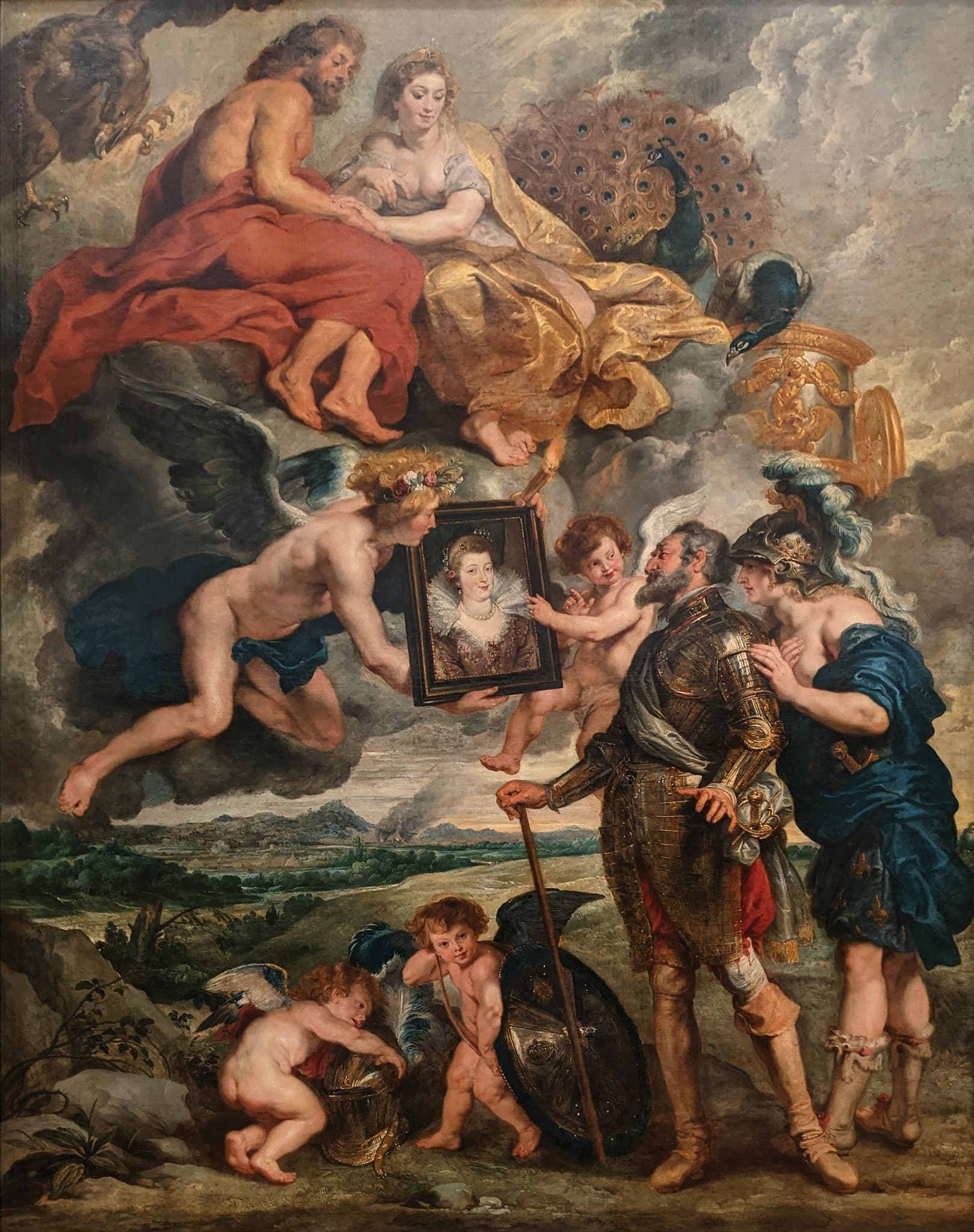
Work and context. Henri IV Receives the Portrait of Marie de’ Medici (c. 1622–1625) is among the most iconic canvases in Rubens’s Marie de’ Medici cycle, conceived for the Luxembourg Palace and now installed in the Louvre’s Galerie Médicis. It has never been traded on the modern market and forms part of France’s national collections, which are effectively inalienable [1][6]. Any valuation is therefore hypothetical, intended to frame likely private-treaty or indemnity values for a canonical Baroque state image of exceptional scale and authorship.
Approach and artist benchmarks. With no direct sale history, we anchor value to the artist’s top public results and to category comparables. Rubens’s auction apex remains The Massacre of the Innocents (Sotheby’s London, 2002) at £49.5m (about $76.7m then) [2], followed by Lot and His Daughters (Christie’s London, 2016) at £44.9m (c.$58m) [3]. More recently, the autograph Salome presented with the Head of Saint John the Baptist achieved $26.9m at Sotheby’s New York (2023), underscoring current liquidity for prime works while highlighting the rarity of true trophies [7].
Cross-category ceiling and nine‑figure support. Within Old Masters, nine-figure private prices are validated by the Dutch State’s €175m acquisition of Rembrandt’s The Standard Bearer (2022) [4]. At auction, Botticelli’s Young Man Holding a Roundel realized $92.2m (2021), setting a contemporary auction-era benchmark for the category below the Rembrandt state purchase but well beyond typical Old Master totals [5]. A cycle-defining, fully autograph, monumental Rubens with unassailable provenance sits credibly between these poles, supporting a valuation in the low-to-mid nine figures.
Work-specific premiums and constraints. This composition is a signature image of dynastic propaganda, frequently reproduced and central to the narrative of Marie de’ Medici’s life—attributes that command a premium relative to even major Rubens altarpieces. Its near 4 x 3 m scale, theatrical allegory, and autograph quality amplify institutional demand and brand recognition [1]. Scarcity is decisive: paintings of equivalent stature are functionally unavailable, and when nearest analogs have surfaced historically, they have reset artist records [2][3].
Conclusion and range. Balancing trophy-level significance against practical constraints (scale, allegorical subject narrowing the private buyer pool, and the general Old Masters discount to contemporary), a reasoned hypothetical value of $200–250 million is justified. This positioning sits above Rubens’s public auction record, in line with state-level Old Master acquisitions, and below outlier peaks in the broader art market. It presumes stable institutional condition and confirms the work’s unsold status within an inalienable national collection [1][6][7].
Key Valuation Factors
Art Historical Significance
High ImpactThis canvas is a linchpin of the celebrated Marie de’ Medici cycle, one of Rubens’s most ambitious and public commissions. As the emblematic scene in which Henri IV accepts Marie’s likeness, it fuses dynastic propaganda, mythological allegory, and Baroque statecraft into a single, widely reproduced image. Its prominence within the narrative, prime dating (c. 1622–1625), and continuous display in the Louvre elevate it above most standalone Rubens works. In market terms, such canonical status translates to a trophy premium, positioning the painting alongside the artist’s greatest altarpieces and allegories as a definitive summation of Rubens’s style, political theater, and courtly iconography.
Rarity and Scarcity of Comparable Works
High ImpactMasterpiece-level, fully autograph Rubens paintings of this size, date, and importance are essentially absent from the market. The Marie de’ Medici cycle is institutionally held and integral to the Louvre’s identity; comparable multi-figure allegories with undisputed authorship almost never emerge. Scarcity has historically propelled the artist’s top results, as evidenced by record-setting appearances in 2002 and 2016. Given the near-zero supply of equivalently important works, a hypothetical valuation must extrapolate from the artist’s records and from cross-category benchmarks, resulting in a pronounced scarcity premium that securely supports a nine-figure estimate.
Scale and Display Impact
Medium ImpactAt roughly 3.94 x 2.95 meters, the painting delivers commanding museum-scale presence and curatorial impact. For institutions, this physical grandeur is a virtue, enhancing gallery narratives and public programming; for private buyers, it introduces logistical limits that can narrow the pool. In pricing, scale contributes positively to perceived importance but is moderated by practical considerations (installation, conservation environment, and transport). Net, scale supports a premium for institutional demand and cultural prestige but tempers auction liquidity among private collectors, making a private-treaty context the most realistic setting for a transaction of this magnitude.
Attribution and Provenance Certainty
High ImpactThe canvas is a cornerstone of a thoroughly documented royal commission, with continuous provenance into the French national collection and a long scholarly literature. This eliminates two principal sources of Old Master risk—attributional doubt and provenance gaps—both of which can undermine pricing even for celebrated names. Rubens’s workshop practices are well studied, and while the cycle involves studio organization, the autograph authorship of this composition is firmly established in leading references. The absence of attributional or title risk, combined with state-level stewardship, supports pricing near the category ceiling for Baroque masterworks.
Market Liquidity and Buyer Pool
Medium ImpactThe Old Masters segment is selective at the top end: the best objects remain highly coveted, but the active buyer pool is concentrated among museums, sovereign entities, and a small cadre of private collectors. Allegorical state images of monumental scale are less flexible for domestic display than portraits or cabinet pictures, which narrows private bidding. This constraint is offset by demonstrated nine-figure institutional buying (e.g., Rembrandt in 2022), indicating that when a masterpiece with national or canonical resonance is hypothetically available, demand from public stakeholders can bridge private-market limitations and sustain nine-figure pricing.
Sale History
Henri IV Receives the Portrait of Marie de’ Medici has never been sold at public auction.
Peter Paul Rubens's Market
Peter Paul Rubens is a premier Old Master with a thin but powerful market at the top. The artist’s public auction record is The Massacre of the Innocents at £49.5m (Sotheby’s London, 2002), followed by Lot and His Daughters at £44.9m (Christie’s London, 2016). More recently, an autograph Salome presented with the Head of Saint John the Baptist realized $26.9m (Sotheby’s New York, 2023). Supply drives performance: masterworks of the highest caliber are extraordinarily scarce, while autograph sketches and cabinet-scale paintings transact more regularly in the $1m–$10m band. For truly canonical pictures, private-treaty values can outstrip auction precedents, supported by museum and state-level demand.
Comparable Sales
The Massacre of the Innocents
Peter Paul Rubens
Same artist; large multi-figure history painting and the artist’s top public auction record; a key benchmark for prime, autograph Rubens trophies.
$76.7M
2002, Sotheby's London
~$136.5M adjusted
Lot and His Daughters
Peter Paul Rubens
Same artist; prime Baroque subject with multiple figures; second-highest public auction price for Rubens and a modern-era market anchor.
$58.2M
2016, Christie's London
~$77.4M adjusted
Salome Presented with the Head of Saint John the Baptist
Peter Paul Rubens
Same artist; strong autograph work sold recently; demonstrates current top-end liquidity for high-quality Rubens paintings.
$26.9M
2023, Sotheby's New York
~$28.3M adjusted
The Standard Bearer
Rembrandt van Rijn
Category ceiling comparator: 17th‑century Old Master trophy with national significance acquired by a major state museum; illustrates nine‑figure pricing for canonical Baroque masterpieces.
$199.0M
2022, Private sale (Dutch State/Rijksmuseum)
~$216.9M adjusted
Young Man Holding a Roundel
Sandro Botticelli
Top Old Masters auction benchmark of recent years; shows contemporary market appetite and price ceiling for blue‑chip Renaissance/Baroque trophies at auction.
$92.2M
2021, Sotheby's New York
~$108.8M adjusted
Salvator Mundi
Leonardo da Vinci
Record Old Master price and an outlier; included only to indicate the absolute upper bound for market-defining trophies.
$450.3M
2017, Christie's New York
~$589.9M adjusted
Current Market Trends
Old Masters have been firm but selective, with the very best works outperforming while middling lots face scrutiny. After a softer 2024, the category rebounded in 2025, aided by a handful of strong consignments and continued institutional participation. Record-level signals—such as the Dutch State’s €175m Rembrandt acquisition and Botticelli’s $92.2m auction result—confirm a durable ceiling for blue-chip Renaissance/Baroque trophies, even as the category’s headline prices trail modern and contemporary art. In this environment, canonical, museum-grade masterpieces with secure authorship, strong narratives, and compelling exhibition histories command premiums and are best placed via private treaty.
Sources
- Musée du Louvre Collections: Henri IV Receives the Portrait of Marie de’ Medici
- The Independent: Lost Rubens fetches record £49.5m at auction (2002)
- The Art Newspaper: Rubens puts Christie’s on top during Old Masters Week in London (2016)
- Government of the Netherlands: Netherlands to buy Rembrandt masterpiece ‘The Standard Bearer’ for €175 million
- Sotheby’s: Marquee Masters sale achieves $114.5 million, led by Botticelli’s Embodiment of Beauty (2021)
- Legifrance: Code du patrimoine — public collections, inalienability/imprescriptibility
- Sotheby’s: Rubens and Bronzino Lead Masters Week to $100m Sales (2023)