How Much Is Pier and Ocean 5 Worth?
Last updated: July 9, 2026
Quick Facts
- Methodology
- comparable analysis
Based on directly comparable results for top-tier Mondrian drawings from the 1914–15 ‘sea/plus-minus’ period, a credible current auction value for a work equivalent to Pier and Ocean 5 is $5–7.5 million, all-in. This range is anchored by Kornfeld’s 2024 Ocean 4 hammer (~$4.94m) and Christie’s Paris 2026 drawing result (~$4.68m with premium), and sits below the artist’s prime color-grid oils but at the pinnacle for early ‘sea’ drawings.
Valuation Analysis
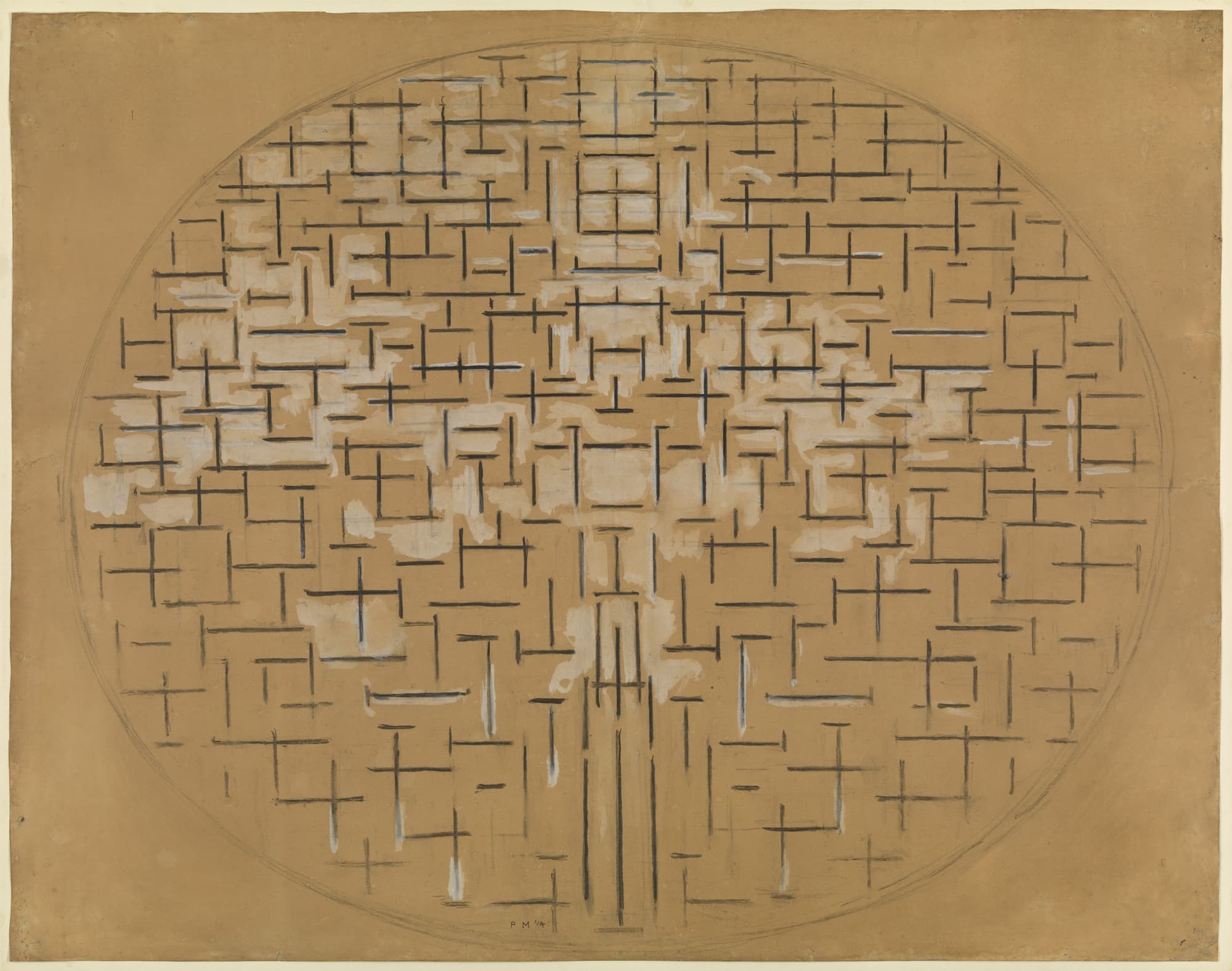
Conclusion: A directly comparable, A‑caliber example to Piet Mondrian’s Pier and Ocean 5 (Sea and Starry Sky), 1915, would be expected to realize approximately $5–7.5 million (all‑in) at auction today. The MoMA drawing itself is not for sale, but it defines the type: a large, canonical ‘sea/plus‑minus’ work on paper from 1914–15—the fulcrum of Mondrian’s move from nature to full abstraction [1].
Method and key comparables: The range is grounded in two hard datapoints for top Mondrian works on paper. First, Galerie Kornfeld’s Ocean 4 (1914) achieved CHF 4,200,000 hammer in September 2024—about USD ~$4.94m at the contemporaneous rate, with the all‑in price higher once buyer’s premium is included [2]. Second, Christie’s Paris sold Study I for Broadway Boogie Woogie (a marquee drawing, different period) for €3,964,000 in April 2026 (price realized, with premium), roughly USD ~$4.68m [3]. Given Pier and Ocean 5’s larger scale, central place in the seminal 1914–15 series, and deep publication/exhibition standing, a premium over these benchmarks is warranted, supporting a $5–7.5m expectation for an equally first‑rate example.
Market temperature check: Mondrian’s blue‑chip demand remains exceptionally deep at the top end. His auction record stands at $51m (Sotheby’s, 1930 Composition No. II, 2022), and a museum‑caliber 1922 canvas realized $47.56m in May 2025, confirming sustained appetite for the artist’s best material even in a selective market [4][5]. These painting results do not set the level for drawings, but they establish the overall confidence and ceiling of demand for Mondrian, which in turn supports five‑to‑seven‑figure outcomes for prime works on paper.
What drives the estimate: Pier and Ocean 5 represents a pivotal phase—Mondrian’s ‘plus‑minus’ language, derived from the sea and pier at Domburg, where short vertical and horizontal strokes become a near‑total abstraction. Its art‑historical significance is outsized; scholarship and teaching surveys consistently foreground this series as the bridge to full Neoplasticism [1]. Within the drawing category, size and graphic clarity matter; the MoMA sheet is notably large, and the series examples are visually decisive. Rarity is acute: many ‘Pier and Ocean’ works reside in institutions, and truly comparable, well‑documented sheets appear infrequently. Provenance and literature/exhibition depth (e.g., early ownership and Valentine Gallery/MoMA histories) can push a work to the top of the range. Condition is crucial for early paper—whiteness, staining, handling edges, and light exposure materially affect results.
Positioning and risks: The $5–7.5m band positions a top ‘sea/plus‑minus’ drawing clearly below Mondrian’s iconic primary‑color oils but near the apex of his works on paper. Upside risks include a fresh‑to‑market, exceptionally preserved, and fully published sheet with museum‑level provenance, which could test or exceed the upper bound. Downside risks would stem from condition compromises, weaker provenance, or thin literature/exhibition histories. On balance, the comparables and market context justify the stated range for an A‑example closely akin to Pier and Ocean 5 [2][3][4][5].
Key Valuation Factors
Art Historical Significance
High ImpactPier and Ocean 5 belongs to Mondrian’s 1914–15 ‘sea/plus‑minus’ corpus, the decisive bridge from Cubist‑inflected nature studies to full abstraction. The compositions convert the visual rhythm of waves and pier into a network of vertical and horizontal marks, laying the groundwork for Neoplasticism. Within the oeuvre, these drawings are disproportionately influential in scholarship, exhibitions, and pedagogy, often cited as the pivot that made the mature grid paintings possible. For serious collectors and institutions, such works carry canonical weight comparable to early milestones by other Modern masters. That centrality supports a premium within Mondrian’s works on paper, especially for large, visually resolved sheets with strong publication and exhibition histories.
Rarity and Supply
High ImpactTruly comparable ‘Pier and Ocean’ drawings are scarce in private hands because many examples are held by major museums. The category trades infrequently at public auction, which heightens competition when a best‑in‑class sheet surfaces. Infrequent supply also shifts price discovery toward the most recent strong comparables—a dynamic illustrated by Kornfeld’s 2024 Ocean 4 hammer and Christie’s Paris 2026 drawing record for a different period. This constrained availability, alongside persistent institutional demand and long‑term private holding periods, amplifies pricing resilience and underpins the $5–7.5 million expectation for an A‑level sheet akin to MoMA’s example.
Medium, Scale, and Aesthetic Quality
High ImpactWithin Mondrian’s drawings, larger, compositionally resolved sheets command clear premiums over studies or smaller sketches. The Pier and Ocean 5 type is large and graphically assertive, with a dense yet legible ‘plus‑minus’ field that collectors recognize as pivotal. Surface quality (paper tone, contrast, crispness of marks) and overall freshness to light greatly affect the perceived power and thus price. When the scale and facture achieve the same authority seen in the MoMA sheet, market response strengthens markedly, supporting a level above $5 million and justifying a bid toward the upper half of the proposed range under ideal conditions.
Provenance, Literature, and Exhibition History
High ImpactBulletproof provenance and deep scholarly visibility are major value drivers for this series. The canonical MoMA drawing traces to the artist, early Dutch ownership, and Valentine Gallery before entering MoMA in 1942, and it has been widely published and exhibited. For a privately held counterpart, a similarly robust chain of ownership and inclusion in key retrospectives and catalogues materially increases confidence and price. Works lacking comprehensive documentation or with gaps in custody can face a discount. Conversely, a fully vetted example with long exhibition history and cataloguing by recognized authorities often trades at a premium and can stretch to the top of the valuation band.
Sale History
Pier and Ocean 5 has never been sold at public auction.
Piet Mondrian's Market
Piet Mondrian is a foundational figure of Modernism and De Stijl, with a market led by the iconic color‑grid oils of the late 1910s–early 1930s. His auction record is $51 million for Composition No. II (1930) at Sotheby’s in 2022, and Christie’s achieved $47.56 million in 2025 for a 1922 canvas—evidence of sustained depth for blue‑chip material. While drawings price below the top oils, best‑in‑class works on paper can achieve mid‑seven figures, as seen in Paris in 2026 with a marquee Broadway Boogie Woogie study. Scarcity is structural—major museums hold many masterpieces—so fresh, museum‑caliber examples attract strong competition and resilient pricing.
Comparable Sales
Ocean 4
Piet Mondrian
Same artist and near-identical 1914–15 'sea/plus-minus' series; work on paper, slightly smaller. Hammer price only; strong like-for-like benchmark.
$4.9M
2024, Galerie Kornfeld, Bern
~$5.1M adjusted
Study I for Broadway Boogie Woogie (recto/verso)
Piet Mondrian
Same artist; top-tier museum-caliber drawing (charcoal); different subject/period but an A-level work on paper showing current ceiling for prime Mondrian drawings.
$4.7M
2026, Christie's Paris
~$4.6M adjusted
Composition with Large Red Plane, Bluish Gray, Yellow, Black and Blue
Piet Mondrian
Blue-chip Neoplastic oil (1922). Not a drawing, but a prime market anchor for top Mondrian demand/price climate in 2025.
$47.6M
2025, Christie's New York
Composition No. II
Piet Mondrian
Artist auction record; canonical 1930 oil. Not medium-matched, but establishes the upper bound of market appetite for Mondrian.
$51.0M
2022, Sotheby's New York
~$55.7M adjusted
Current Market Trends
Modern art remains a pillar of the global auction market, with 2025 seeing a measured rebound and buyers concentrating on historically important, high‑quality works. The Art Basel & UBS 2026 report underscores that blue‑chip material led performance, while mid‑tier works met greater selectivity. For Mondrian, this translates into robust outcomes when A‑level pieces appear, supported by limited supply and enduring institutional demand. Works on paper have benefited from sustained scholarly and exhibition attention, with prime examples nearing or exceeding $5 million. Overall, the category favors rarity, condition, and depth of documentation—factors that align strongly with the best ‘Pier and Ocean’ drawings.
Sources
- The Museum of Modern Art (MoMA), Pier and Ocean 5 (Sea and Starry Sky), 1915
- Galerie Kornfeld, Bern — Piet Mondrian, Ocean 4 (1914), sale result
- Christie’s Press — Paris sale featuring Study I for Broadway Boogie Woogie (2026)
- Sotheby’s — Mondrian, Composition No. II (1930), $51m record (2022)
- Christie’s — Masterworks by Mondrian (1922), price realized $47.56m (2025)
- Art Basel & UBS Global Art Market Report 2026