How Much Is Disputation of the Holy Sacrament (La Disputa) Worth?
Last updated: April 27, 2026
Quick Facts
- Methodology
- extrapolation
La Disputa is an immovable, in‑situ Vatican fresco and therefore not legitimately marketable; any monetary estimate is hypothetical. For a forced auction‑equivalent exercise, extrapolating from top Raphael comparables and Old‑Master record sales yields a working range of approximately USD 200 million to USD 1 billion+.
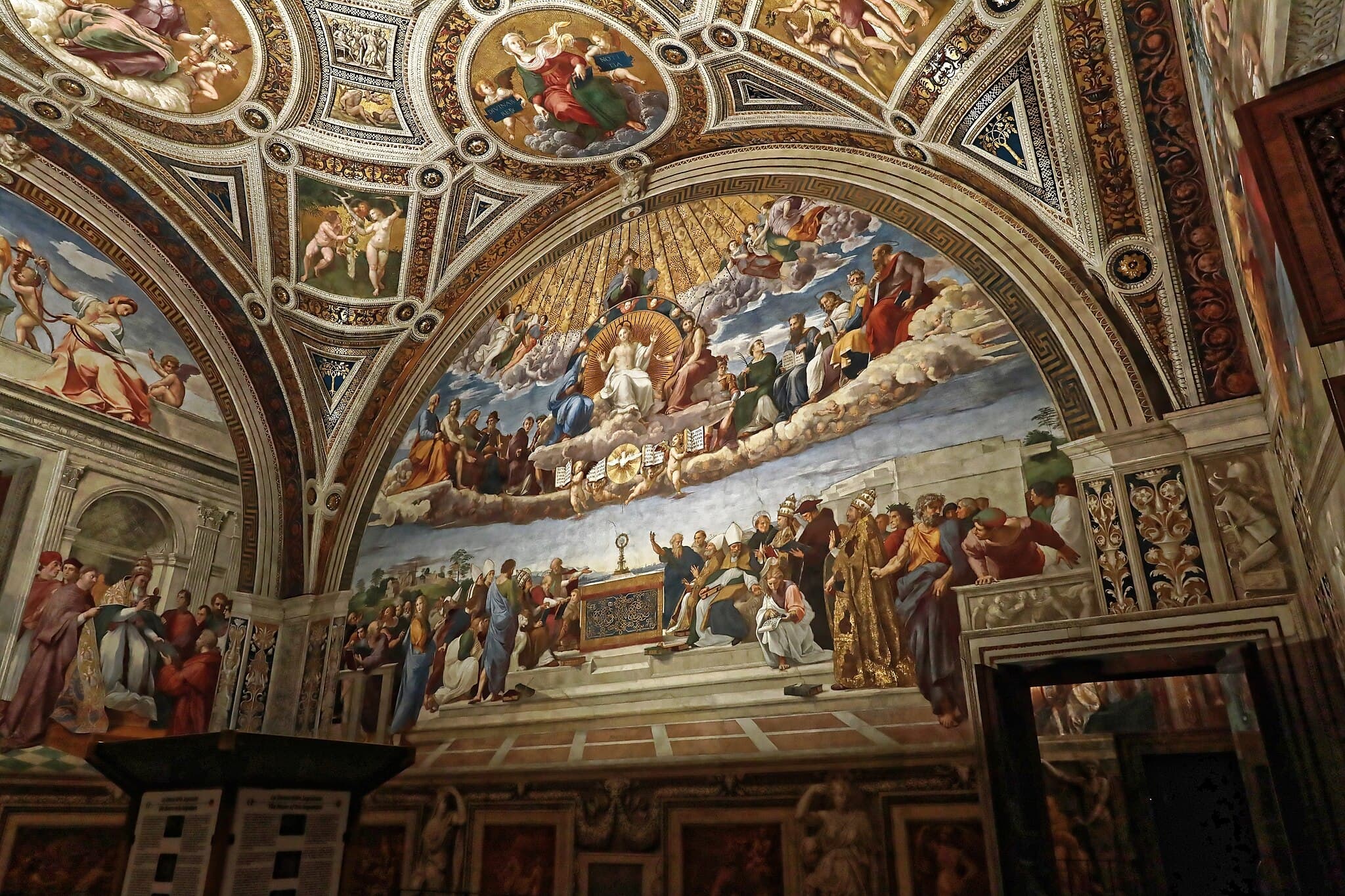
Disputation of the Holy Sacrament (La Disputa)
Raphael • Fresco (Stanza della Segnatura, Vatican)
View more by Raphael →Valuation Analysis
Overview: Raphael’s Disputation of the Holy Sacrament (La Disputa) is an in‑situ fresco in the Stanza della Segnatura, Apostolic Palace (Vatican) and has no sale history or legitimate market pathway [1]. Because the work is physically bound to the architecture and protected under cultural‑heritage regimes, it is effectively unsellable under normal legal and ethical practice. The figure below is therefore a reasoned, hypothetical auction‑equivalent range, not a realizable market price.
Methodology: This estimate is derived by extrapolating from three inputs: (1) market realizations for the rare, securely attributed Raphael drawings and portable paintings that do appear on the open market (high tens of millions), (2) the absolute ceiling set by record Old‑Master sales (most visibly Leonardo’s Salvator Mundi at $450.3M) which demonstrates demand capacity for unique Renaissance masterpieces [2], and (3) a contextual/uniqueness premium applied to an artwork that is central to Western art history. The absence of a tradable object requires applying both an upward premium for rarity/importance and a discount for non‑transferability.
Legal, technical and practical constraints: Fresco is a mural technique physically integrated into the building fabric; coherent removal is destructive, technically risky, and would erode essential historical context. Italian and Vatican cultural‑heritage frameworks treat such works as inalienable, sharply restricting any transfer or export and thereby precluding a legitimate market transaction [3]. These constraints mean there is no market mechanism to discover price; the estimate is a hypothetical construct for comparative, insurance, or institutional planning purposes only.
Comparable signals and premium logic: The best market signals are Raphael drawings and the occasional Raphael easel painting that have realized multi‑tens of millions; these inform the low end of the scale. The mid‑to‑high range draws on the market’s demonstrated willingness to pay extraordinary sums for uniquely important Renaissance works (Leonardo’s Salvator Mundi provides a modern ceiling) [2]. Applying a substantial rarity/importance multiplier to top Raphael comparables yields a plausible hypothetical bracket of roughly USD 200M at the conservative lower bound to USD 1B+ at an extreme upper bound in a scenario that ignores legal and ethical constraints.
Interpretation and recommended next steps: Treat USD 200M–1B+ as a communication of scale — it signals the fresco’s status as effectively priceless and far beyond routine Old‑Master transactions. For any formal institutional needs (insurance, restoration budgeting, internal replacement valuation), pursue: (a) direct consultation with leading Old‑Master specialists at major auction houses for confidential opinion, (b) requests to the Vatican for any internal appraisal or conservation valuations, and (c) a compendium of sale records for Raphael drawings/panels to refine multiplier logic. This will convert a theoretical range into defensible institutional figures.
Key Valuation Factors
Art Historical Significance
High ImpactLa Disputa is one of Raphael’s signature achievements and a central component of the Vatican Stanza della Segnatura cycle. Its theological complexity, compositional innovation and centrality to Raphael’s papal commissions grant it exceptional cultural capital that cannot be approximated by ordinary market comparables. This degree of canonical importance drives a large uniqueness premium in any hypothetical valuation exercise: institutions, scholars and the public recognize the fresco as integral to the narrative of the High Renaissance, and that collective recognition underpins any theoretical auction‑equivalent value. The work’s global visibility and influence amplify demand in a thought experiment where legal/ethical barriers were absent.
Physical Immovability & Technical Constraints
High ImpactAs a fresco executed directly on plastered wall, La Disputa cannot be separated from its architectural substrate without catastrophic alteration. Technical options for transfer (strappo, stacco) are invasive and historically risky; removal would destroy contextual integrity and likely damage the composition. This immovability eliminates the core market attribute—transportability—and severely restricts tradability. In valuation terms this both reduces the reliability of any price discovery mechanism and forces reliance on indirect comparables plus a contextual premium. Practically, immovability makes the work unsuitable for sale, exhibition loans are technically possible but limited, and insurability is handled via specialized institutional regimes, not open‑market instruments.
Legal & Cultural Heritage Protections
High ImpactLa Disputa is protected by Vatican and Italian cultural‑heritage law which treat major monuments and museum holdings as inalienable cultural property. These regimes impose strict controls on export, deaccession and commercial transfer; the legal barriers make lawful sale effectively impossible. Beyond statute, institutional norms and international cultural‑property protocols (and the Vatican’s custodial mission) create powerful non‑market constraints. For valuation this means the hypothetical price cannot be realized legitimately; legal protection therefore both preserves public value and precludes use of market transactions to verify or refine price estimates.
Market Comparables & Rarity Premium
High ImpactThe most relevant market signals are prices for securely attributed Raphael drawings and rare easel paintings that have nonetheless traded: these commonly achieve high tens of millions when attribution and condition are secure. At the top end, Leonardo’s Salvator Mundi ($450.3M) demonstrates the ceiling for uniquely important Renaissance works. Because La Disputa is both more publicly and historically consequential than most portable Raphael works, applying a substantial rarity and historic‑importance premium to the best Raphael comparables is the principal mechanic used to derive the hypothetical USD 200M–1B+ bracket.
Condition, Provenance & Conservation Record
Medium ImpactAlthough La Disputa benefits from continuous institutional conservation oversight, any hypothetical valuation should account for condition and restoration history. Persistent environmental factors (humidity, visitor traffic) and past treatments can affect perceived integrity; however, institutional stewardship at the Vatican is strong and provenance is unequivocal. In a market context, condition and clarity of provenance materially influence buyer confidence; for La Disputa these factors support a high value, but they do not overcome immovability and legal constraints. Detailed conservation reports would be necessary for an insurance/replacement estimate.
Sale History
Disputation of the Holy Sacrament (La Disputa) has never been sold at public auction.
Raphael's Market
Raphael occupies a supremely high standing in the Old‑Master market: autograph paintings are exceedingly rare and most major works are museum‑held, producing an illiquid but high‑value market where the most secure Raphael drawings and occasional panels sell for tens of millions. Public auction records for Raphael are concentrated in works on paper and a handful of portable paintings; prices vary sharply with attribution certainty and condition. Because canonical Raphaels seldom appear for sale, the market is driven by episodic, high‑stakes offerings and institutional demand rather than steady transactional flow.
Comparable Sales
Head of a Young Apostle
Raphael
Top public auction result for Raphael (drawing); indicates the market ceiling for securely attributed, museum‑quality Raphael sheets.
$47.8M
2012, Sotheby's London
~$66.6M adjusted
Head of a Muse
Raphael
Major Raphael drawing sale (2009); another high‑water mark for Raphael on paper and useful for rarity/attribution premium comparisons.
$48.0M
2009, Christie's London
~$71.6M adjusted
Portrait of Lorenzo de' Medici
Raphael
Notable easel‑painting sale by Raphael (2007); a painting‑level comparable (though smaller and transportable, unlike an in‑situ fresco).
$37.3M
2007, Christie's London
~$57.5M adjusted
Salvator Mundi (The Saviour of the World)
Leonardo da Vinci
Record Old‑Master auction (global market ceiling). Not a direct technical/artistic comparable, but defines the extreme top end of what buyers have paid for a uniquely important Renaissance easel painting.
$450.3M
2017, Christie's New York
~$587.5M adjusted
Mary Magdalene in Prayer (small panel)
Raphael (attributed/early panel)
Recent small Raphael panel sale (2025) — shows contemporary price levels for painting‑scale Raphael works on the market today.
$3.1M
2025, Sotheby's New York
Current Market Trends
Current Old‑Master market conditions favor quality over volume: after a softer general market period, collectors and institutions still compete aggressively for best‑of‑class Renaissance drawings and rare paintings. Attribution certainty, exhibition provenance and technical scholarship are major price drivers. Overall liquidity remains low and top lots attract concentrated interest from a small pool of deep‑pocket buyers.