How Much Is Prophet Isaiah (Sant’Agostino) Worth?
Last updated: April 27, 2026
Quick Facts
- Methodology
- comparable analysis
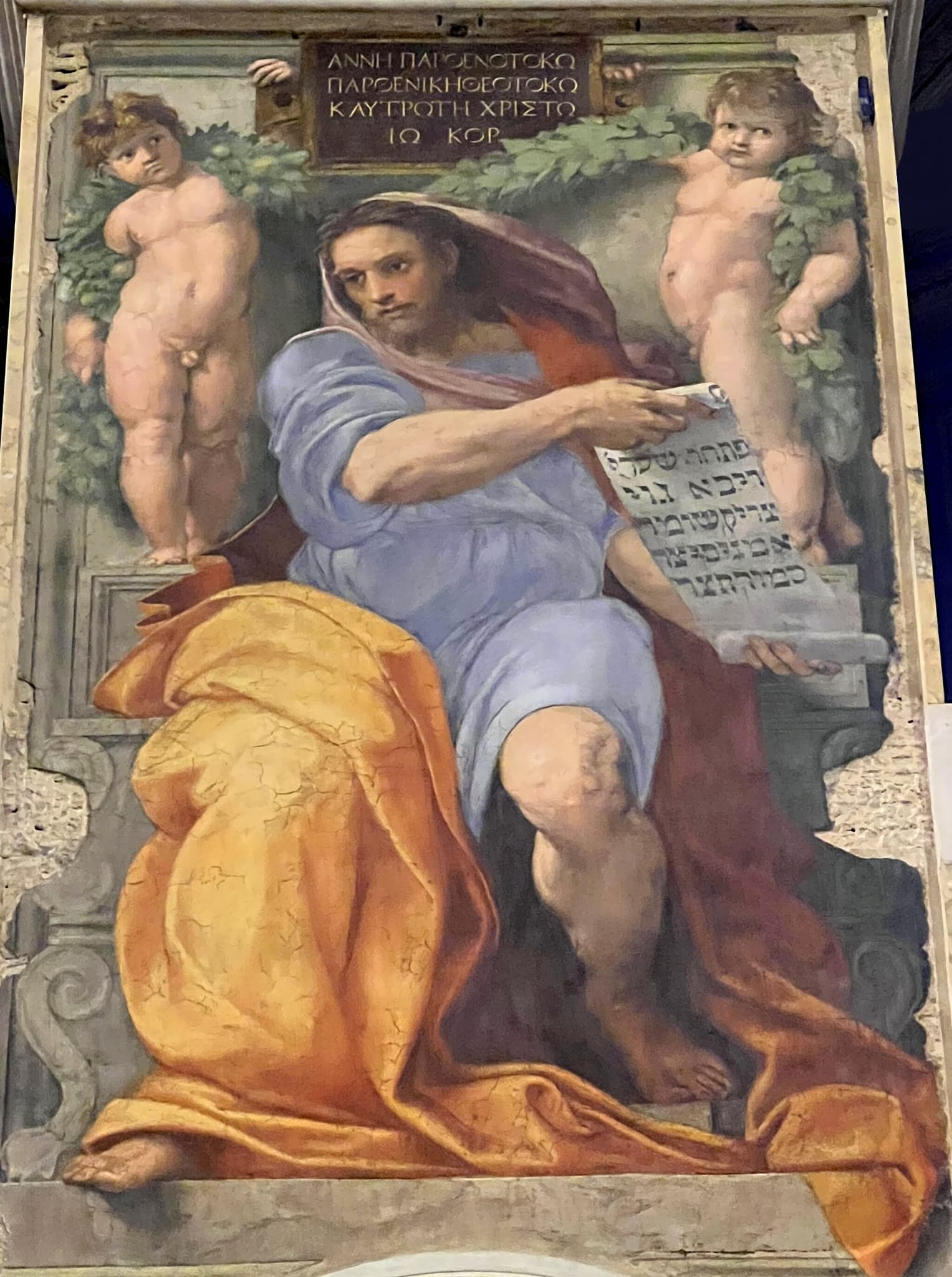
Prophet Isaiah (Sant’Agostino) is a major, autograph Roman-period fresco by Raphael, executed in situ c.1511–1512 and closely tied to his dialogue with Michelangelo. Although legally immovable and not market-tradable, its hypothetical fair‑market equivalent is estimated at $320–520 million, reflecting extreme rarity, art‑historical importance, and the current ceiling for Renaissance masterworks.
Valuation Analysis
Work and context. Raphael’s Prophet Isaiah at the Basilica di Sant’Agostino in Rome (c.1511–1512) is an autograph, Roman‑period fresco painted in situ on a nave pier. It stands as a key articulation of Raphael’s early Roman style and a deliberate exchange with Michelangelo’s Sistine Chapel prophets, making it a touchstone within the artist’s mature oeuvre [1].
Legal and practical status. The fresco is a fixed element of an active church in Italy and is protected under the Italian Cultural Heritage Code. For all practical purposes, it is inalienable and non‑exportable; there is no open‑market pathway for this work. Accordingly, the valuation presented here is a hypothetical fair‑market equivalent (i.e., what the work would command if legally transferable, portable, and in strong condition) rather than a realizable sale estimate for a transaction in today’s market [2].
Market anchors and scarcity premium. Raphael’s top auction results are for drawings, with a prime head study achieving about $47.8 million in 2012—an apex signal for the artist’s work on paper and an index of demand for secure, masterpiece‑level material [3]. At the painting tier for Renaissance icons, the market’s upper bound was reset by Leonardo’s Salvator Mundi at $450.3 million (2017) [4], while Botticelli’s portrait reached $92.2 million in 2021, demonstrating robust appetite for canonical High Renaissance trophies with unimpeachable attribution [5].
Medium, risk and discount. As a fresco, Isaiah entails unique conservation and portability risks. Detachment or transfer from a structural support introduces high technical, condition, and aesthetic uncertainty. Even in a purely hypothetical framework, these risks warrant a significant discount relative to a panel or canvas painting of comparable stature. However, the work’s autograph status, scale, and centrality to Raphael’s Roman period offset this with a powerful scarcity premium: there are effectively no directly comparable, tradeable Raphaels of similar importance.
Conclusion and range. Triangulating between (i) apex Raphael drawings (~$48m), (ii) the demonstrated trophy band for Renaissance icons (Botticelli at ~$92m; Leonardo at $450m+), and (iii) a material/portability discount for a fresco offset by extreme rarity and museum‑level significance, the hypothetical fair‑market equivalent for Prophet Isaiah is $320–520 million. This positions the work well above drawing benchmarks, below Leonardo’s singular peak, and consistent with what an accepted, major Raphael of this caliber could command in a perfect‑scenario sale—recognizing that, in practice, the fresco is a protected cultural monument and not a market asset [3][4][5].
Key Valuation Factors
Art Historical Significance
High ImpactProphet Isaiah is a flagship work of Raphael’s early Roman period, created contemporaneously with his dialogue with Michelangelo’s Sistine prophets. Its commanding scale, sculptural modeling, and integration into a key Roman ecclesiastical setting place it among the most discussed fresco figures outside the Vatican. As an autograph work tied to a pivotal stylistic moment, it functions as a benchmark for Raphael’s mature language and for the High Renaissance ideal more broadly. This level of art-historical centrality commands a substantial premium over even exceptional drawings or secondary paintings, anchoring the work firmly in the uppermost tier of Old Master valuations.
Rarity and Market Scarcity
High ImpactFirst‑rate, autograph Raphaels are extraordinarily scarce in private circulation; most are in museums or protected ecclesiastical settings. No comparable in‑situ Raphael fresco has ever transacted on the open market, and autograph paintings rarely appear at auction. This scarcity produces a profound supply‑demand imbalance: when masterpiece‑level Raphaels do surface (typically drawings), prices have reached tens of millions of dollars. A major, securely attributed, public‑scale work by Raphael implies a multi‑hundreds‑of‑millions scarcity premium in a hypothetical sale, particularly in a post‑2017 market that has validated unprecedented prices for canonical Renaissance masterworks.
Legal and Physical Constraints (Immovability/Fresco Medium)
High ImpactThe fresco is immovable and protected under Italy’s cultural heritage regime, rendering it effectively inalienable and non‑exportable. Even in a counterfactual scenario, detachment and transfer of a fresco carry exceptional conservation risk, structural complexity, and potential loss of original surface integrity. These factors impose a meaningful discount relative to panel or canvas works of similar stature. The final range reflects this constraint: while the work’s importance argues for a value in the top tranche of Renaissance art, the medium and legal status prevent full parity with the most market‑optimized masterpieces.
Demand Benchmarks and Trophy Dynamics
Medium ImpactRenaissance trophy pricing has been emphatically redefined in recent years, with Leonardo’s Salvator Mundi establishing a global ceiling and Botticelli’s portrait confirming nine‑figure demand for canonical names. Raphael’s prime drawings have achieved nearly $50 million, signaling deep, international competition for apex material with secure attribution and museum‑level relevance. In a hypothetical sale of a major Raphael painting or fresco, multiple institutional‑scale and UHNW buyers could be expected to participate, driving competitive pricing. This dynamic supports a mid‑hundreds‑of‑millions outcome even after applying prudent discounts for medium and portability.
Sale History
Prophet Isaiah (Sant’Agostino) has never been sold at public auction.
Raphael's Market
Raphael (Raffaello Sanzio, 1483–1520) is among the most coveted Old Masters, with supply that is extraordinarily thin. Autograph paintings are largely in museums or protected ecclesiastical settings and almost never appear at public auction. The artist’s auction records are led by drawings at roughly $48 million, underscoring intense global demand for masterpiece‑level works on paper with secure attribution and links to major commissions. Since 2017, top‑end pricing for pre‑20th‑century icons has expanded significantly, raising the theoretical ceiling for a prime Raphael painting or fresco. In practice, market activity centers on drawings and high‑quality workshop pieces, while truly museum‑grade, autograph works remain largely out of trade, reinforcing scarcity premiums.
Comparable Sales
Head of a Young Apostle (drawing)
Raphael
Artist’s auction record; a top‑tier autograph study linked to a major commission. Establishes the high end of demand for prime Raphael works-on-paper, useful to benchmark scarcity/value for a major Roman-period fresco figure.
$47.8M
2012, Sotheby's London
~$67.0M adjusted
Head of a Muse (drawing)
Raphael
Record-level Raphael drawing tied to the Stanze. Confirms sustained willingness to pay c.$70m (2025 dollars) for apex sheets, framing a floor for what a museum-grade, securely attributed Raphael can command.
$47.9M
2009, Christie's London
~$72.0M adjusted
Portrait of Lorenzo de’ Medici, Duke of Urbino (painting)
Raphael
One of the last major Raphael paintings sold at auction. Although pre-2017 ‘trophy reset,’ it provides a painting benchmark to triangulate value above the drawing market for a prime autograph work.
$37.3M
2007, Christie's London
~$57.9M adjusted
Salvator Mundi (painting)
Leonardo da Vinci
Ceiling-setter for a universally recognized Renaissance masterpiece. While a different artist/medium, it anchors the upper bound for blue‑chip High Renaissance works and informs a hypothetical ceiling for a museum‑level Raphael.
$450.3M
2017, Christie's New York
~$592.0M adjusted
Portrait of a Young Man Holding a Roundel (painting)
Sandro Botticelli
Top Old Master painting result of the 2020s (pre-2025). Demonstrates current trophy pricing for a canonical Renaissance masterwork with strong attribution—useful mid‑range anchor below Leonardo and above most drawings.
$92.2M
2021, Sotheby's New York
~$110.0M adjusted
Study for the Libyan Sibyl (drawing)
Michelangelo
Record Michelangelo drawing tied directly to the Sistine ceiling prophets/sibyls that informed Raphael’s Isaiah. A very tight subject/context comp for best‑in‑class High Renaissance preparatory material.
$27.2M
2026, Christie's New York
~$26.5M adjusted
Current Market Trends
The Old Masters segment has stabilized and, at the top end, re‑accelerated following the post‑2017 recalibration of trophy pricing. Buyers display a pronounced flight to quality: secure attributions, museum‑level provenance, and works tied to canonical projects command substantial premiums, while secondary or debated material is price‑sensitive. Recent nine‑figure results for Renaissance masters and strong records for blue‑chip drawings indicate deep demand for best‑in‑class lots despite episodic supply. Against this backdrop, a major, autograph Raphael—were it hypothetically transferable—would be positioned for competitive bidding in the mid‑hundreds of millions, moderated by medium‑specific risks and portability constraints.
Sources
- Basilica di Sant’Agostino, Rome – Il Profeta Isaia
- Italy’s Code of Cultural and Landscape Heritage (Legislative Decree 42/2004)
- Bloomberg – Raphael drawing ‘Head of a Young Apostle’ sells for £29.7m (2012)
- Wikipedia – Leonardo da Vinci, Salvator Mundi auction result (2017)
- Sotheby’s – Botticelli, Portrait of a Young Man Holding a Roundel reaches $92.2m (2021)