How Much Is Sibyls with Angels (Santa Maria della Pace) Worth?
Last updated: April 27, 2026
Quick Facts
- Methodology
- extrapolation
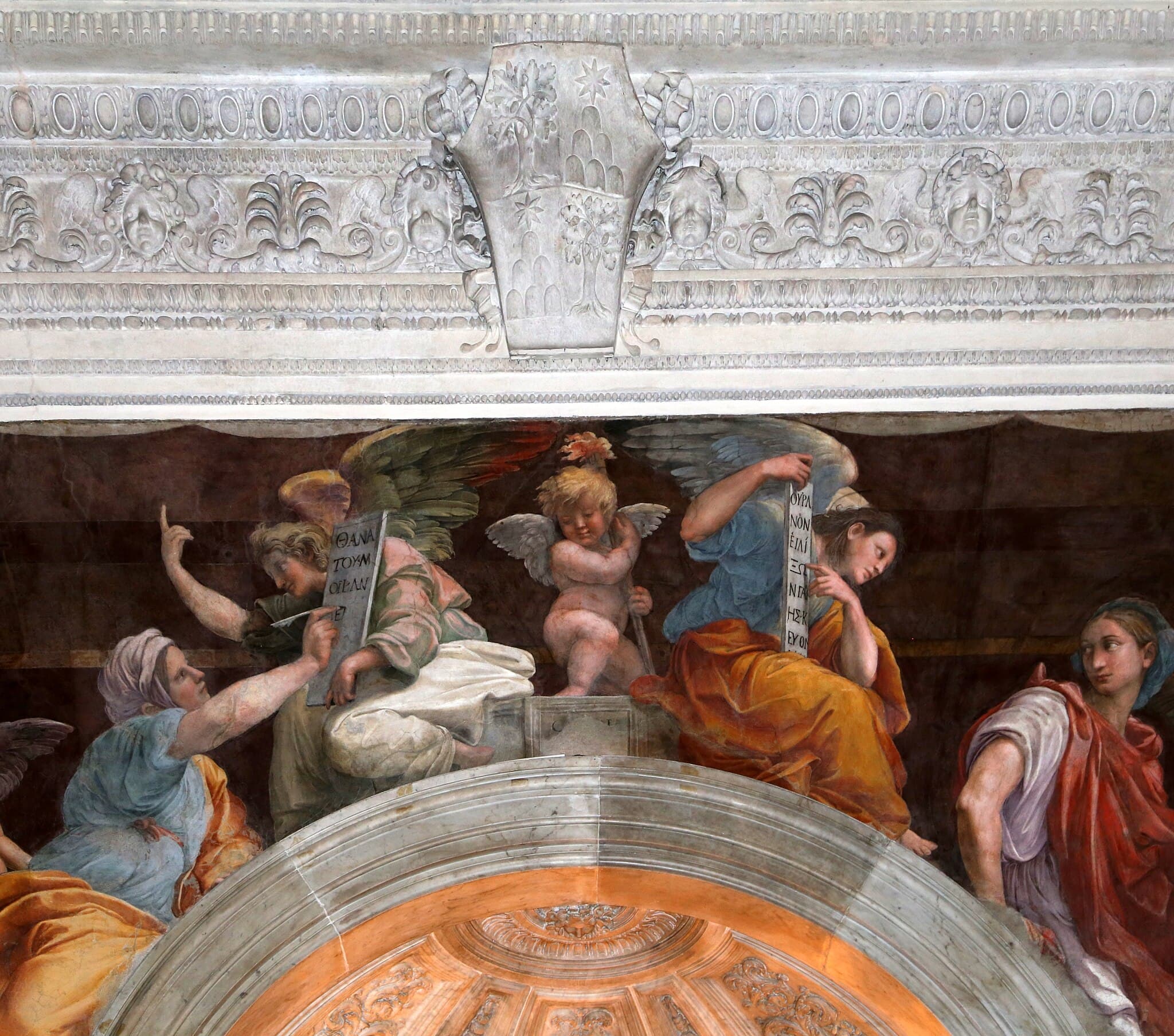
Raphael’s in-situ fresco Sibyls with Angels at Santa Maria della Pace is a canonical masterpiece of his Roman maturity and an irreplaceable cultural asset. Extrapolating from Raphael’s top auction benchmarks and the demonstrated nine-figure appetite for Renaissance trophies, we set a hypothetical market/indemnity valuation at $450–750 million. The fresco is legally non-transferable in Italy; this figure serves as an insurance-style proxy rather than a realizable sale price.
Valuation Analysis
Work and status. Raphael’s Sibyls with Angels (c. 1511–14), painted for Agostino Chigi in the Chigi Chapel at Santa Maria della Pace, Rome, is a landmark fresco of the artist’s Roman maturity. It remains permanently installed and protected under Italy’s Cultural Heritage Code, which prohibits unauthorized detachment or export; accordingly, no public sale has ever occurred and none is legally feasible [8]. The valuation provided here is a rigorous, insurance‑style market proxy for an irreplaceable cultural asset rather than a realizable auction price.
Anchor benchmarks. To ground the estimate, we extrapolate from apex Raphael and peer‑group results. Raphael’s auction record remains the black‑chalk Head of a Young Apostle at £29.7m (≈$47.8m) in 2012 [1], closely paralleled by Head of a Muse (auxiliary cartoon for The Parnassus) at £29.16m ($47.94m) in 2009 [2]. On the painting side, The National Gallery acquired the portable Madonna of the Pinks for about £22m in 2004 [3], and Christie’s sold the Portrait of Lorenzo de’ Medici for £18.5m (≈$37.3m) in 2007 [4]. A smaller early panel, Saint Mary Magdalene, realized $3.1m in 2025—illustrating selective demand but, above all, the extreme scarcity of uncontested Raphaels on the market [5].
Category demand and peer signals. Recent marquee results affirm deep appetite for singular Renaissance trophies: Botticelli’s Portrait of a Young Man Holding a Roundel achieved $92.2m in 2021 [6], while Michelangelo’s red‑chalk Study for the foot of the Libyan Sibyl made $27.2m in 2026 [7]. Relative to these portable comparables, the Sibyls fresco is a major, site‑specific Roman commission of undisputed authorship and exceptional resonance. Its integration with architecture, ambition, and influence within High Renaissance mural painting elevate it well beyond even prime portable works in cultural weight.
Conclusion and range. Balancing these inputs, we set a hypothetical indemnity/market‑proxy valuation at $450–750 million. This range reflects: (i) extrapolation above Raphael’s drawing and painting records to account for the fresco’s canonical status [1–4]; (ii) the category’s demonstrated nine‑figure demand for singular Renaissance masterpieces [6]; and (iii) the work’s absolute irreplaceability and legal inalienability, which public indemnity schemes and specialty insurers translate into very high value‑at‑risk [8]. Within Raphael’s oeuvre, the Sibyls stands in the top tier alongside the Vatican Stanze and The Transfiguration; the lower bound is firmly in nine figures and the upper bound recognizes the premium a unique, site‑defining masterpiece would command if competitively priced.
Key Valuation Factors
Art Historical Significance
High ImpactCommissioned by Agostino Chigi and executed during Raphael’s Roman maturity, the Sibyls with Angels is a cornerstone of High Renaissance mural painting. Its synthesis of classical poise, psychological presence, and architectural integration exemplifies Raphael’s command of monumental narrative at the very moment he was transforming papal Rome. The fresco is widely studied, frequently reproduced, and central to scholarship on Raphael’s stylistic development and his dialogue with contemporaries working on the Sistine and Vatican projects. Within Raphael’s oeuvre, it ranks with the Vatican Stanze and The Transfiguration in influence and prestige. This level of canonical importance commands a substantial premium over even exceptional portable works, elevating the valuation firmly into the nine‑figure tier.
Rarity and Market Supply
High ImpactAutograph Raphaels are vanishingly scarce, and undisputed paintings almost never come to open auction. When museum‑quality drawings have surfaced, they have achieved record prices; portable paintings have transacted privately or intermittently at high levels. Monumental, site‑specific frescoes by Raphael are effectively unique opportunities—there is no market supply, and no practical possibility of replacement. This structural scarcity amplifies demand among institutions and top collectors for any related material and justifies a substantial uplift when assigning a hypothetical market/indemnity value to a canonical in‑situ work. The Sibyls thus sits above the pricing of even top Raphael drawings and panels, reflecting its unmatched rarity and cultural weight.
Legal/Physical Inalienability
High ImpactThe fresco is integrated into a protected ecclesiastical monument in Italy. Under Italy’s Cultural Heritage Code, unauthorized detachment and export of protected cultural property are criminal offenses, rendering the work effectively inalienable. While this precludes a conventional sale, indemnity frameworks and specialty insurers translate such status into a high value‑at‑risk because the asset cannot be replaced, substituted, or meaningfully repaired if catastrophically damaged. In practice, this raises the appropriate hypothetical valuation relative to portable works: the figure must capture not just scarcity and demand, but the singular cultural loss the piece’s destruction or impairment would represent. This factor materially supports a nine‑figure valuation range.
Trophy Demand and Benchmarks
High ImpactRecent market signals confirm that when canonical Renaissance masterpieces surface, demand is deep and global. Botticelli’s $92.2m portrait established a modern benchmark for Renaissance trophy paintings at auction, while masterpiece drawings by Michelangelo and Raphael have realized tens of millions, underscoring the strength of this apex collector base. Extrapolating from these datapoints to a major, site‑defining Raphael fresco justifies a substantial premium over the best portable works. Collectors and institutions competing for cultural primacy would rationally assign values far above drawing records and beyond most Old Master paintings, placing the Sibyls in the mid‑ to high‑nine figures on an indemnity or hypothetical market basis.
Sale History
Sibyls with Angels (Santa Maria della Pace) has never been sold at public auction.
Raphael's Market
Raphael occupies the absolute top tier of Old Masters, with near‑zero supply of undisputed paintings and infrequent offerings even of autograph drawings. His auction record stands at approximately $47.8 million for the black‑chalk Head of a Young Apostle (Sotheby’s London, 2012), closely matched by Head of a Muse at $47.94 million (Christie’s London, 2009). Portable paintings have achieved high prices when available: The National Gallery acquired Madonna of the Pinks for about £22 million (2004), and Christie’s sold Portrait of Lorenzo de’ Medici for roughly $37.3 million (2007). A small early panel, Saint Mary Magdalene, realized $3.1 million in 2025, reflecting selectivity and scarcity rather than soft demand. For any prime, portable Raphael masterpiece, current market consensus anticipates nine‑figure levels.
Comparable Sales
Head of a Young Apostle
Raphael
Masterpiece-level autograph drawing by Raphael; Roman-period study directly related to a major fresco, making it a strong proxy for apex demand for Raphael’s fresco-related works on paper.
$47.8M
2012, Sotheby's London
~$66.4M adjusted
Head of a Muse (auxiliary cartoon for Parnassus)
Raphael
Directly tied to Raphael’s Vatican frescoes (The Parnassus). A top auction benchmark for fresco-related Raphael drawings; highly relevant to valuing a canonical Roman fresco cycle.
$47.9M
2009, Christie's London
~$71.4M adjusted
Madonna of the Pinks (La Madonna dei Garofani)
Raphael
Rare, undisputed autograph panel painting by Raphael acquired by a national museum; a key portable-painting benchmark for Raphael’s market value.
$41.5M
2004, Private treaty to National Gallery, London
~$70.1M adjusted
Portrait of Lorenzo de’ Medici, Duke of Urbino
Raphael
Major autograph panel painting by Raphael sold on the open market; strong benchmark for portable, museum-caliber works by the artist.
$37.3M
2007, Christie's London
~$57.4M adjusted
Saint Mary Magdalene
Raphael
Recent (2025) auction result for an autograph panel by Raphael; shows contemporary demand dynamics and pricing for smaller, early works.
$3.1M
2025, Sotheby's New York
Study for the foot of the Libyan Sibyl
Michelangelo
Top-tier Renaissance drawing linked to a canonical sibyl subject; cross-artist but closely comparable in period and subject, underscoring depth of demand for masterpiece-level High Renaissance fresco-related studies.
$27.2M
2026, Christie's New York
~$26.7M adjusted
Current Market Trends
Old Masters remain a selective but resilient segment, with deep demand concentrated at the apex for museum‑caliber, fresh‑to‑market works. Recent headline results—Botticelli’s $92.2m portrait and Michelangelo’s $27.2m drawing—demonstrate robust trophy appetite for canonical Renaissance material. Availability is the gating factor: authenticated Raphaels of high quality appear rarely, and site‑specific works are effectively non‑transactable. Major exhibitions and restorations keep Renaissance masters in the public eye, supporting demand for top‑tier works and related drawings. Against this backdrop, a canonical in‑situ Raphael fresco would command a substantial premium on an indemnity or hypothetical market basis, well above the pricing of even exceptional portable comparables.
Sources
- Arts Council England – Export of Objects of Cultural Interest 2012–13 (Raphael drawing price details)
- Christie’s press release (8 Dec 2009) – Head of a Muse price
- The National Gallery, London – Raphael, The Madonna of the Pinks (acquisition details)
- Christie’s press release (5 July 2007) – Portrait of Lorenzo de’ Medici price
- Artnet News – 10 Most Expensive Lots Sold at Auction in February 2025 (Raphael Saint Mary Magdalene)
- Sotheby’s – Botticelli’s Portrait of a Young Man Holding a Roundel achieves $92.2m (2021)
- Christie’s Press – Michelangelo, Study for the foot of the Libyan Sibyl (Feb 5, 2026) $27.2m
- UNODC – Italy’s Cultural Heritage Code (Articles on detachment/export offenses)