How Much Is Sistine Madonna Worth?
Last updated: April 27, 2026
Quick Facts
- Methodology
- extrapolation
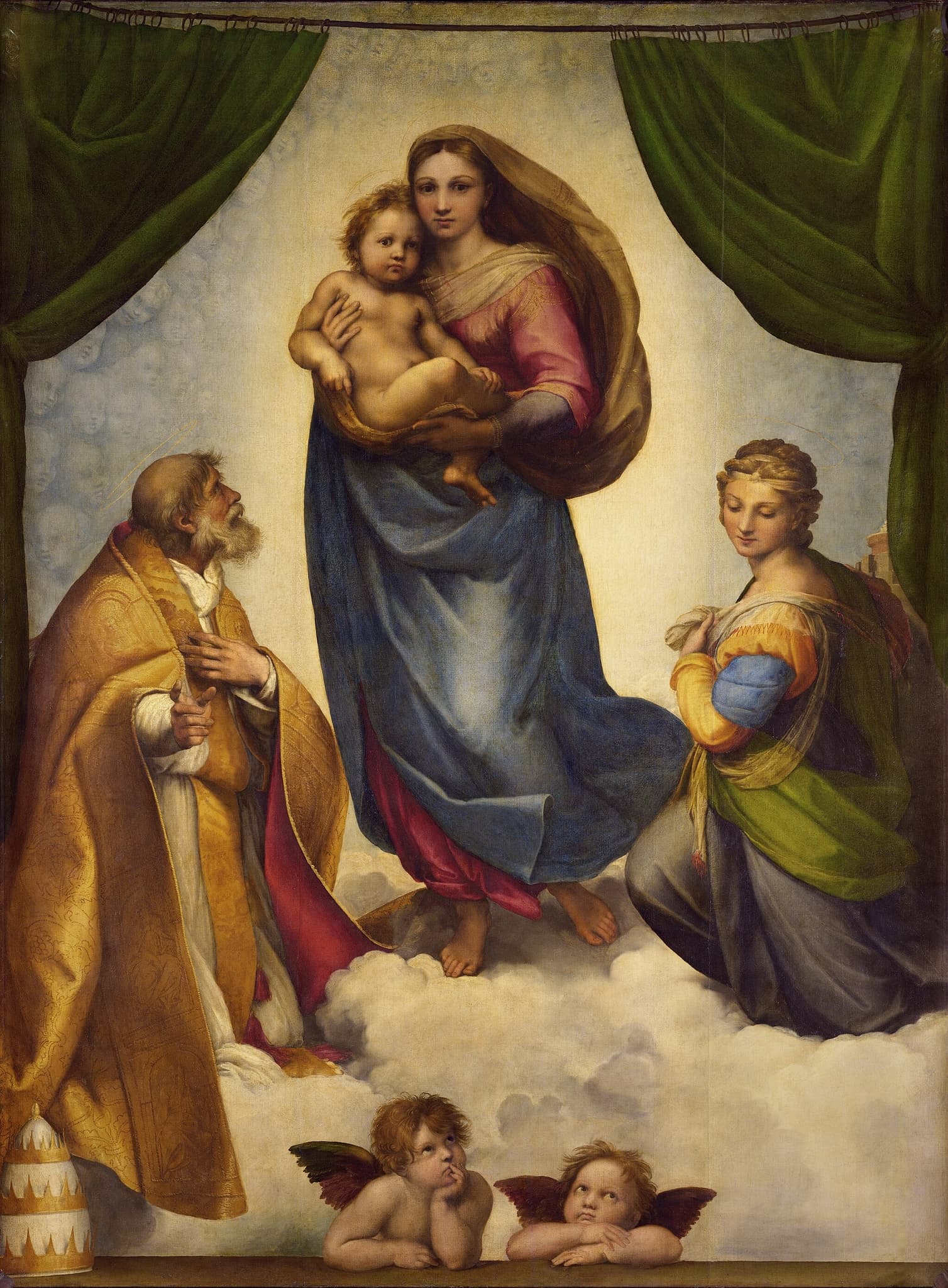
Hypothetically salable, Raphael’s Sistine Madonna would command an estimated market range of approximately $300 million to $1.2 billion. This extrapolation draws on extreme‑tier comparables (e.g., Leonardo’s Salvator Mundi), Raphael auction precedents for drawings, and the painting’s unique art‑historical status — while acknowledging that museum ownership and cultural‑heritage law make any real sale effectively impossible.
Valuation Analysis
Valuation conclusion: Were the "Sistine Madonna" to be placed on the open market — a hypothetical made highly unlikely by current ownership, legal protections and public policy — a reasoned extrapolation places its value at approximately $300,000,000 to $1,200,000,000. The painting is the centerpiece of the Gemäldegalerie Alte Meister in Dresden and has no modern auction sale history; therefore this figure is a theoretical market price rather than an observed transaction [1].
Comparative anchors: The market ceiling for a single Renaissance masterpiece was demonstrated by Leonardo’s "Salvator Mundi" (Christie’s, 2017, $450,312,500), showing that canonical Old Master works can move into the mid‑hundreds of millions in highly publicized, competitive sales [2]. For Raphael specifically the best public benchmark is a 2012 Sotheby’s sale of a Raphael drawing (~$47.8M), which confirms strong collector demand for autograph Raphael material despite the rarity of studio paintings at auction [3]. These datapoints create a band in which a top Raphael altarpiece logically sits well above routine Old Masters lots but below (or potentially above, under extreme circumstances) the unique Leonardo ceiling.
Rarity, provenance and marketability: The Sistine Madonna’s provenance (commissioned for San Sisto; acquired into the Saxon collection mid‑18th century; long public museum custody) is impeccable and supports a premium valuation, but state/museum ownership, export controls and intense public sentiment make practical saleability extremely constrained [1]. The constrained buyer universe (primarily national institutions, sovereign collectors, or extraordinary private buyers) both elevates theoretical value and narrows liquidity: only exceptional political will, indemnity structures or sovereign transactions could effect a sale.
Condition and documentation sensitivity: Museum‑grade conservation, full technical documentation, and transparent condition reporting are prerequisites to realizing the top of the range; absent those disclosures, any formal appraisal must carry additional downward risk. The Gemäldegalerie has maintained and conserved the work, but no publicly available, recent replacement/insurance valuation has been released. Significant restoration history or structural issues would materially depress a hypothetical price, while pristine technical documentation would support the high end.
Range logic and refinement steps: The lower bound (~$300M) reflects a conservative trophy‑level estimate that recognizes importance but anticipates constrained buyer competition and legal friction; the upper bound (~$1.2B) models a trophy sale scenario with multiple motivated buyers (sovereign/institutional or ultra‑high‑net‑worth) and exceptional publicity/negotiation conditions. To refine this estimate further would require the museum’s replacement/insurance valuation, access to detailed conservation and technical reports, and confidential market feedback from Old Master specialists at leading auction houses.
Key Valuation Factors
Art Historical Significance
High ImpactThe Sistine Madonna is one of Raphael’s most iconic and influential easel pictures: a canonical High Renaissance altarpiece widely reproduced, studied and exhibited. Its compositional importance, historical place in Raphael’s output and global cultural recognition create demand that is largely non‑fungible — collectors and institutions prize authenticity and attribution above many commercial considerations. This level of significance elevates theoretical market value because buyers pay heavily for irreplaceable masterpieces, but it also creates political resistance to sale; the same cultural weight that increases theoretical price simultaneously reduces liquidity and broad marketability.
Provenance & Ownership
High ImpactProvenance is exemplary: painted for San Sisto and acquired for the Saxon collection in the mid‑18th century, the work has long belonged to a major public collection. That provenance minimises authenticity risk and supports the highest possible valuation in a hypothetical market scenario. Conversely, public/state ownership imposes legal and political constraints (export licensing, cultural patrimony rules, parliamentary oversight) that make actual sale extremely difficult. The net effect is high — excellent provenance increases theoretical price but state custodianship materially constrains conversion to cash.
Rarity & Marketability
High ImpactAutograph Raphael altarpieces almost never reach the secondary market; supply is effectively zero. This scarcity amplifies theoretical value because the few potential buyers who could contemplate purchase face intense competition for similarly rare works. At the same time, the tiny buyer universe (national museums, sovereign collectors, very few private patrons) means that realizable price is highly scenario‑dependent: institutional acquisitions are conservative and politically sensitive, while private trophy purchases — if they occur — can push prices above public auction ceilings.
Condition & Conservation
Medium ImpactCondition is a pivotal valuation input for any Old Master. The Gemäldegalerie maintains the painting and has undertaken conservation and wartime measures; nevertheless, detailed recent condition and technical reports are not publicly published. Heavy past restorations, structural weakness or unstable supports would reduce market value materially; conversely, pristine condition with thorough technical provenance and conservation documentation would support the top of the hypothesised range. Access to the conservation dossier is therefore essential for any firm appraisal.
Comparable Sales & Market Precedents
High ImpactComparable evidence is limited but instructive: Leonardo’s Salvator Mundi (Christie’s, 2017, $450.3M) demonstrates a public market ceiling for singular Renaissance works; Raphael’s highest auction showing is a 2012 drawing (~$47.8M), which signals high demand for autograph Raphael material when it appears. Other high‑quality Old Master sales in the tens of millions provide secondary context. Because direct painting comparables for a Raphael altarpiece are absent, extrapolation from these precedents is necessary and introduces model uncertainty at the high end.
Sale History
Sistine Madonna has never been sold at public auction.
Raphael's Market
Raphael is among the canonical High Renaissance masters; his major autograph paintings are predominantly museum‑held and rarely, if ever, appear at auction. Price discovery for Raphael therefore relies on episodic, high‑profile sales of drawings and rare studio works, alongside broader Old Masters and Renaissance trophy sales. This scarcity and cultural prestige mean that when Raphael material does reach the market it commands premium pricing, but the lack of frequent comparable painting sales increases uncertainty around exact dollar figures for a work of the Sistine Madonna’s magnitude.
Comparable Sales
Salvator Mundi
Leonardo da Vinci
Top‑end market ceiling for a single Renaissance masterpiece; demonstrates what an ultra‑rare, canonical Old Master can fetch at auction.
$450.3M
2017, Christie's New York
~$562.9M adjusted
Head of a Young Apostle (black‑chalk study for the Transfiguration)
Raphael
Direct artist precedent — record public sale for a Raphael work (drawing). Shows collector/institutional willingness to pay high multiples for Raphael provenance and rarity, though this is a drawing (not an altarpiece).
$47.8M
2012, Sotheby's London
~$64.5M adjusted
The Man of Sorrows
Sandro Botticelli
Comparable period (Italian Renaissance) and religious subject; recent high‑value sale showing strong demand for museum‑quality Renaissance paintings (but generally below the unique Leonardo/Raphael ceiling).
$45.4M
2022, Sotheby's
~$49.0M adjusted
Le Melon Entamé
Jean‑Siméon Chardin
Top Old Masters sale in 2024 — useful as a contemporaneous indicator of demand and pricing for museum‑quality Old Masters outside the absolute superstar tier.
$28.9M
2024, Christie's Paris
~$29.5M adjusted
Current Market Trends
The Old Masters segment has been episodic in recent years: a softer 2024 gave way to selective recovery in 2025–2026. Top‑tier, museum‑quality lots still attract serious buyer interest and can produce very large prices, but the market is more selective — buyers demand impeccable provenance, condition documentation and scholarly backing. Consequently, truly exceptional works can still command extraordinary sums, while middling material faces downward pressure.