Diogenes on the Steps in The School of Athens
A closer look at this element in Raphael's 1509–1511 masterpiece
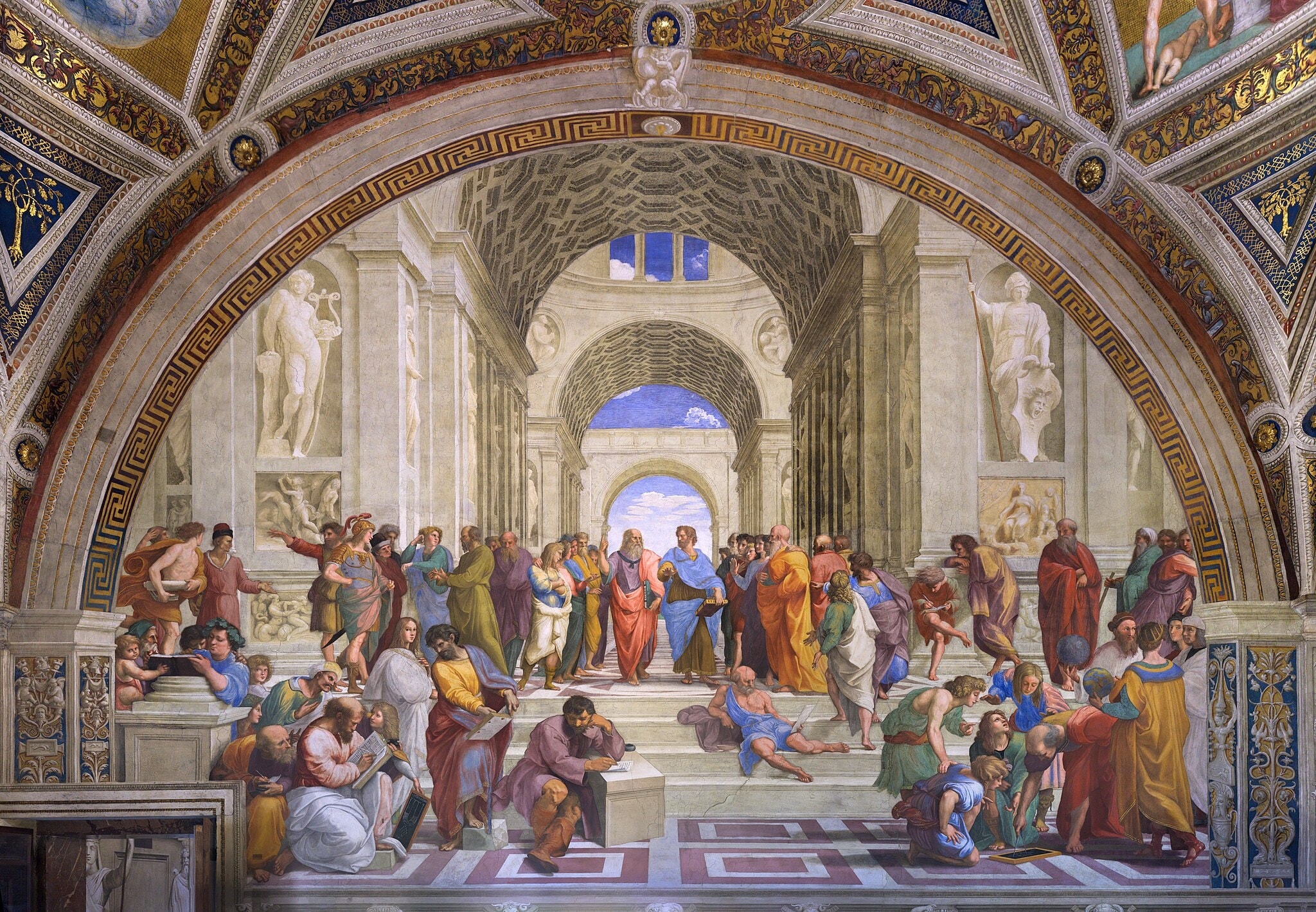
At the heart of Raphael’s School of Athens, a blue‑clad philosopher reclines across the central steps with a simple bowl at his side: Diogenes the Cynic. His aloof pose and minimal accoutrements proclaim radical self‑sufficiency amid papal splendor, while his horizontal body becomes a compositional hinge that slows the eye between the disputing throngs.
Historical Context
Raphael painted The School of Athens between 1509 and 1511 for Pope Julius II’s private library, the Stanza della Segnatura, as part of a quattro‑wall program celebrating Theology, Poetry, Philosophy, and Justice. The Philosophy wall assembles antiquity’s great minds within a grand, Bramante‑like hall, projecting the papal court’s humanist embrace of classical learning 2. In the very center of the stairway lies Diogenes, identified by the Vatican Museums as the figure "reclining on the steps with a bowl," a precise placement and attribute that have anchored the figure’s identification in museum literature 1.
Raphael’s inclusion of the Cynic among Platonists, Aristotelians, mathematicians, and astronomers widens “philosophy” beyond schoolroom systems to encompass competing ways of life. In Julius II’s library—where sacred and secular learning were set in deliberate dialogue—Diogenes represents the ancient critique of convention and luxury standing shoulder‑to‑shoulder with more courtly traditions of knowledge, a breadth and balance central to the fresco’s program and its enduring appeal 21.
Symbolic Meaning
Raphael casts Diogenes as the embodiment of Cynicism: near‑naked, indifferent to the bustle around him, absorbed in reading, and content with almost nothing. The Städel Museum, which preserves Raphael’s preparatory study, describes him as the “unconventional philosopher without needs,” sprawled before the august procession of Plato and Aristotle—an image of principled detachment staged at the fresco’s core 3. The small bowl beside him, explicitly noted by the Vatican (“scodella”), distills the Cynic ethic; it recalls the anecdote in which Diogenes threw away even his cup after seeing a boy drink with his hands, a visual shorthand for radical simplicity 16.
His isolation is intentional: while most figures debate, measure, or teach, Diogenes remains alone, signaling the Cynic refusal of social bonds and conventions in favor of living “according to nature.” The early tradition recorded by Vasari and preserved in the study’s provenance underpins this identification, keeping the figure’s meaning stable from the sixteenth century onward 4. Placed amid papal magnificence, the bowl, bare limbs, and lounging pose turn Diogenes into a counter‑monument—a reminder that wisdom can also mean subtracting needs rather than accumulating knowledge or honors 136.
Artistic Technique
Raphael refined the figure from life in a silverpoint study, calibrating anatomy, foreshortening, and incident light so the reclined body reads convincingly across successive risers 3. In the fresco, crisp chiaroscuro models torso and limbs, and cast shadows anchor him to the marble steps. A cool palette—light blue tunic with purplish‑gray wrap—echoes historical notes recorded in John Downman’s 1774 study (“light Blue / White / Black Purple”), evidence for the figure’s intended chromatic effect 8.
Compositionally, Diogenes is set squarely on the central stairs that organize Raphael’s perspectival scheme; his horizontal sprawl cuts across the orthogonals that converge between Plato and Aristotle, creating a measured visual pause in the central axis 25. The economical props (papers and bowl) and the taut drapery further focus attention on the body’s pose and the clarity of the surrounding architecture 3.
Connection to the Whole
Diogenes functions as the compositional hinge of the School of Athens. His prone body slows the viewer’s eye as it moves along the central axis toward Plato and Aristotle, clarifying their descent and organizing the circulation of surrounding groups—an elegant pause point within Raphael’s stagecraft 52. Identified by the Vatican as lying “on the steps,” he literally occupies the passage between schools, mediating the upper debates and the foreground demonstrations 1.
Thematically, he expands the fresco’s spectrum of inquiry: alongside metaphysics, ethics, mathematics, and astronomy, Raphael gives Cynic asceticism a central, if solitary, seat at the table. Overhead, the tondo labeled "Causarum Cognitio"—knowledge of causes—frames this wall’s pursuit of first principles, to which Diogenes contributes the severe test of need and convention within human reason’s domain 72.
Explore More from This Painting
This detail is one part of The School of Athens. Use the links below to return to the full interpretation, browse the full set of details, or view the painting's valuation if available.
Sources
- Vatican Museums, Scuola di Atene (official object page; identification of Diogenes on the steps with a bowl)
- Encyclopaedia Britannica, The School of Athens (commission, program, architecture, and compositional equilibrium)
- Städel Museum, Raphael, Study of Diogenes in the School of Athens (pose, light, and meaning)
- Royal Collection Trust, Study for the figure of Diogenes in The School of Athens (Vasari-rooted identification)
- Smarthistory, Raphael, School of Athens (composition and figure staging)
- Web Gallery of Art, The School of Athens (detail; bowl/cup anecdote of Diogenes)
- Wikipedia, The School of Athens (vault tondo labels, including "Causarum Cognitio")
- Art Institute of Chicago, John Downman, Study after Raphael’s Diogenes (1774) (historical color notes)