The School of Athens

by Raphael

Raphael’s The School of Athens orchestrates a grand debate on knowledge inside a perfectly ordered, classical hall whose one-point perspective converges on the central pair, Plato and Aristotle. Their opposed gestures—one toward the heavens, one level to the earth—establish the fresco’s governing dialectic between ideal forms and empirical reason [1][2]. Around them, mathematicians, scientists, and poets cluster under statues of Apollo and Athena/Minerva, turning the room into a temple of Renaissance humanism [1][3].

Fast Facts

Year
1509–1511
Medium
Fresco
Dimensions
c. 500 × 770 cm (196.9 × 303.1 in)
Location
Stanza della Segnatura, Apostolic Palace, Vatican Museums, Vatican City
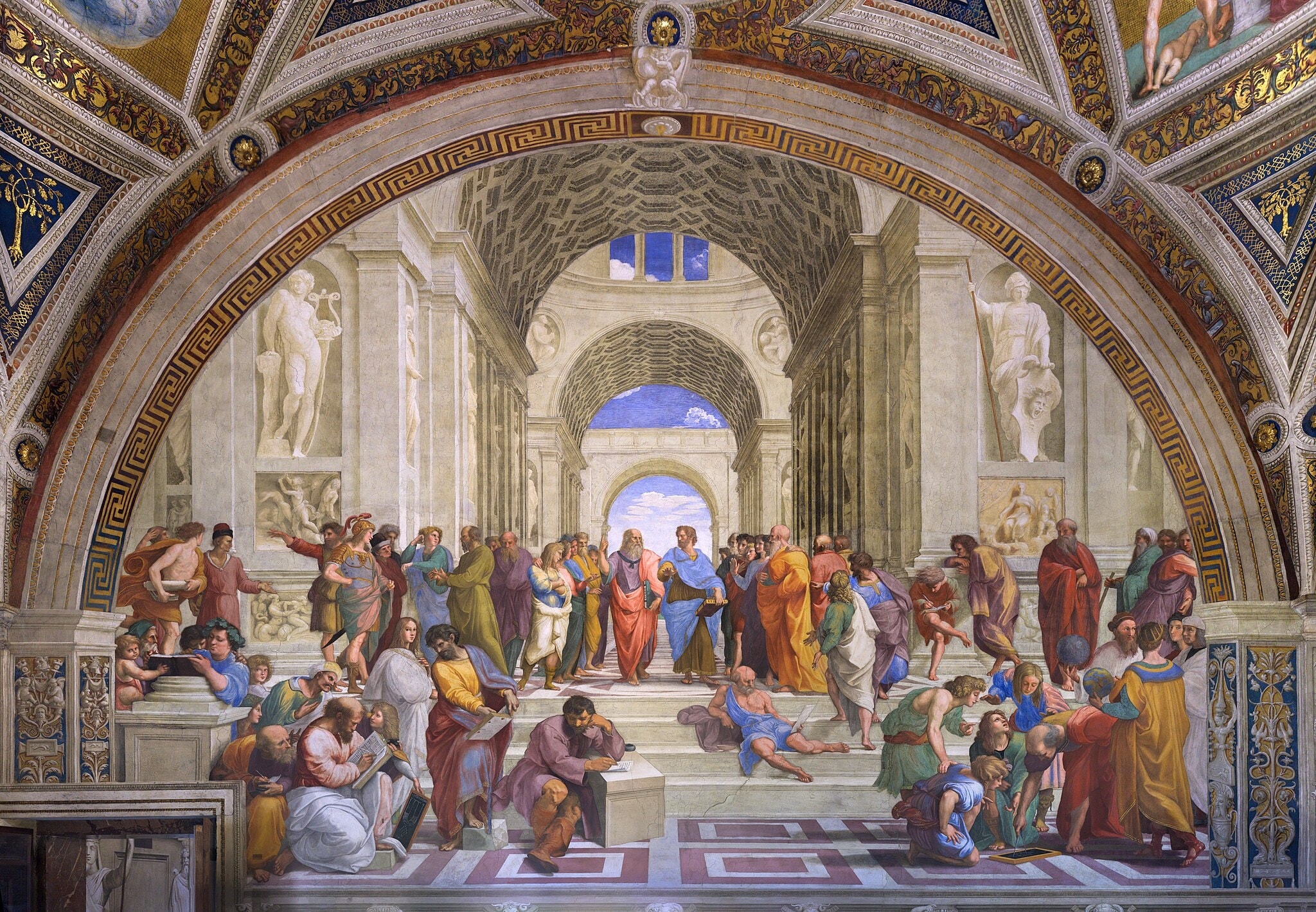
The School of Athens by Raphael (1509–1511) featuring Plato’s upward gesture and the book Timaeus, Aristotle’s level hand and the book Ethics, Statue of Apollo with lyre, Statue of Athena/Minerva with helmet and aegis (Gorgon head)

Click on any numbered symbol to learn more about its meaning

Meaning & Symbolism

Raphael builds the argument through structure. The coffered barrel vault and patterned pavement marshal a flawless one-point perspective that culminates in the paired figures at center: Plato, pointing upward with the Timaeus, and Aristotle, extending his hand horizontally with the Ethics. Their gestures encode the fresco’s core: metaphysical universals versus immanent causes, a dialectic that orders every group assembled along the steps and aisles 2. Above, the statues of Apollo with a lyre and Athena/Minerva with helmet and aegis anchor the space in harmony and prudence, asserting that artistic measure and civic wisdom govern inquiry 5. The setting itself reads as a utopian basilica—often linked to Bramante’s vision for the new St. Peter’s—so that reason is staged within an idealized architecture of Church and city alike 34. Raphael then demonstrates how knowledge operates. At the lower right, a master commonly identified as Euclid bends with a compass to demonstrate a theorem to eager pupils, foregrounding mathematical proof as the engine of shared understanding; the figure likely bears Bramante’s features, joining architecture to geometry in a single intellectual craft 35. At the lower left, Pythagoras composes harmonic ratios while a turbaned observer (often read as Averroes) leans in—an emblem of number, music, and transmission across cultures 35. Near the center steps, Diogenes reclines apart, an ascetic counterpoint to the bustling school, while the brooding writer resting an arm on a block is widely taken as Heraclitus with Michelangelo’s features, a late insertion that nods to the rival genius at work on the Sistine Ceiling and registers philosophy’s tragic, solitary strain within communal inquiry 26. At the right, two scholars present globes—terrestrial and celestial—commonly identified as Ptolemy and Zoroaster, adjoining Raphael’s own self-portrait; the pairing insists that mapping earth and charting the heavens belong in the same conversation as ethics and metaphysics 25. In the room-wide program, The School of Athens represents Philosophy (rational truth) opposite the Disputa (revealed truth), alongside Poetry (Parnassus) and Justice (Virtues and Law). The wall therefore argues not for a single doctrine but for a synthesis: diverse disciplines reconcile under a higher order, and painting itself proves its intellectual status by organizing and clarifying that order 13. The clarity of grouping, the measured color harmonies, and the legible sequence from observation to abstraction exemplify the High Renaissance claim that beauty is a mode of knowledge. This is why The School of Athens is important: it naturalizes philosophy as a public, civic good within the papal library; it demonstrates that ancient thought empowers contemporary making; and it models a politics of learning in which debate, proof, and imagination cohere within the same luminous architecture 124.

Explore Deeper with AI

Ask questions about The School of Athens

Popular questions:

Powered by AI • Get instant insights about this artwork

💬 Ask questions about this artwork!

Interpretations

Political Theology and Program Authorship

Beyond a general harmony of reason and faith, the fresco participates in Julius II’s political theology: philosophy is enlisted to authorize papal rule as the arbiter of all knowledge domains. Competing scholarly theses about the program’s authorship sharpen this point. Heinrich Pfeiffer attributes a Christian‑Neoplatonic synthesis to Egidio da Viterbo’s circle, casting the room as a prophetic vision of renewal under Julius II, while Joost‑Gaugier foregrounds librarian Tommaso Inghirami’s curatorial role in choreographing the room’s intellectual “geography.” Either way, the ensemble reads as ideology by design, not neutral display—mapping a Church that contains and orders secular wisdom within its walls. 1256

Source: Vatican Museums; Heinrich Pfeiffer; C. L. Joost‑Gaugier

Architectural Utopia as Meaning

The basilican interior is not mere backdrop but the fresco’s argumentative armature. Its coffered vaults, colossal orders, and calibrated perspective likely echo Bramante’s designs for the new St. Peter’s, turning architecture into a theory of knowledge: proportion, measure, and axial clarity become epistemic virtues. In this reading, Raphael fuses the city’s most ambitious building project with the staging of philosophy, proposing a Church rebuilt on rational order and civic grandeur. The space operates as a utopian diagram in which classical Rome and papal Rome align, converting spatial harmony into political and intellectual claim. 234

Source: The Met; Encyclopaedia Britannica; Smarthistory

Cross‑Cultural Transmission and the Global Canon

The turbaned observer near Pythagoras (often read as Averroes) and the pairing of Ptolemy and Zoroaster with terrestrial and celestial globes announce a canon expanded by Islamicate and Hellenistic science. The School of Athens models philosophy as a translatio studii—knowledge moving across languages and traditions—folding astronomy, geography, and mathematics into ethics and metaphysics. Raphael thus visualizes a global epistemology long before modern academies: the map of earth and chart of heaven sit beside Plato and Aristotle as coequal pursuits. The minor uncertainties over which figure holds which globe underscore our historiographic distance even as the fresco proclaims a cosmopolitan ideal. 23

Source: Encyclopaedia Britannica; Smarthistory

Paragone, Rivalry, and the Intellectual Artist

By inserting a brooding Heraclitus with Michelangelo’s features, Raphael acknowledges—and competes with—the epochal project across the corridor, the Sistine Ceiling. This calculated citation turns the fresco into a paragone (contest) about what thinking looks like in images: solitary, tragic genius versus social pedagogy and measured debate. Framing Euclid as Bramante and including his own self‑portrait, Raphael recasts ancient philosophers as modern makers, asserting painting’s parity with poetry, architecture, and philosophy. The work becomes a manifesto of the thinking painter, where likeness, allegory, and contemporary portraiture elevate the visual arts to the liberal arts. 37

Source: Smarthistory; Web Gallery of Art

Pedagogy, Method, and the Library Function

As the keystone of a working library/studio, the fresco diagrams methods of knowing: demonstration (Euclid’s compass), harmonics and notation (Pythagoras), dialectical dialogue (Plato/Aristotle), empirical instruments (globes), and skeptical detachment (Diogenes). The room-wide program (True–Good–Beautiful) organizes disciplines as usable knowledge, making the wall a didactic tool for readers, jurists, and courtiers. Raphael’s lucid grouping and sequential sightlines translate pedagogy into spatial choreography—proof that High Renaissance style could function as epistemic technology, not ornament. 14

Source: Vatican Museums; Smarthistory

Related Themes

About Raphael

Raphael (1483–1520), summoned to Rome by Pope Julius II in 1508, became the leading decorator of the papal apartments while Michelangelo painted the Sistine Ceiling. He synthesized Florentine draftsmanship with Roman monumentality and later succeeded Bramante as architect of St. Peter’s in 1514, before his early death in 1520 [3][7].
View all works by Raphael