Euclid's Geometry Lesson in The School of Athens
A closer look at this element in Raphael's 1509–1511 masterpiece
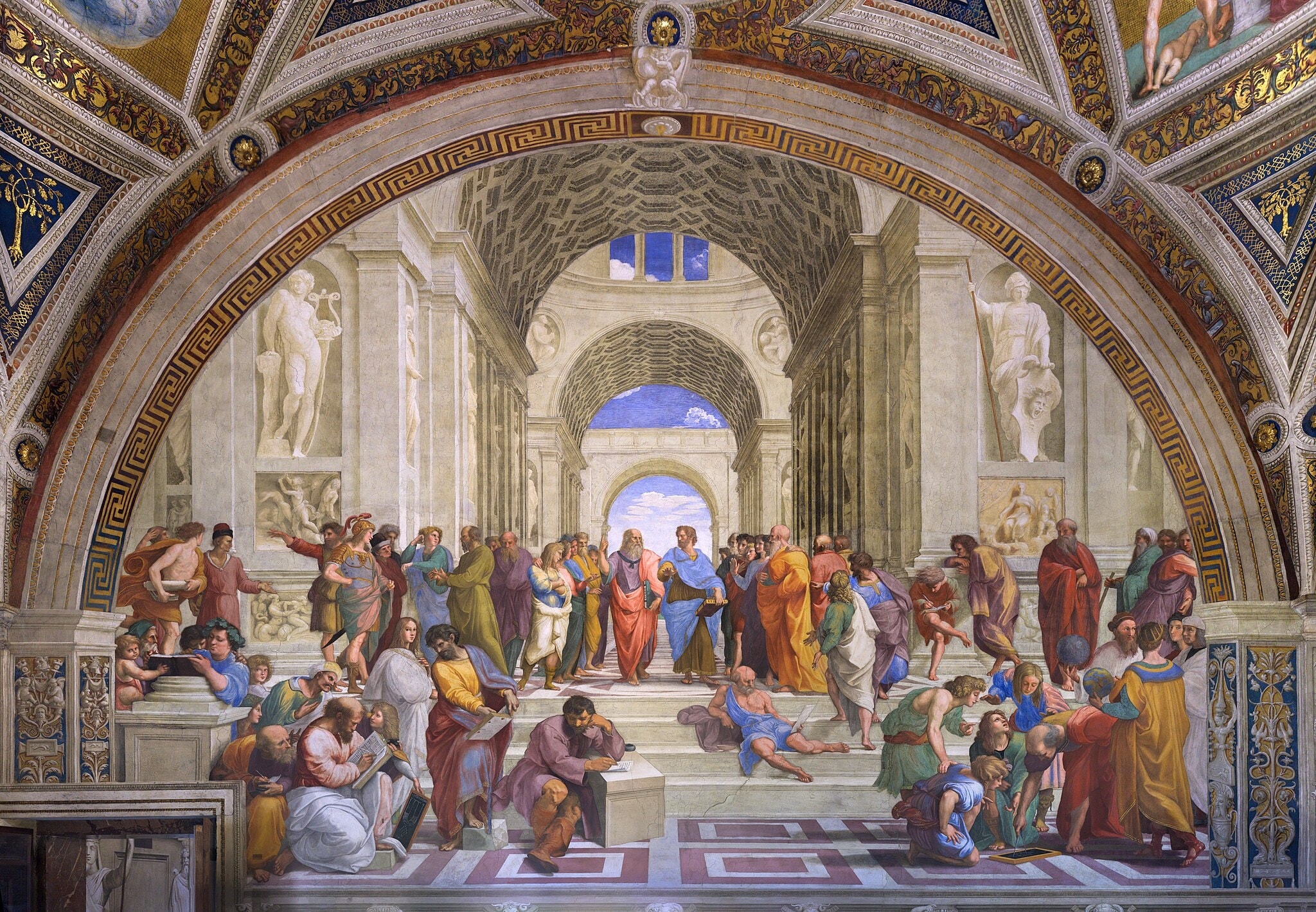
At the right front of Raphael’s School of Athens, an elderly geometer bends over a slate, compass poised, while young students crowd close to follow his construction. This vivid “Euclid’s geometry lesson” crystallizes the Renaissance belief that truth can be demonstrated, linking ancient mathematics to the new architecture and cosmography transforming Julius II’s Rome.
Historical Context
Painted between 1509 and 1511 for Pope Julius II’s Stanza della Segnatura, the School of Athens represents Philosophy within a room that maps the great branches of knowledge. In this scheme, the right‑hand group of the stooping teacher and pupils embodies mathematics taught through demonstration—an essential strand of the Renaissance humanist curriculum that balanced sacred learning with rational inquiry 1.
Raphael situates the lesson inside a grand, rigorously ordered architectural setting and, according to early and modern commentators, gives the geometer the features of Donato Bramante, Julius II’s architect. This choice binds geometry to the architectural practice then remaking Rome, while the compass and slate make the act of proof visible. The cluster’s placement on the pavement’s orthogonals leads viewers into the fresco’s unified space and signals how measured knowledge undergirds the whole philosophical enterprise of the room 2.
Symbolic Meaning
The scene personifies Geometry—knowledge grounded in measure, proportion, and demonstrable truth. The master’s compass poised above a diagram on the slate makes rational proof tangible, staging knowledge as something transmitted from teacher to students and advanced through shared scrutiny. Smarthistory reads this lower‑right cluster as “measure,” the practical arm of wisdom, counterbalancing more ideal or speculative inquiry at the lower left around Pythagoras 2.
Behind the lesson, Zoroaster with a celestial sphere and Ptolemy with a terrestrial globe expand geometry into cosmography: mathematics not just as abstract ratio but as a language for mapping heavens and earth. Scholarship emphasizes that these identities and their instruments are deliberate, embedding a humanist syllabus where mathematical science, cosmography, and the visual arts mutually reinforce one another 6. Within the Stanza’s triad of the True, the Good, and the Beautiful, this group asserts rational truth as demonstrable and world‑shaping 1. Vasari’s notice that Raphael modeled the teacher on Bramante further underlines that geometry is the architect’s first principle, joining ancient authority to modern making—and turning the lesson into an emblem of Renaissance synthesis 7.
Artistic Technique
Raphael composes the group as a tight semicircle animated by varied, foreshortened poses: a crouching youth holds the slate, others lean in or jot notes, and the master arcs forward with the compass. Their placement rides the pavement’s orthogonals, locking the vignette into the fresco’s one‑point perspective and the monumental, Bramantean architecture beyond 2.
A surviving preparatory study in metalpoint shows Raphael fixing the gestures and central compass‑work before transferring the design to fresco, evidence of his rigorous planning and sensitive figure construction 3. Color and light model the bodies with High Renaissance clarity—warm ochres and reds against cooler greens and blues—while the crisp rendering of the compass, slate, and intent faces makes the drama of demonstration the visual focus 5.
Connection to the Whole
This lesson is a working engine of the fresco’s meaning. It pairs with the Pythagoras cluster across the foreground and, through the tiled floor’s perspective, helps drive the eye toward Plato and Aristotle at the architectural vanishing point—where differing paths to truth meet 2.
Flanked by cosmographers and joined by Raphael’s own self‑portrait at far right, the group knits mathematics, world‑mapping, and artistic practice into a single humanist enterprise. Within the Stanza della Segnatura’s program, it proclaims the legibility of the world through number and measure, complementing Theology, Poetry, and Justice to complete a vision of knowledge that is rational, ordered, and shareable 16.
Explore More from This Painting
This detail is one part of The School of Athens. Use the links below to return to the full interpretation, browse the full set of details, or view the painting's valuation if available.
Sources
- Vatican Museums — School of Athens overview
- Smarthistory — Raphael, School of Athens
- Royal Collection Trust — Euclid instructing his pupils (after Raphael’s Ashmolean study)
- Web Gallery of Art — School of Athens, right foreground group
- Renaissance Quarterly (Joost-Gaugier) — Cosmography and painting in the School of Athens
- Giorgio Vasari, Lives — reference to Bramante with compasses