Heraclitus (Michelangelo) in The School of Athens
A closer look at this element in Raphael's 1509–1511 masterpiece
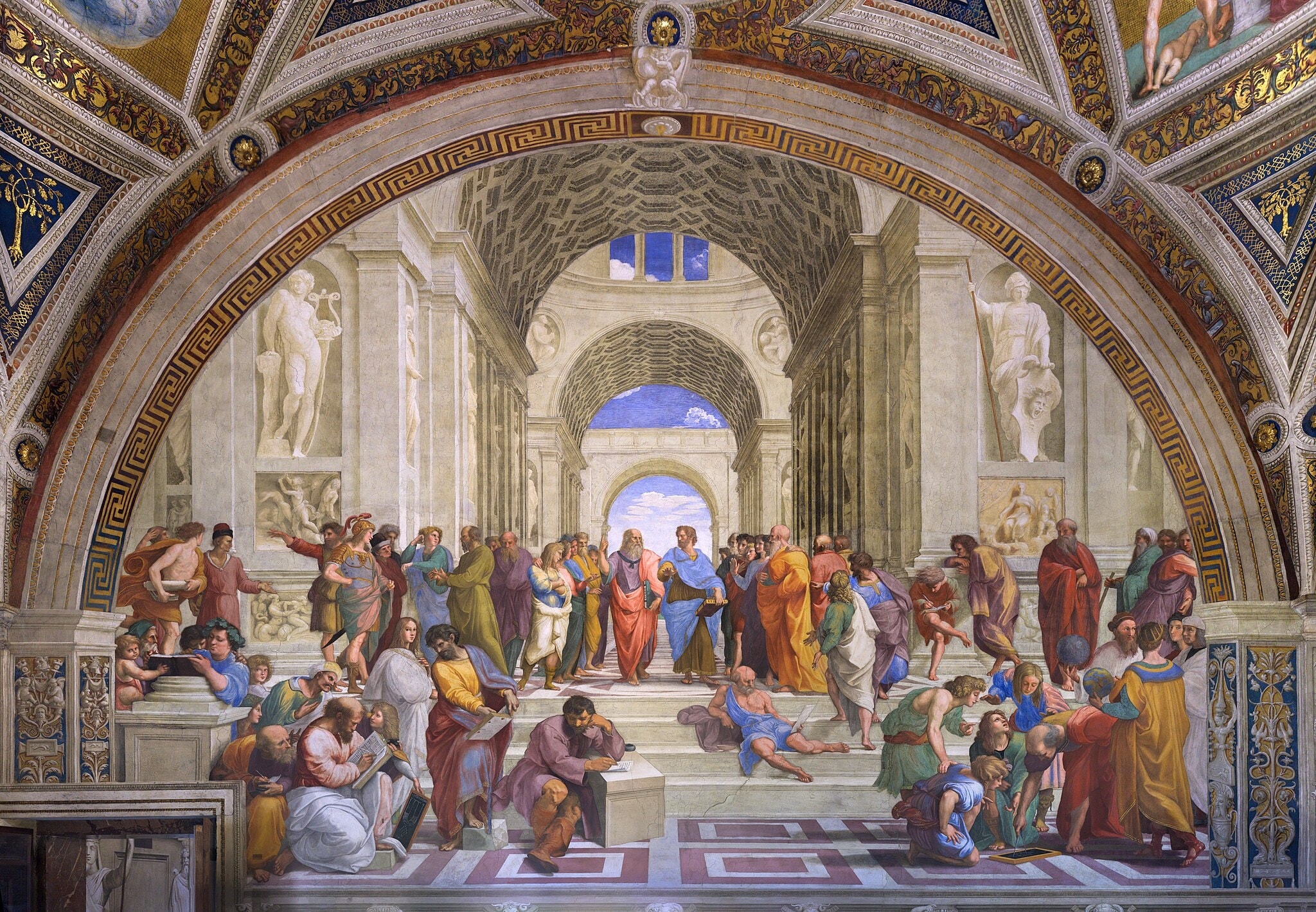
In the center foreground of Raphael’s School of Athens sits a solitary writer leaning on a marble block—Heraclitus rendered with the likeness of Michelangelo. Added on fresh plaster after the main fresco was complete, this brooding figure is Raphael’s pointed homage and challenge to his contemporary working on the Sistine ceiling nearby, folding living genius into the pantheon of ancient thought.
Historical Context
Raphael painted The School of Athens in the Stanza della Segnatura for Pope Julius II around 1509–1511, while Michelangelo, only a few doors away, was laboring over the Sistine Chapel ceiling. The Vatican Museums identify the dark-robed man who leans on a marble block and writes as Heraclitus bearing the features of Michelangelo—a contemporary tribute placed at the very threshold of the scene 1.
Technical and stylistic evidence align with a vivid workshop story: after completing the main fresco, Raphael returned to the wall, laid a new patch of wet plaster, and inserted this figure. Smarthistory concisely summarizes that sequence and frames the gesture as a deliberate homage within the competitive climate of Julius II’s court—Raphael acknowledging, and engaging, Michelangelo’s formidable presence by casting him as the melancholic pre-Socratic thinker 2. In short, the figure materializes the artistic dialogue of early sixteenth‑century Rome, where rivalry sharpened invention and where Raphael integrated the living present into an image of ancient philosophy 12.
Symbolic Meaning
Heraclitus stands for flux, paradox, and a solitary, even melancholic, disposition; Britannica calls him an “arch pessimist,” a temperament that Raphael visualizes through isolation, bent posture, and inward concentration on the page rather than debate 4. Casting Heraclitus with Michelangelo’s features fuses philosophical character with artistic persona: the brooding, self-contained genius who wrestles with first principles becomes a cipher for Michelangelo’s sculptural intellect 126.
Within Renaissance discourse, this amounts to a clear statement in the paragone—the contest of the arts. The figure quotes the muscular, prophetic gravitas of the Sistine ceiling, echoing Michelangelo’s seated prophets and sibyls and recoding that authority within Raphael’s philosophical assembly 2. The identification is standard in museum and teaching literature, even as recent scholarship has urged caution about turning a technical “late addition” into a tidy anecdote; Maria Loh, for example, scrutinizes how the modern narrative crystallized around this likeness 7. Yet the symbolism holds: a philosopher of perpetual change embodied by the era’s most “sculptural” painter becomes a living bridge between ancient wisdom and modern achievement, signaling that contemporary artists belong inside the genealogy of knowledge the fresco celebrates 124.
Artistic Technique
Raphael rendered the figure as a late addition on a separate intonaco patch, evidenced by conservation and by the absence of the foreground Heraclitus in the full‑scale cartoon at the Pinacoteca Ambrosiana 35. The body is modeled with blocky, weighty volumes, seated in a contrapposto twist that recalls Michelangelo’s prophets; drapery clings and bunches over a massive torso and forearms, intensifying the sculptural effect 2.
Chromatically, deep plum and earth tones set the brooding thinker apart from the brighter robes clustering around Plato and Aristotle. The marble block doubles as a sculptor’s support and a philosopher’s desk, and the angled placement of the figure—obliquely across the foreground—cuts diagonally into the viewing space, asserting tactile presence at the viewer’s feet 123.
Connection to the Whole
The Stanza della Segnatura orchestrates the faculties of the human spirit—Philosophy (Truth), Theology, Poetry, and Justice. Within this program, the School of Athens stages rational inquiry; Heraclitus’s isolation amid lively dialogue strikes a counterpoint of solitary reflection that philosophy also requires 8. Positioned at the threshold, his mass slightly interrupts the spatial glide toward Plato and Aristotle, recalibrating the composition so that Renaissance Rome stands alongside antiquity 2.
By giving Heraclitus Michelangelo’s face, Raphael binds the living present to the ancient past, just as other figures quote contemporary masters. The insertion declares that modern artistic intellect is part of the same continuum of knowledge the fresco venerates—an idea made legible the moment a viewer steps into the room and encounters this thinking, writing body first 128.
Explore More from This Painting
This detail is one part of The School of Athens. Use the links below to return to the full interpretation, browse the full set of details, or view the painting's valuation if available.
Sources
- Vatican Museums — School of Athens (official object page)
- Smarthistory — Raphael, School of Athens (homage and late addition)
- Pinacoteca Ambrosiana — Cartoon for the School of Athens (foreground figure absent)
- Encyclopaedia Britannica — Overview of School of Athens (Heraclitus as portrait of Michelangelo)
- Italian scholarly synthesis — Separate intonaco confirmed in restoration (1996)
- Web Gallery of Art — Detail caption: Heraclitus with the features of Michelangelo
- USC Dornsife (DecamerOnline) — Maria Loh on the modern codification of the identification
- Vatican Museums — Stanza della Segnatura (program of the room)