Raphael's Self-Portrait in The School of Athens
A closer look at this element in Raphael's 1509–1511 masterpiece
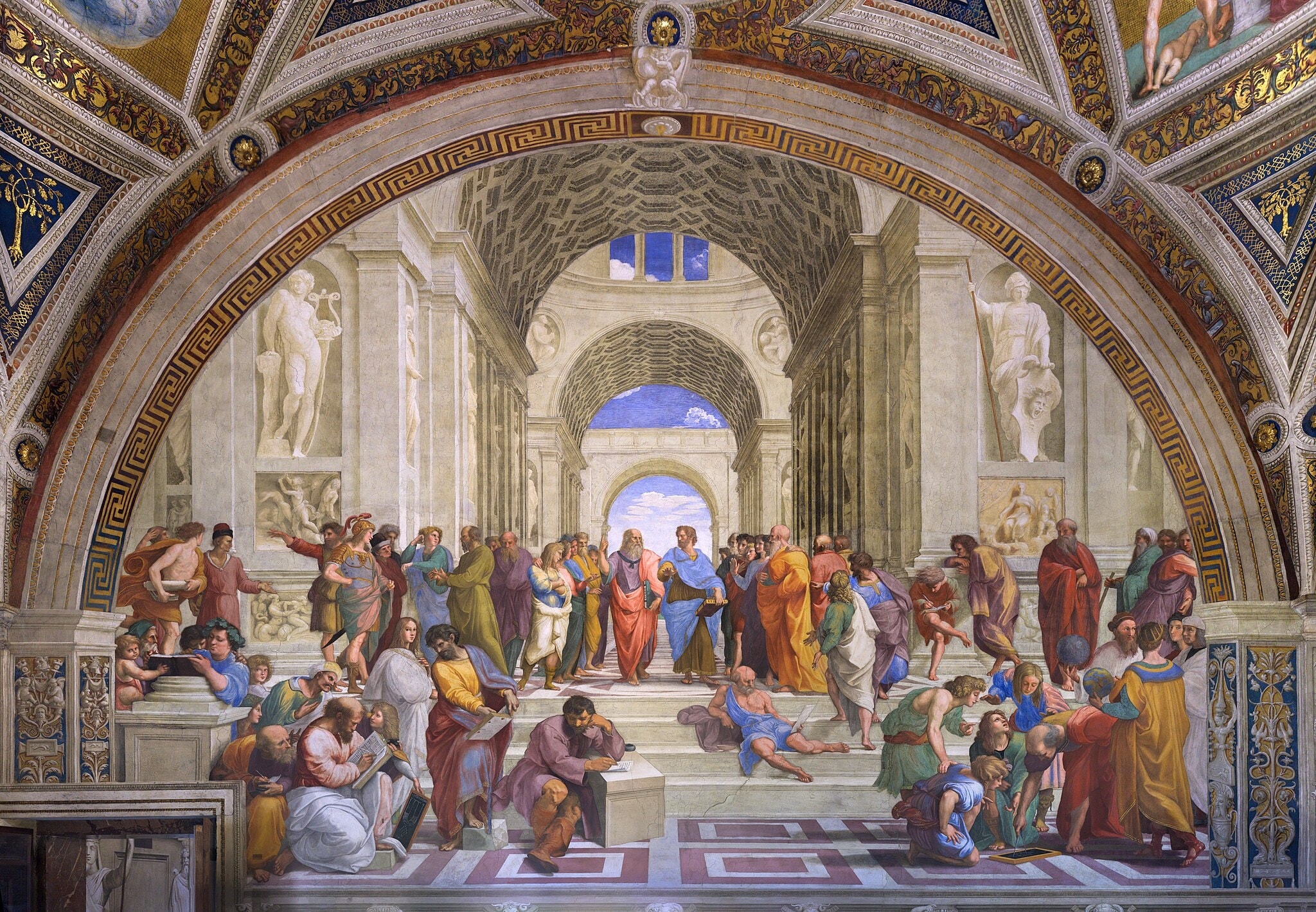
At the extreme right edge of The School of Athens, a youthful figure in a black beret turns to meet our eyes. Identified by the Vatican Museums as Raphael’s self-portrait, he stands beside the bearers of the celestial and terrestrial spheres, asserting the painter’s place among the luminaries of knowledge. His steady gaze is a signature of authorship and an invitation to step into the fresco’s intellectual world.
Historical Context
Raphael painted The School of Athens between 1509 and 1511 for Pope Julius II’s Stanza della Segnatura, the pope’s library and study. The fresco embodies the wall dedicated to Philosophy. At the far right edge, the Vatican Museums identify a young man in a black beret turning outward as Raphael’s own likeness; he stands beside figures who hold the celestial and terrestrial spheres, anchoring him within the painting’s constellation of scientific learning 1.
Placing himself here matched the intellectual ambitions of the room and the moment. As Smarthistory explains, Raphael deliberately inserted his portrait among “some of the most important astronomers of all time,” next to Zoroaster (celestial orb) and Ptolemy (terrestrial globe) 2. In Julius II’s library—where sacred and secular texts conversed—this move publicly aligned the painter with the learned disciplines gathered under Philosophy. It signaled a High Renaissance conviction: the artist is not a craftsman at the margins but an intellectual participant in the creation and transmission of knowledge 2.
Symbolic Meaning
Raphael’s self-portrait is a programmatic claim. By standing on the Aristotelian, empirical side of the fresco amid geometry and cosmography, he declares painting’s parity with disciplines that measure and map the world—an essential humanist proposition in the Stanza della Segnatura, where sacred theology faces secular learning in ordered harmony 3. His outward gaze doubles as a threshold device, acknowledging authorship while drawing the viewer into a living dialogue with classical wisdom renewed in the Renaissance 23.
Scholars have further read this figure as an allusion to the ancient master painter Apelles, with the companion at his side as Protogenes, thereby rooting Raphael’s claim in classical precedent and aligning painting with mathematical and geographic inquiry at the right of the fresco 4. Whether the adjacent figure holding the starry sphere is labeled Zoroaster (Vatican Museums) or identified as the geographer Strabo, the grouping keeps Raphael’s likeness squarely within a nexus of cosmography and geometry, reinforcing the painter-as-thinker ideal 14. The enduring recognition of this image—replicated, for example, in an eighteenth‑century drawing after the self-portrait—shows how quickly it became an emblem of the artist’s intellectual status 5.
Artistic Technique
Executed within a buon fresco field, the self-portrait is modeled with Raphael’s hallmark clarity: softly graduated flesh, lucid contours, and a restrained palette punctuated by the dark beret and cloak named by the Vatican Museums 1. Even, cool illumination and linear perspective integrate him seamlessly with the right-hand cluster of astronomers and geometers while his head subtly pivots toward us, creating a clean visual hinge with the surrounding group 2. Comparison with Raphael’s early painted Self‑Portrait in the Uffizi—similar cap, youthful features—reinforces the identification and highlights his preference for composed, unforced characterization over bravura display 6.
Connection to the Whole
The School of Athens stages Philosophy as an ordered, collaborative search for truth. By inserting his likeness on the Aristotelian side, beside Euclidean geometry and cosmographic study, Raphael aligns the visual arts with empirical knowledge—perfectly consonant with the room’s synthesis of sacred and secular wisdom 3. His direct gaze functions as a visual bridge: it acknowledges the author, breaks the pictorial fourth wall, and invites viewers to enter the discourse enacted by the assembled thinkers 2.
Compositionally, placing the self-portrait at the outer right margin stabilizes the bustling group and creates a point of entry into the perspectival space. In concert with debates over Apelles/Protogenes and the cosmographers nearby, the detail becomes a key that unlocks the fresco’s larger argument: painting participates in, and helps orchestrate, humanity’s mapped understanding of the world 4.
Explore More from This Painting
This detail is one part of The School of Athens. Use the links below to return to the full interpretation, browse the full set of details, or view the painting's valuation if available.
Sources
- Vatican Museums, School of Athens (official collection page)
- Smarthistory, Raphael: School of Athens
- Encyclopaedia Britannica, School of Athens
- Christiane L. Joost‑Gaugier, 'Ptolemy and Strabo and Their Conversation with Apelles and Protogenes' (Renaissance Quarterly, 1998)
- British Museum, Portrait of Raphael (after the self‑portrait in the fresco), V,6.1
- Web Gallery of Art, Raphael, Self‑Portrait (Uffizi)