Plato and Aristotle in The School of Athens
A closer look at this element in Raphael's 1509–1511 masterpiece
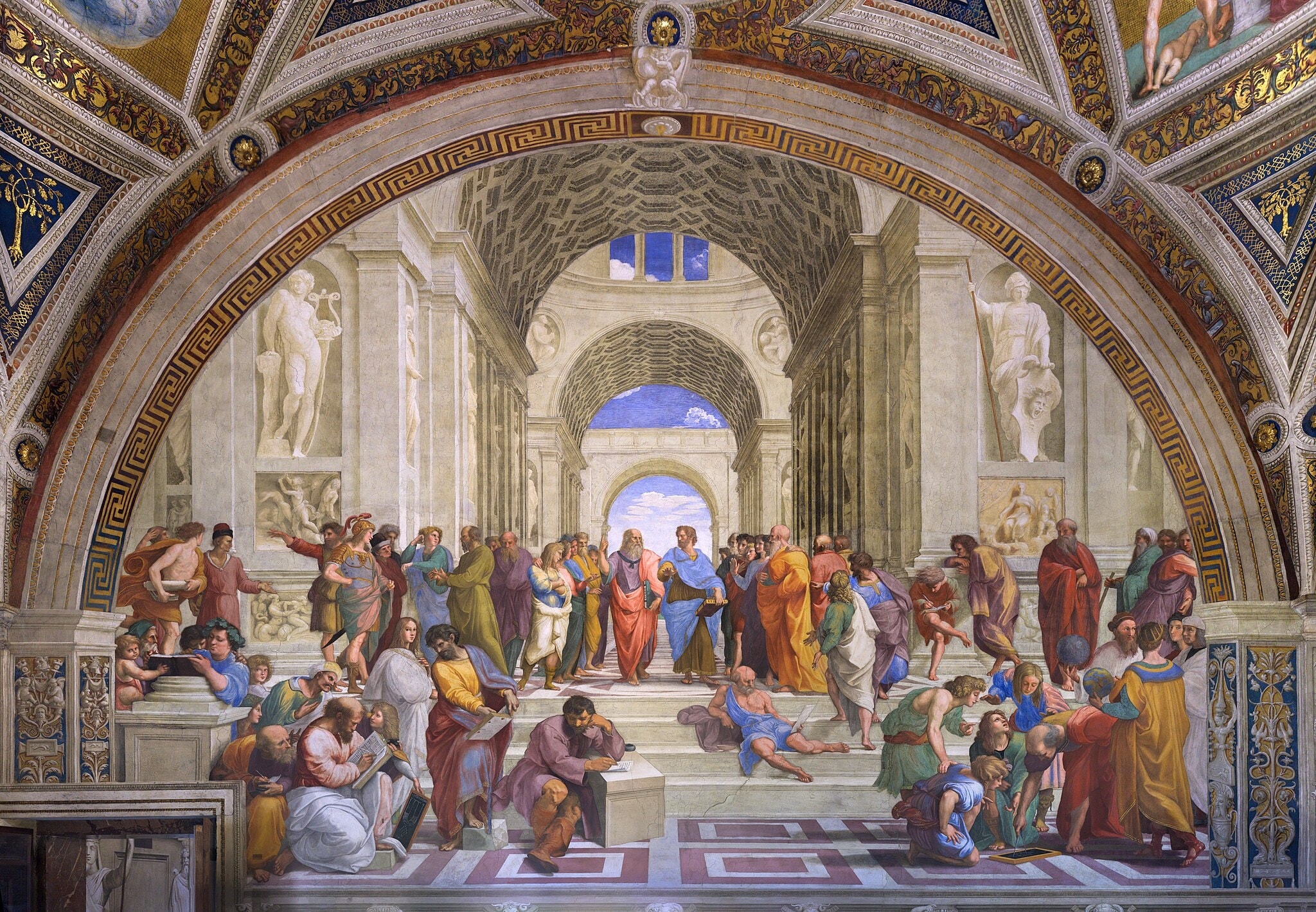
At the center of Raphael’s School of Athens, Plato and Aristotle stride forward like twin poles of philosophy—one pointing upward with the Timaeus, the other extending a leveled hand while holding the Nicomachean Ethics. Their books, gestures, and color-coded robes crystallize the fresco’s core argument: the dialogue between transcendent ideals and empirical inquiry.
Historical Context
Raphael painted the School of Athens around 1509–1511 for Pope Julius II’s private library, the Stanza della Segnatura. In this room the pope’s program arranged the highest pursuits of the mind—Theology, Philosophy, Poetry, and Justice—on four walls. The School of Athens embodies Philosophy as rational truth, and Raphael placed Plato and Aristotle at its visual and conceptual center, identified by their books and opposed gestures 1, 2.
Locating the pair at the heart of the fresco made the room’s intellectual axis unmistakable to visitors moving through Julius’s study. Facing the Disputa (Theology), the philosophers proclaim classical wisdom as an interlocutor within a papal setting, not a rival to it. Their serene advance through a cleared central aisle stages philosophy as civic discourse, ideally suited to a library that housed law, poetry, and theology alongside ancient texts reclaimed by Renaissance humanism 1, 2.
Symbolic Meaning
Plato and Aristotle operate as personifications of two paradigms that shaped Western thought. Plato, in red and purple, points heavenward and holds the Timaeus—an emblem of metaphysical inquiry into ideal forms. Aristotle, in blue and brown, steadies his right hand horizontally while carrying the Nicomachean Ethics, signaling a turn to ethics, politics, and the knowable world. Their opposed vectors—vertical versus level—have become a canonical shorthand for idealism and empiricism in art and pedagogy 1, 3, 4.
Raphael extends the symbolism across the composition. On Plato’s side gather figures tied to abstract harmonies (such as Pythagoras), while Aristotle’s side concentrates practical, measure-based study (such as Euclid teaching with a compass)—a living map of the discipline’s breadth 3, 5. The adjacent statues underscore the polarity: Apollo (poetry, measure, music) to the left and Athena/Minerva (prudence, practical wisdom) to the right, mirroring each philosopher’s emphasis 1, 3. Read together, the pair proclaims the Renaissance aspiration to reconcile rival truths within one learned community—an image of concord between contemplation and action that viewers in Julius II’s court were meant to emulate 4, 5.
Artistic Technique
Raphael fuses program and space by placing Plato and Aristotle at the vanishing point, where the paving’s orthogonals and the coffered vaults converge. The crowd parts symmetrically, clearing a processional corridor that funnels attention to the philosophers’ measured stride 6, 3. Classical drapery and calm, monumental poses anchor the duo as the fresco’s still center.
Color intensifies doctrine: Plato’s red–purple (fire and aether) contrasts with Aristotle’s blue–brown (air/water, earth), a didactic pairing widely observed in museum teaching. The surrounding architecture—evoking Roman grandeur and Bramante’s designs—frames the pair with flanking niches for Apollo and Athena, whose attributes echo the fresco’s thematic poles. Gesture, hue, and perspective cohere into a single, legible argument about how knowledge is pursued 3, 1.
Connection to the Whole
Within the Stanza’s four-part scheme, the central pair acts as the thesis statement for Philosophy, positioned opposite the Disputa so that classical reason and Christian revelation confront one another across the room. Overhead, the ceiling tondo labeled with the motto Causarum cognitio (“knowledge of causes”) frames the wall’s subject and aligns perfectly with Aristotle’s definition of wisdom—clarifying why these two authors personify the program’s aim 2, 8.
Spatially, every sightline converges on the pair; conceptually, their books, gestures, and neighboring groups model philosophy as a civic conversation that integrates universals with particulars. Plato and Aristotle thus translate the room’s humanist vision into a single, unforgettable image: truth advanced through disciplined dialogue among schools, not by one doctrine alone 3, 2.
Explore More from This Painting
This detail is one part of The School of Athens. Use the links below to return to the full interpretation, browse the full set of details, or view the painting's valuation if available.
Sources
- Musei Vaticani — Scuola di Atene (official figure IDs, books, gestures, statues)
- Musei Vaticani — Stanza della Segnatura overview (program of four walls)
- Smarthistory — Raphael, School of Athens (gestures, color symbolism, composition, Apollo/Athena)
- Encyclopedia Britannica — overview emphasizing the central tension of Plato and Aristotle
- Princeton University educational note — active vs. contemplative life; left/right groupings
- Wikipedia — The School of Athens (composition and vanishing point details)
- Wikipedia (German) — Disputa del Sacramento (lists the ceiling mottos including Causarum cognitio)