How Much Is The Triumph of Galatea Worth?
Last updated: July 4, 2026
Quick Facts
- Methodology
- comparable analysis
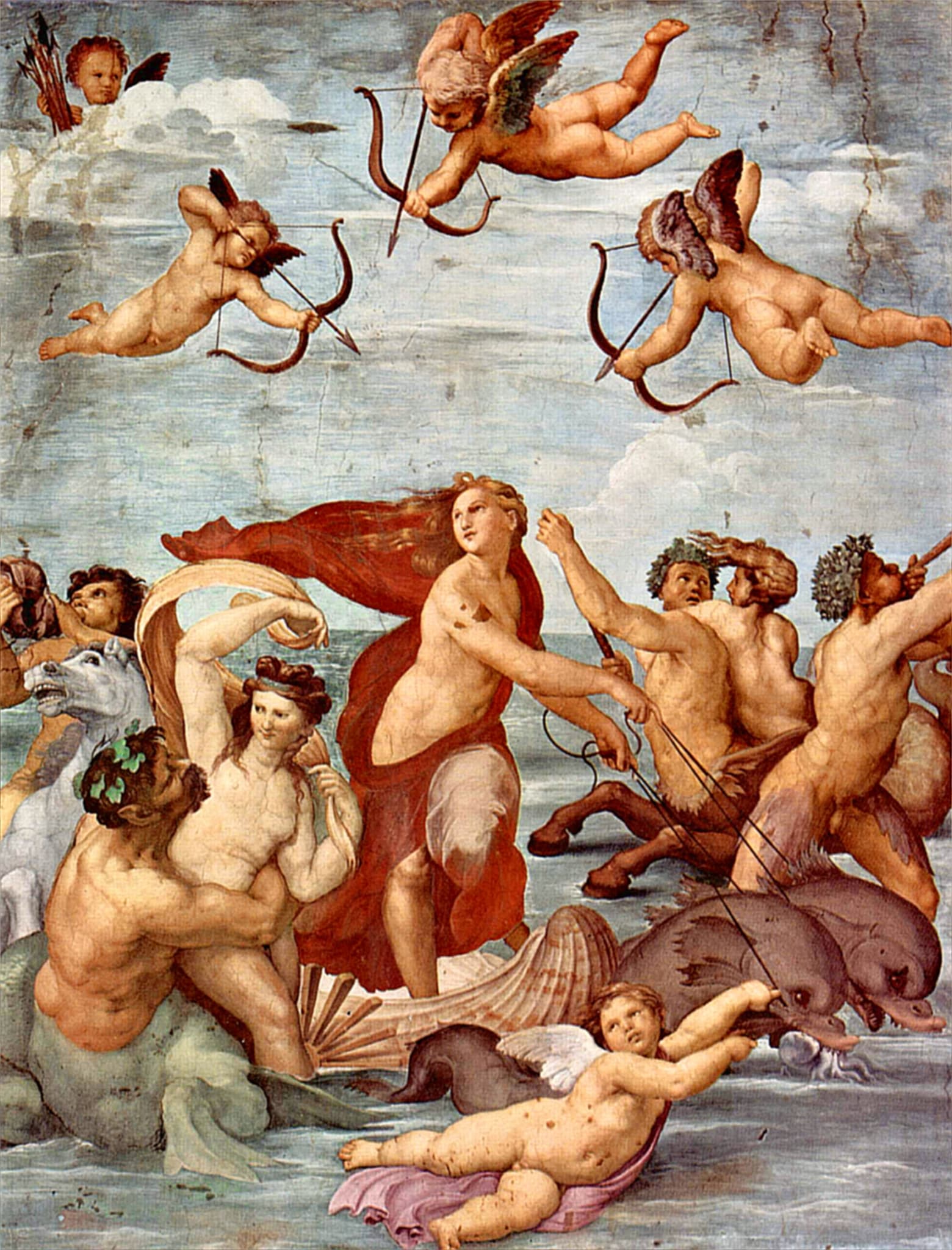
Raphael’s The Triumph of Galatea is an in-situ fresco (c.1511–12) at the Villa Farnesina in Rome and is legally immovable, so it has no practical market value. Using best-in-class comparables for portable, canonical Old Masters, an equivalently important, portable autograph Raphael is estimated at $250–350 million. This band reflects Galatea’s art-historical stature, the extreme scarcity of autograph Raphaels, and nine-figure demand for top-tier Renaissance masterpieces.
Valuation Analysis
What is being valued and why a proxy is required. The Triumph of Galatea is an autograph fresco by Raphael, painted c.1511–12 for Agostino Chigi’s Villa Farnesina in Rome, where it remains in situ as part of a protected historic monument [1]. Under Italy’s Cultural Heritage Code, integral wall paintings in listed buildings are effectively immovable; detachment or export requires state authorization and is strictly limited [2]. As a result, the fresco has no realizable market value. This valuation therefore synthesizes a hypothetical proxy: what a portable, equivalently important autograph Raphael might command today.
How the estimate was derived. We anchor the analysis to trophy-level Old Master comparables and same-artist benchmarks. The global auction peak for the category is Leonardo da Vinci’s Salvator Mundi at $450.3m (2017) [4]. A major private-treaty yardstick is Rembrandt’s pendant portraits acquired jointly by the Louvre and Rijksmuseum for about €160m (2016) [6]. Botticelli’s $92.2m portrait (2021) evidences deep demand beyond Leonardo for blue-chip Renaissance pictures [5]. Within Raphael’s own market, supply is vanishingly scarce: drawings lead the public record (Head of a Young Apostle, c.$47.8m, 2012) [3], while the National Gallery’s 2004 private-treaty purchase of Madonna of the Pinks at £22m (≈$40m then) underscores institutional pull for autograph paintings [7]. Triangulating these, an equivalently important, portable Raphael masterpiece supports a $250–350m range.
Positioning of Galatea within Raphael’s oeuvre. Galatea is a signature image of Raphael’s Roman maturity and among the most reproduced secular compositions of the High Renaissance. Its quality, iconic status, and centrality within Chigi’s famed decorative program place it just below the Vatican Stanze in public renown, and well above most works in market salience were a portable counterpart to emerge [1].
Physical/legal constraints and condition considerations. As a fresco integral to the Farnesina, Galatea cannot be brought to market; any imaginary extraction would be both unlawful and severely value-destructive. The proxy therefore assumes a panel or canvas of comparable authorship, quality, period, scale, and fame—not an actual detached fresco [2].
Conclusion. On a comparable basis, and acknowledging the extreme scarcity of autograph Raphaels and nine-figure appetite for canonical Renaissance trophies, an equivalently important, portable work is credibly framed at $250–350 million. The fresco itself remains culturally “priceless” and unsellable, but this proxy reflects where market demand would likely clear for a Galatea-tier Raphael masterpiece in today’s environment [3–6].
Key Valuation Factors
Art Historical Significance
High ImpactGalatea is a canonical expression of Raphael’s Roman period, blending dynamic classicism with idealized beauty in a composition that has become one of the most reproduced mythological images of the High Renaissance. Executed for Agostino Chigi’s Villa Farnesina program, it crystallizes Raphael’s mastery of anatomy, movement, and narrative design at a pivotal career moment. Within the oeuvre, it ranks among the artist’s most celebrated secular works—second only to the Vatican Stanze in global recognition—making it a prime reference point for a market proxy. If a portable painting of equal authorship, period, and cultural imprint emerged, it would be perceived as a once-in-a-generation opportunity for both institutions and top private collectors.
Legal and Physical Immoveability
High ImpactAs an integral wall fresco in a protected Italian monument, Galatea is governed by Italy’s Cultural Heritage Code, which restricts detachment and export of integral decorations in listed buildings. The work is therefore not legally or practically marketable. While this precludes a real-world sale, it also enhances the fresco’s institutional standing and public visibility in situ, reinforcing its cultural primacy. For valuation purposes, the legal status requires a hypothetical approach: pricing a portable equivalent of similar significance and quality rather than the fresco itself. This constraint does not depress the proxy estimate; if anything, it elevates perceived rarity since true peers are largely locked in institutions.
Market Scarcity and Comparable Benchmarks
High ImpactAutograph Raphael paintings almost never appear on the market; the artist’s public price peaks are dominated by drawings, including a c.$47.8m record (2012). At the trophy level for Old Masters, Leonardo’s $450.3m auction record and Rembrandt’s ~€160m private sale confirm a deep, sovereign-capable buyer base, while Botticelli’s $92.2m shows breadth of demand for Italian Renaissance icons. When mapped to Raphael—whose name recognition and institutional esteem rival any peer—the scarcity premium is profound. These benchmarks justify placing a Galatea-tier, portable Raphael squarely in the $250–350m band, comfortably above Botticelli and well below Leonardo, with Rembrandt’s pendant sale serving as a midline anchor.
Condition, Visibility, and Narrative Strength
Medium ImpactAs an in-situ fresco, Galatea benefits from unparalleled visibility and a compelling commission narrative tied to Chigi’s villa. While frescos are structurally sensitive, the proxy assumes a portable work of comparable authorship and period in sound condition—since condition is a principal price driver at the nine-figure tier. The Farnesina setting and centuries of scholarship amplify the work’s story value, an increasingly important factor for trophy buyers balancing cultural prestige with asset significance. Strong provenance, exhibition history, and technical documentation would be essential for any true market counterpart, and, if present, would reinforce the upper half of the indicated range.
Sale History
The Triumph of Galatea has never been sold at public auction.
Raphael's Market
Raphael is among the most coveted Old Masters, with autograph paintings exceedingly scarce in private hands. His auction peaks are led by drawings, notably Head of a Young Apostle at roughly $47.8m (Sotheby’s London, 2012), indicating a very high floor for prime autograph works on paper. Direct painting benchmarks are limited: the National Gallery, London’s private-treaty purchase of Madonna of the Pinks in 2004 for £22m (~$40m then) underscores institutional competition for authentic works. Given such rarity, a museum-grade, portable Raphael of major importance would likely trigger cross-border institutional interest, third-party guarantees, and sovereign-level bidding, supporting a several-hundred-million-dollar outcome for a true masterpiece.
Comparable Sales
Salvator Mundi
Leonardo da Vinci
Trophy-level High Renaissance painting by the period’s apex master; demonstrates the upper bound of demand for portable, blue-chip Renaissance works.
$450.3M
2017, Christie's New York
~$586.8M adjusted
Portrait of a Young Man Holding a Roundel
Sandro Botticelli
Iconic High Renaissance master; highly publicized nine-figure-caliber trophy (with fees) showing deep demand for top-tier Italian 15th/16th-century pictures outside Leonardo.
$92.2M
2021, Sotheby's New York
~$108.7M adjusted
Pendant portraits of Maerten Soolmans and Oopjen Coppit
Rembrandt van Rijn
Museum-caliber Old Master private sale at a nine-figure level; signals pricing for singular, canonical works with national-heritage stature (though Baroque, not High Renaissance).
$180.0M
2016, Private sale via Christie's (to the Rijksmuseum & the Louvre)
~$239.6M adjusted
Madonna of the Pinks (La Madonna dei Garofani)
Raphael
Direct same-artist anchor; scarce autograph Raphael painting in modern times. Smaller devotional panel but crucial benchmark for Raphael’s market scarcity and institutional pull.
$40.0M
2004, Private treaty (to the National Gallery, London)
~$67.7M adjusted
Head of a Young Apostle (drawing)
Raphael
Record-setting Raphael drawing; demonstrates top-end pricing for autograph works by Raphael and serves as a floor for masterpiece-level material by the artist.
$47.8M
2012, Sotheby's London
~$66.5M adjusted
Rest on the Flight into Egypt
Titian
Recent auction record for a leading High Renaissance/Venetian master; shows current liquidity and appetite for early 16th-century masterpieces at auction.
$22.1M
2024, Christie's London
~$22.6M adjusted
Current Market Trends
Old Masters experienced a contraction in 2024 but rebounded in 2025 with selective, quality-driven demand. At the apex, trophy works with strong authorship, pristine condition, and marquee narratives continue to draw deep bidding, often from institutions, foundations, and sovereign buyers. Recent headline results for Renaissance and Baroque masters show sustained willingness to pay nine figures for canonical works, while mid-market material remains estimate-sensitive. In this environment, a top-tier, portable Raphael masterpiece would be positioned as a once-in-a-generation event, likely achieving a price well above historical Raphael data and aligned with the strongest Old Master comparables.
Sources
- Villa Farnesina – The Loggia of Galatea
- Italian Cultural Heritage and Landscape Code (Art. 50)
- Sotheby’s London (2012): Raphael, Head of a Young Apostle
- Christie’s Press: Leonardo da Vinci’s Salvator Mundi sells for $450,312,500
- The Art Newspaper: Botticelli portrait sells for $92.2m at Sotheby’s New York
- Musée du Louvre Press: Rembrandt pendants jointly acquired for €160m
- National Gallery (London): Raphael, Madonna of the Pinks