Primavera Auction History
There is no auction or private sale record for Botticelli’s Primavera. Documented in Medici collections by 1550, it entered Florentine state custody by 1815 and has been at the Uffizi since 1919. The work is designated an unloanable masterpiece and is not a market-traded object.
- Artwork
- Primavera
- Artist
- Sandro Botticelli
- Sale type
- No known public sale
- Current location / owner
- Uffizi Gallery, Florence
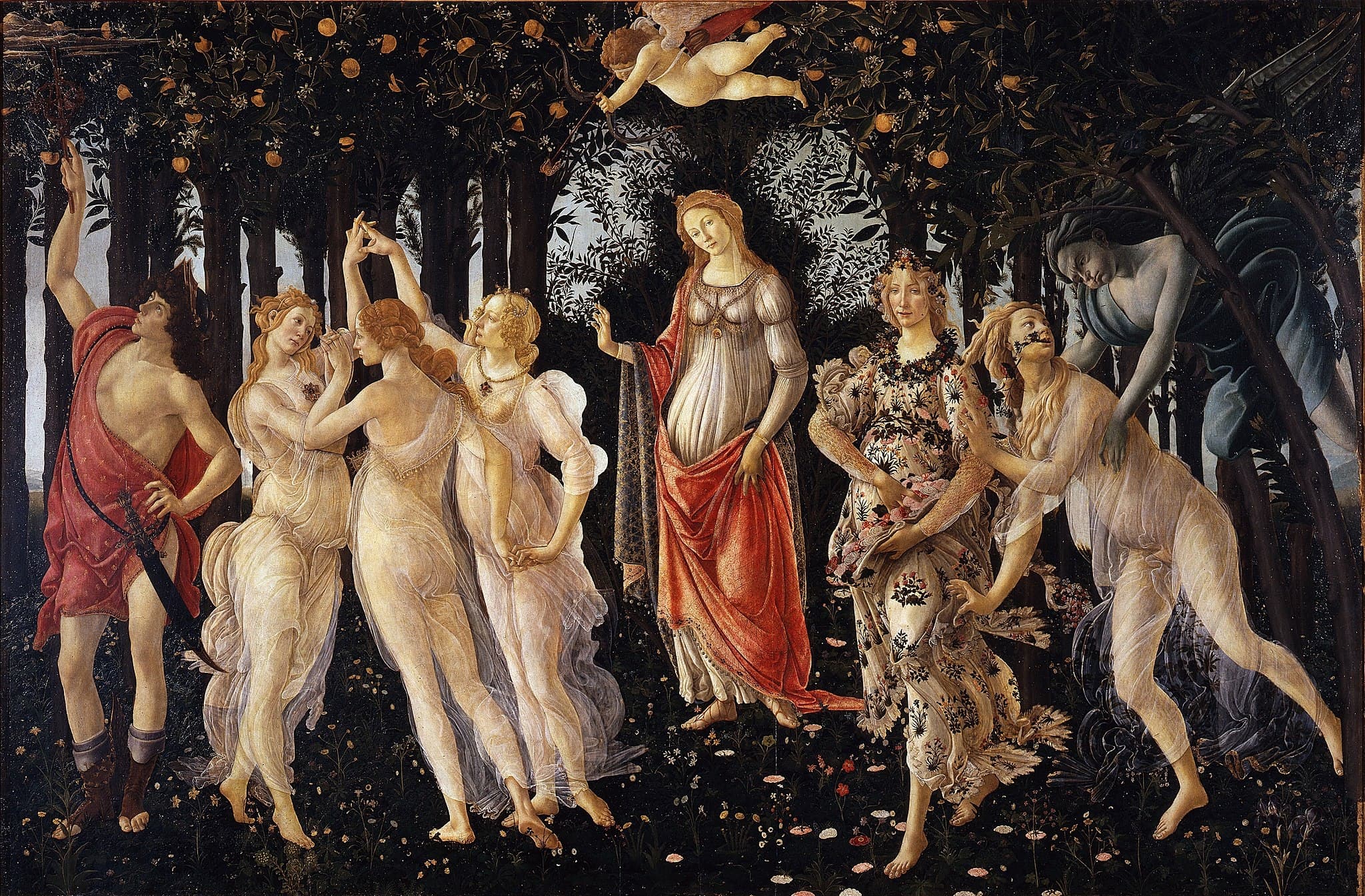
Auction and Ownership Timeline
Painted in Florence
Florence
Botticelli completes Primavera around 1480; the Uffizi dates the work to c. 1480 [1].
Recorded at the Medici Villa di Castello
Villa di Castello, Florence
Giorgio Vasari describes Primavera at the Medici Villa di Castello together with Botticelli’s Birth of Venus [1].
Documented in Castello inventories
Villa di Castello, Florence
From 1598 onward the painting is repeatedly cited in Castello inventories through the 18th century [5].
Recorded in the Guardaroba (state collection)
Florence
After Napoleonic-era reorganizations, the painting is listed in the Guardaroba of the grand-ducal/state collections [2].
Transferred to the Galleria dell’Accademia
Galleria dell’Accademia, Florence
Moved from the Guardaroba to the Galleria dell’Accademia, Florence [2].
Transferred to the Uffizi Galleries
Uffizi Galleries, Florence
Placed in the Uffizi Galleries, where it remains; Uffizi inventory 1890 n. 8360 [2].
New Botticelli Rooms installation
Uffizi Galleries, Florence
Uffizi announces the new permanent installation of the Botticelli Rooms, presenting Primavera with The Birth of Venus [4].
Provenance and Ownership
Late 15th century: In the Medici palace on Via Larga, Florence; later described by Vasari in 1550 at the Medici Villa di Castello together with the Birth of Venus [1]. The painting is repeatedly cited in Castello inventories from 1598 through the 18th century [5].
19th–20th century: Recorded in the Guardaroba (grand-ducal/state collections) by 1815; transferred to the Galleria dell’Accademia in 1853; and to the Uffizi in 1919, where it remains (inv. 1890 n. 8360) [2]. The Uffizi lists the work among its unloanable masterpieces, underscoring its non-circulating status [3].
Quick Facts
- Last known sale
- Not publicly reported
- Known sale price
- Not publicly reported
- Sale type
- No known public sale
- Venue / institution
- Uffizi Gallery, Florence (current holder)
- Current owner or location
- Uffizi Gallery, Florence
- Publicly viewable?
- Yes
Why This Sale Matters
Primavera has never appeared at public auction and has no recorded private sale; its ownership is continuous from the Medici household to today’s Florentine state collections, culminating in its placement at the Uffizi in 1919 [1][2]. The Uffizi formally designates the painting as an unloanable masterpiece, reflecting both its fragility and its central importance to the museum’s identity; practically, this confirms that Primavera is not a market-traded object [3].
This matters for Botticelli’s market because the artist’s most iconic mythologies—Primavera and The Birth of Venus—are held by the Uffizi and are not available for purchase, leaving no direct market comparables for Botticelli’s large-scale secular allegories [1]. As a result, the artist’s auction benchmarks are set by different genres and scales, notably the $92.2 million record for Portrait of a Young Man Holding a Roundel (Sotheby’s, New York, 2021) and the $45.4 million result for The Man of Sorrows (Sotheby’s, New York, 2022) [6][7]. These prices shape expectations for high-quality paintings and rare autograph works by Botticelli, but they cannot be extrapolated to Primavera, which is inalienable public property.
Primavera’s provenance—rooted in Medici display contexts documented by Vasari and later inventories—anchors its art-historical primacy rather than any market trajectory [1][5]. Its stable, celebrated status at the Uffizi helps sustain scholarly and public attention, indirectly supporting demand for related works by Botticelli and his workshop while keeping the artist’s absolute masterpieces outside the realm of price discovery [3]. The 2026 reinstallation of the Botticelli Rooms underscores this continuum, positioning Primavera as a museum-defining work rather than a tradeable asset [4].
Related Pages
Sources
- Spring (Primavera) — Uffizi Galleries — Uffizi Galleries
- Catalogo Generale (ICCD) — Botticelli, Primavera (record 0900158550) — Ministero della Cultura (ICCD)
- Unloanable works — Uffizi Galleries — Uffizi Galleries
- The new permanent installation of the Botticelli Rooms — Uffizi Galleries
- Castello inventories references to Botticelli’s Primavera (1598–1761) — Università Ca’ Foscari Venezia
- Botticelli Portrait of a Young Man Holding a Roundel achieves $92.2m — Sotheby's
- Masters Week results: Botticelli’s The Man of Sorrows sells for $45.4m — Sotheby's