The Hora of Spring in The Birth of Venus
A closer look at this element in Sandro Botticelli's c. 1484–1486 masterpiece
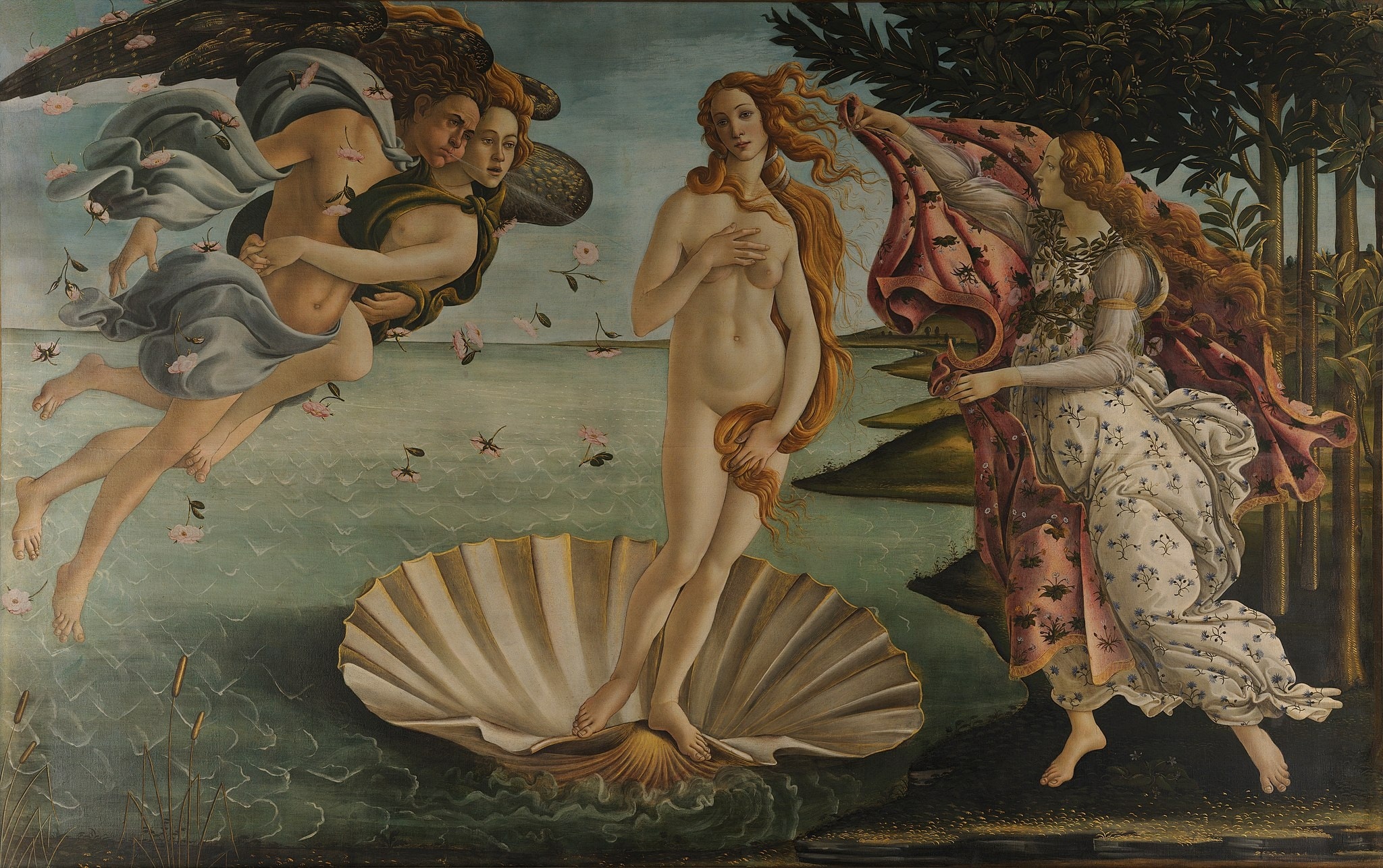
The right-hand attendant in Botticelli’s The Birth of Venus is the Hora of Spring, striding ashore with a flowered mantle to welcome and clothe the newborn goddess. Drawn from a precise classical episode and staged in a Medici-coded grove, she personifies the season when beauty and love enter—and civilize—the world.
Historical Context
Painted in the mid-1480s for a Medici environment, The Birth of Venus casts the right-hand figure as the Hora of Spring, the classical Season who greets Aphrodite on land. The Uffizi identifies her directly as the Hora of springtime and describes the cloak covered with pink flowers that she extends toward Venus; behind her rises an orange grove, a Medici emblem that locates the myth in Florentine court culture 1.
Botticelli translates an ancient text into Quattrocento imagery. In the Homeric Hymn to Aphrodite, the “gold‑filleted Horae” receive the goddess and dress her in heavenly garments as she arrives; Botticelli visualizes this ceremonial welcome by sending Spring forward with a mantle to wrap the nude deity 2. The subject aligns with the humanist circle around the Medici—Agnolo Poliziano’s poetry celebrated Venus’s advent and the Hours—providing a literary prompt and ideological frame for the painting 1. Executed as tempera on canvas, an unusual support in Florence, the work’s airy surface and its spring iconography (roses, floral textiles, citrus trees) fuse classical revival with seasonal festivity in late fifteenth‑century Florence 1.
Symbolic Meaning
The Hora of Spring embodies renewal, fecundity, and the social power of love. Advancing with a flower-strewn mantle, she performs the ancient rite of adorning Aphrodite, transforming elemental birth into civilized presence. In the Homeric Hymn, the Hours clothe the goddess upon landfall; Botticelli turns that literary act into a visual metaphor for beauty’s passage from nature to culture, from sea-spray to embroidered fabric 2.
Her white dress patterned with blossoms and the pink cloak scattered with flowers proclaim the season of blooming, echoing the roses that the winds blow across the water and binding the terrestrial shore to Venus’s marine arrival 1. Museum texts note that the figure is sometimes identified as Flora or as one of the Graces; in each case the symbolism converges on Spring’s generosity and the adornment of beauty 1. Within the Medici’s humanist milieu, the greeting of Spring can be read as a celebration of ideal beauty entering civic life—an ethical, courtly framing of sensual allure. The act of clothing also modulates the sacred/profane tension of the nude by presenting modesty as an artful rite of welcome, aligning Venus with cultivated virtue as she steps into the world 12.
Artistic Technique
Botticelli renders the figure with his signature linear elegance: fine, continuous contours describe her windswept draperies and outstretched arm, while delicate patterning animates the floral dress and the mantle’s pink field of blossoms 1. The painting is tempera on canvas, applied in thin layers that create an airy transparency akin to fresco, enhancing the buoyant motion of cloth and hair 1. Gilded highlights pick out flickers of light in the hair and foliage, sharpening edges and catching the viewer’s eye at the picture’s right margin 1. Compositionally, the Hora leans forward on light steps, her mantle billowing to catch the onshore breeze, a gesture that both mirrors and contains the wind’s force coming from the left.
Connection to the Whole
The Hora of Spring is the painting’s narrative hinge. She converts the winds’ propulsion and the sea’s birth into arrival, reception, and adornment—the precise moment when myth becomes social ceremony 2. Her forward sweep closes the compositional arc, balancing the Zephyrus group at left and turning the viewer’s gaze back to Venus at center. The floral mantle, roses, and Medici oranges knit sea, shore, and grove into a single seasonal program, so that Venus’s epiphany is also Spring’s advent in Florence 1. By clothing the goddess, the Hora stages beauty’s entry into the human sphere, aligning the painting’s sensual appeal with ideals of order, civility, and renewal 12.
Explore More from This Painting
This detail is one part of The Birth of Venus. Use the links below to return to the full interpretation, browse the full set of details, or view the painting's valuation if available.