The Birth of Venus

by Sandro Botticelli

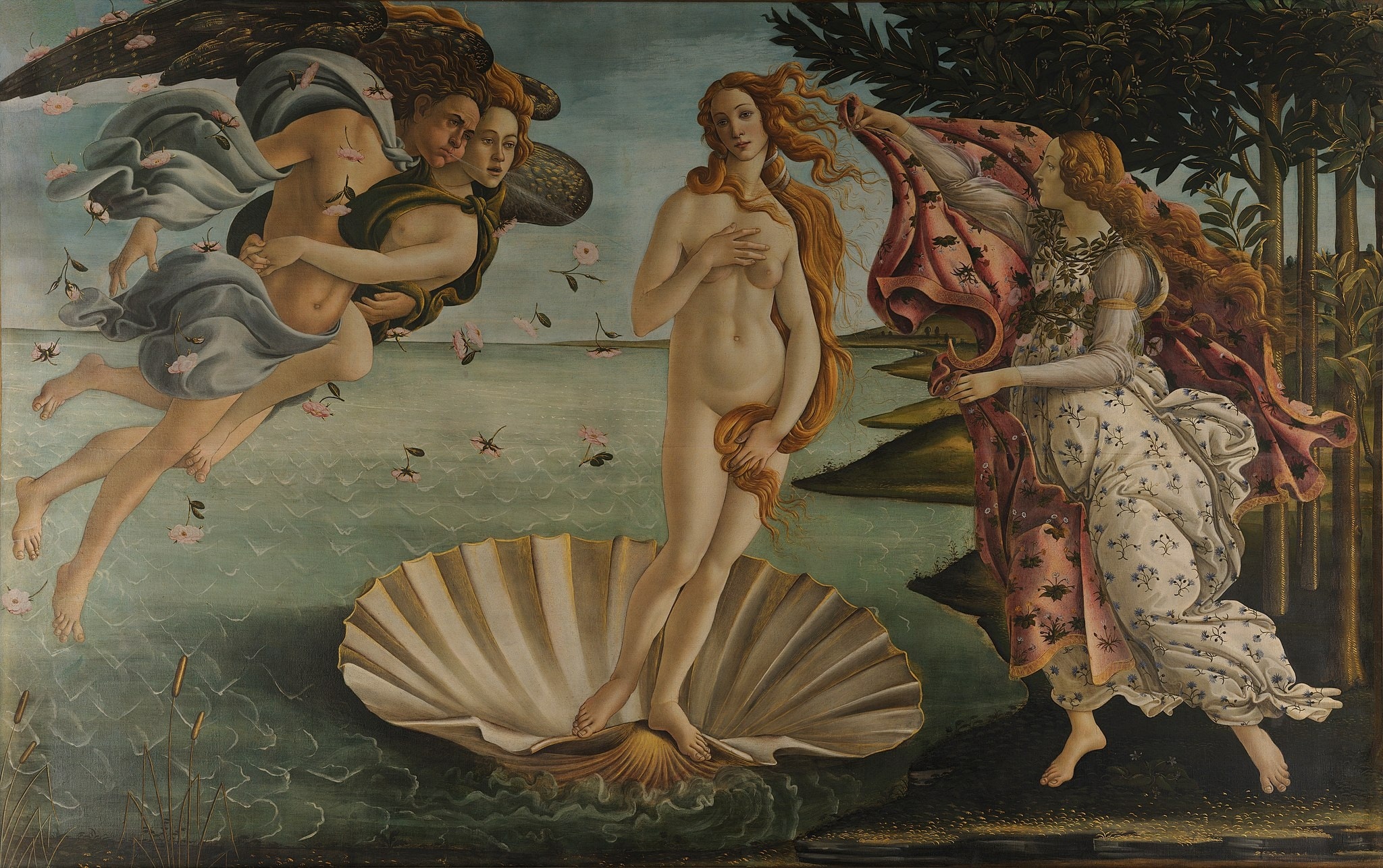
In The Birth of Venus, Sandro Botticelli stages the sea-born goddess arriving on a scallop shell, blown ashore by intertwined winds and greeted by a flower-garlanded attendant who lifts a rose-patterned mantle. The painting’s crisp contours, elongated figures, and gilded highlights transform myth into an ideal of beauty that signals love, spring, and renewal [1][2].

Fast Facts

Year
c. 1484–1486
Medium
Tempera on canvas
Dimensions
172.5 × 278.5 cm
Location
Uffizi Galleries, Florence
The Birth of Venus by Sandro Botticelli (c. 1484–1486) featuring Scallop shell, Intertwined winds (Zephyrus with Aura/Chloris), Roses scattered on the air and water, Flowered mantle

Click on any numbered symbol to learn more about its meaning

Meaning & Symbolism

Botticelli constructs a deliberately unreal, lyrical world to argue that visible beauty can ennoble. Venus stands in a classical Venus pudica contrapposto, her hair and hand modestly veiling her body while she remains luminously exposed on the shell; this poised stillness forms the ethical center of the scene 2. At left, Zephyrus entwined with a breeze (Aura/Chloris) exhales a visible current that scatters pink roses across a patterned, enamel-like sea—desire is active, gusting, and fecund, yet it does not capsize Venus; it bears her forward 12. At right, a figure identified by the Uffizi as a Hora (Spring) or a Grace steps onto the shore’s dark turf and extends a flowered mantle toward Venus; culture meets nature at the waterline, transforming raw allure into civic virtue 1. The orange grove behind her—long read as a Medici allusion—anchors this moralized beauty in Florence’s own social order 1. Symbols refine this ascent from sensual to spiritual. Roses (sweet but thorned) and the myrtle thicket sacred to Venus frame beauty as both pleasure and discipline; the attendant’s white dress strewn with blossoms and the pink cloak echo spring’s renewal, the life-stage when love should ripen into lawful union 14. The huge shell, a standard attribute of Venus Anadyomene, signals birth and purification; set upon ripples that repeat like decorative waves, it reads as a vessel for initiation—a passage from the sea’s generative matter to the cultivated land of custom 13. Botticelli’s tempera on canvas, rare in Florence for elite easel painting, gives the surface a cool clarity enlivened by gold accents in hair and foliage, heightening the aura of the supernal rather than the physical 3. Renaissance viewers could take the scene at multiple levels. Read through Florentine Neoplatonism, the painting teaches that contemplation of ideal beauty elevates the soul from earthly desire (the winds) to divine love (the robed Venus), a moral progress enacted at the very edge of the shore 23. In a household setting, its wedding cues—myrtle, roses, and epithalamic overtones—model chastity, fecundity, and concord for bride and groom, aligning private life with civic ideals 4. Even without learned decoding, the work offers a lucid classical narrative: a goddess arrives, the world welcomes her, and the air fills with flowers. Botticelli thus turns pagan myth into a humanist program—beauty is not merely seen; it civilizes 12.

Explore Deeper with AI

Ask questions about The Birth of Venus

Popular questions:

Powered by AI • Get instant insights about this artwork

💬 Ask questions about this artwork!

Interpretations

Historiography & Patronage Debate

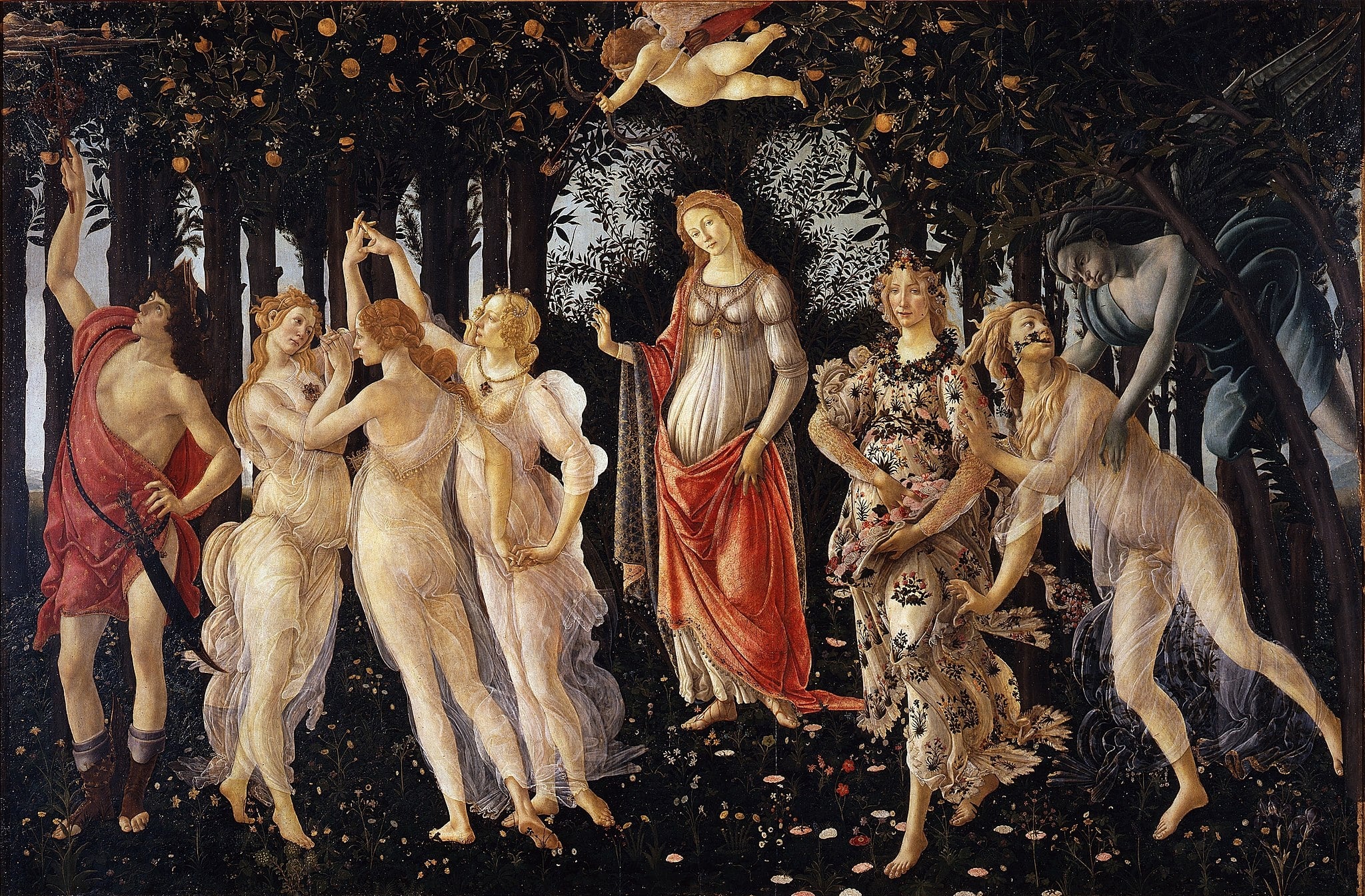
Rather than a settled Medici commission, the work’s early history is contested. Vasari first records it at the Castello villa beside Primavera, yet a 1499 inventory for Lorenzo di Pierfrancesco’s branch omits the painting—complicating the classic attribution of patronage and timing 5. The Uffizi thus hedges: “highly probable” a Medici commission, but unproven 1. This uncertainty matters interpretively: if not tailored for a specific wedding or villa program, the picture’s political and domestic cues become more elastic, capable of serving broader humanist and courtly display purposes across decades. Read this way, the orange grove’s Medicean echo functions less as a dedication than as a flexible branding of Venus’s civilizing beauty within Florence’s ruling culture 15.

Source: Uffizi Galleries; Wikipedia (inventory debate)

Nuptial Culture & Domestic Use

The painting reads fluently as domestic marriage imagery. Myrtle (sacred to Venus), scattered roses, and the epithalamic tone situate the scene within the didactic ecosystem of Renaissance wedding furnishings, which instructed brides and grooms in chastity, fecundity, and concord 14. As Andrea Bayer notes, such mythologies populated bedrooms and cassoni, translating erotic myth into household ethics 4. Venus’s passage from sea to shore parallels the passage from desire to lawful union; the flowered mantle marks the moment raw allure is clothed as virtue. Even if not tied to a documented wedding, its iconography is operable in that register, offering a ritualized script for love’s domestication that harmonizes with civic ideals 24.

Source: Met Museum (Heilbrunn Timeline); Smarthistory; Uffizi

Medium, Surface, and Ideality

Botticelli’s choice of large tempera on canvas—a rarity for elite Florentine easel painting in the 1480s—shapes both viewing and meaning 13. Canvas enabled a lighter, luminous surface and villa-scale portability suited to mythological décor. Botticelli amplifies this with linear clarity and gilded accents in hair and foliage, effects recovered and clarified in the 1987 conservation 3. The result is not tactile flesh but a cool, enamel-like sheen in which beauty appears apparitional rather than corporeal 23. In Neoplatonic terms, the medium’s brilliance aids the ascent from sensual to intellectual beauty; in formal terms, it asserts painting’s power to fabricate an ideal surface where line and light eclipse mimetic weight 23.

Source: Uffizi Galleries; Encyclopaedia Britannica; Smarthistory

Pagan–Christian Syncretism

Several scholars note a visual analogy to Baptism of Christ schemes: a central figure at the water’s edge, flanked by ministering attendants, with a breath or spirit-like agency descending/propelling 5. Read this way, Venus’s emergence becomes a baptismal allegory of beauty—an initiation from watery materia to sanctified culture on shore. The Hora/Grace’s mantle functions like a baptismal garment; Zephyrus’s breath doubles as a pneuma-like impulse translating nature into grace. This bridge doesn’t collapse the myth into doctrine but models the humanist practice of re-signifying pagan forms through Christianized ethics, allowing a Florentine viewer to contemplate Venus as a figure of moral regeneration rather than mere sensuality 25.

Source: Synthesis of scholarship (as summarized in Wikipedia); Smarthistory

Humanist Poetics & Formal Design

The image can be read as a pictorial gloss on Poliziano’s vernacular poetry, where Zephyr, roses, and spring air herald Venus’s advent—part of a Medici humanist milieu that prized antique ekphrasis and the recovery of Apelles’s Venus Anadyomene 12. Botticelli translates verse into line: rhythmic contours, repeated ripples, and arabesque hair render language’s meter as visual prosody. The result is a deliberately “unreal” decorum in which narration (origin myth) fuses with an ornamental system of waves, drapery, and foliage. Here, form is argument: the linear arabesque performs the civilizing syntax the picture proclaims, turning natural forces (wind, sea) into legible, courtly pattern 12.

Source: Uffizi Galleries; Smarthistory

Related Themes

About Sandro Botticelli

Sandro Botticelli (1445–1510) trained in Florence, likely first as a goldsmith and then with Fra Filippo Lippi, developing a lyrical, linear style. He worked for Medici patrons, painted mythologies like Primavera and The Birth of Venus, and contributed frescoes to the Sistine Chapel in Rome (1481–82). His late works turn more visionary, but his idealized line and poetic allegory remain emblematic of Florentine humanism.
View all works by Sandro Botticelli