Venus's Flowing Hair in The Birth of Venus
A closer look at this element in Sandro Botticelli's c. 1484–1486 masterpiece
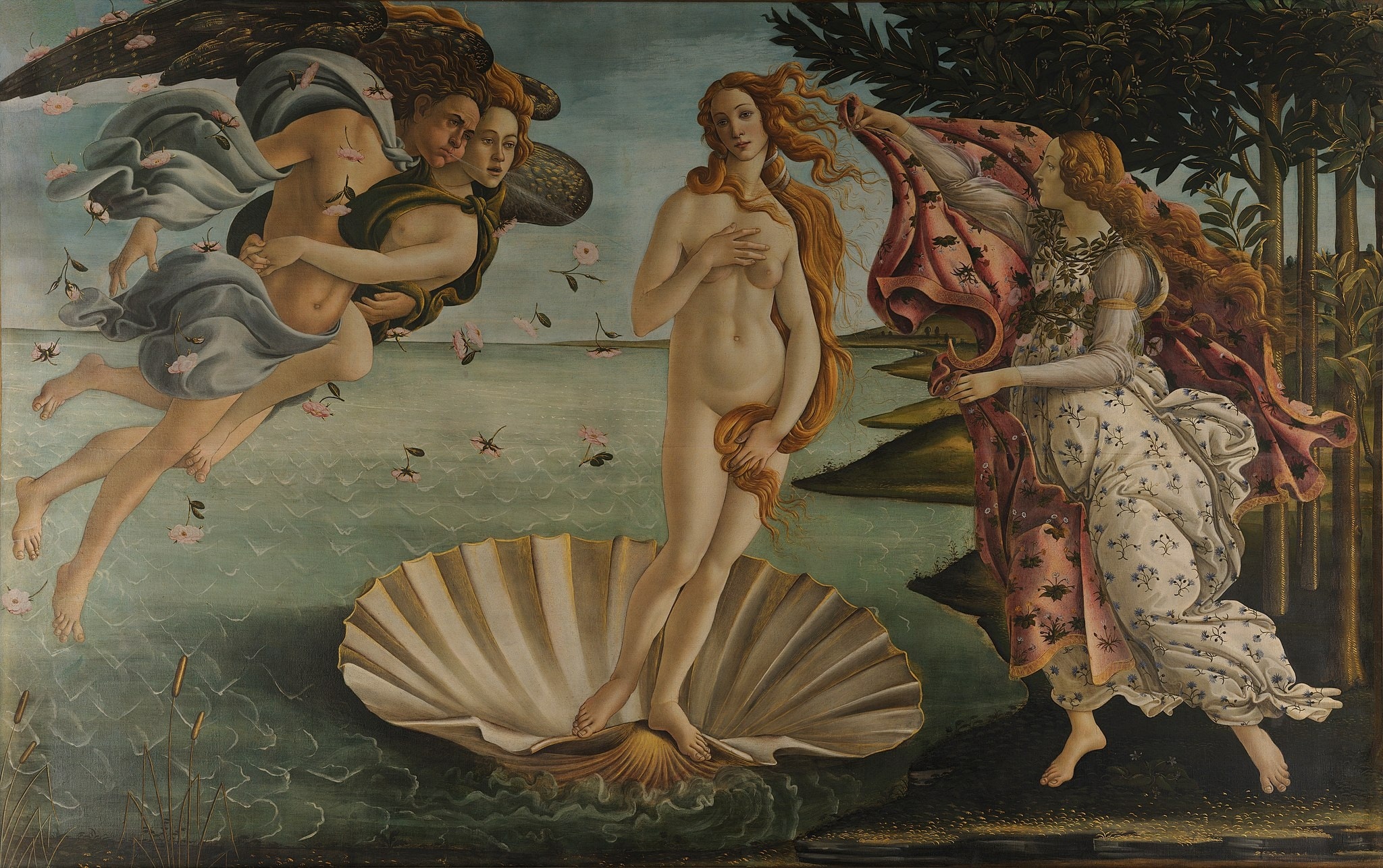
Venus’s flowing hair is at once a veil of modesty, a banner of wind and movement, and a halo of divine radiance. Botticelli turns these cascading, gilded strands into a luminous sign of ideal beauty, fusing antique convention with Medici-court poetics to announce the goddess’s arrival.
Historical Context
Painted in Florence around 1484–1486 for a Medici milieu steeped in humanist poetry, The Birth of Venus stages the goddess’s sea-borne arrival as a celebration of love and beauty. In this setting, Botticelli gives Venus impossibly long, blond hair that responds to the sea breeze while modestly covering her nudity. The Uffizi’s collection entry highlights the hair’s gilded sparkle and its role as a natural covering, and connects the painting’s subject to the courtly culture around Agnolo Poliziano 1.
Smarthistory underscores the work’s Neoplatonic atmosphere and notes that Botticelli literally drew lines of gold into the hair, making it gleam as a visible token of divine beauty rather than mere anatomy. The choice of tempera on canvas and the painting’s lyrical linearity amplify the hair’s flowing contours, allowing it to register the breath of Zephyrus and Aura across the scene while aligning the goddess with an ideal of radiant, elevating beauty celebrated in late quattrocento Florence 2.
Symbolic Meaning
Venus’s hair functions as a modesty veil, updating the ancient Venus Pudica tradition in which gesture—and sometimes hair—softens the erotic display of the nude. Antique and Renaissance examples in major collections clarify this decorum, framing Botticelli’s choice as a learned reference to classical prototypes 34.
The golden color and gilded highlights transform the hair into a sign of ideal beauty with moral and divine overtones. In Florentine culture around Botticelli, fair hair was prized as the most admired female coloring, linking beauty and virtue; gilded strands intensify that aura on Venus herself 512.
As it streams under the breath of Zephyrus and Aura, the hair also visualizes the animating force of love that carries the goddess ashore—beauty literally set in motion 1. This image resonates with the period’s poetic language, especially Petrarch’s celebrated topos of golden hair scattered to the breeze, which Botticelli translates into shimmering line and light 8. Recent scholarship even singles out these windblown tresses as a cultural touchstone of the 1470s–80s, a locus where desire, decorum, and style converge in Florentine visual culture 6.
Artistic Technique
Botticelli paints tempera on canvas, an unusually large, smooth support that lets him articulate long, calligraphic strands without interruption 17. He enriches the locks with gilded accents—actual lines of gold laid over the tempera—to catch and flicker light, making the hair gleam like a luminous filigree 127.
The strands form sinuous S‑curves that echo the rippling sea, airborne drapery, and scattered roses, exemplifying Botticelli’s linear style over sculptural modeling 2. Subtle variations in tone and contour separate clumps of hair while maintaining an elegant rhythm, so that the coiffure reads as both anatomy and ornament. Technical syntheses also note broad use of gold throughout the picture, reinforcing the hair’s role in the painting’s optical choreography 7.
Connection to the Whole
Venus’s hair binds the composition—its gust-swept arcs trace a visual bridge from the winds at left to the attendant at right, guiding the viewer across the surface. Those arcs rhyme with waves, cloak, and roses, creating a single, lyrical current of motion that announces the goddess’s birth and arrival 12.
Iconographically, the hair completes the painting’s synthesis of eros and decorum: it veils the nude in the pudica mode while shining with ideal, near-divine beauty 32. As a moving register of the breeze and a radiant sign of perfection, the hair encapsulates the work’s larger message—beauty animated by love, earthly and elevating at once 12.
Explore More from This Painting
This detail is one part of The Birth of Venus. Use the links below to return to the full interpretation, browse the full set of details, or view the painting's valuation if available.
Sources
- Uffizi Galleries – The Birth of Venus (official collection entry)
- Smarthistory – Sandro Botticelli, The Birth of Venus
- The Metropolitan Museum of Art – Venus Pudica (classical modesty type)
- Walters Art Museum – Modest Venus (Venus Pudica)
- National Gallery (London) – Follower of Botticelli, A Lady in Profile
- Oxford Academic (Art History) – Review noting fascination with Botticelli’s windblown tresses
- The Birth of Venus – Technical consolidation (support, gold highlights, pentimenti)
- Petrarch, Canzoniere 90 (Erano i capei d’oro a l’aura sparsi) – CUNY Manifold