The Scallop Shell in The Birth of Venus
A closer look at this element in Sandro Botticelli's c. 1484–1486 masterpiece
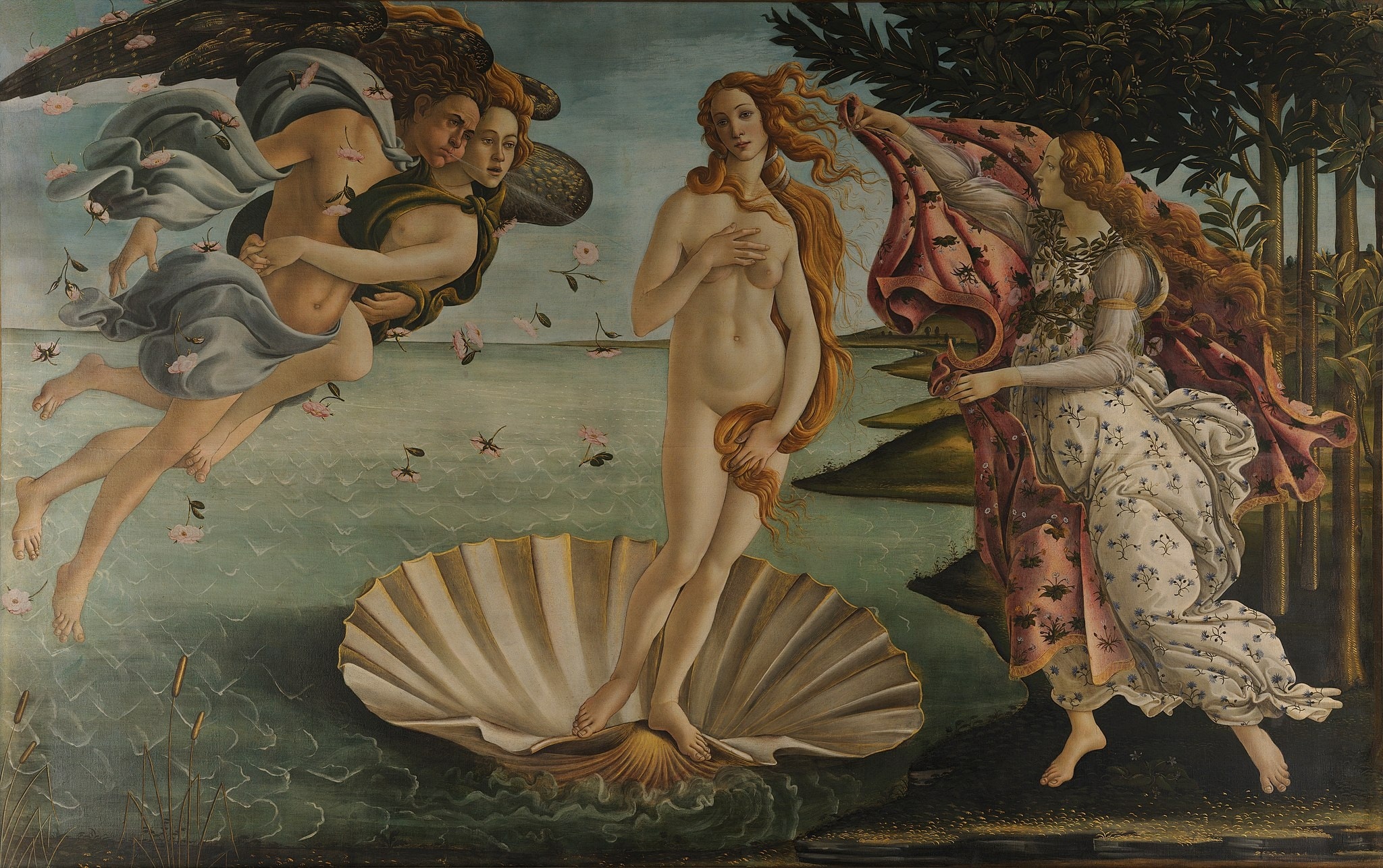
The scallop shell at Venus’s feet is both her vehicle and her signature. Reviving the ancient Venus Anadyomene myth, Botticelli uses the oversized shell to stage the goddess’s shoreward arrival and to announce love and ideal beauty entering the human world.
Historical Context
Painted in Florence around 1484–1486, The Birth of Venus emerged from a humanist milieu steeped in classical poetry and learned mythography. The Uffizi’s curatorial account identifies Venus as "arriving on land" upon a "giant scallop shell," a direct visualization of her sea-birth and landing described in antique sources cherished by Botticelli’s circle 1. Aby Warburg’s landmark 1892 study traced the painting’s invention to Angelo Poliziano’s Stanze, composed for the Medici court, which vividly imagines the winds bearing Venus to shore upon a shell—precisely the moment Botticelli paints 2.
By adopting the shell, Botticelli aligned the work with Florence’s philological classicism, translating text into image with an emblem instantly legible to his audience. The element also suited the painting’s decorative function: a large tempera-on-canvas made for a refined domestic interior, where classical myth signaled erudition and taste. In this context the shell is not an incidental prop but a programmatic citation from revered literature, made visible for a culture devoted to reviving—and reimagining—Antiquity 12.
Symbolic Meaning
Above all, the shell is Venus’s classical attribute. In Greco-Roman and Renaissance iconography it identifies the goddess and narrates her sea-birth, the instant she is conveyed to land as Venus Anadyomene. Museum glossaries and curatorial texts cite this shell-borne arrival as the standard sign of Venus, with Botticelli’s painting the paradigmatic example 319. Ancient artworks, such as Roman mosaics that set Venus against or upon a scallop, confirm the motif’s deep classical pedigree 4.
The shell also carries associations of fertility and erotic generative power bound to Aphrodite/Venus. Classical symbolism links shells to femininity; writers note that the shell’s form and aquatic origin suit the goddess of love and procreation, reinforcing her identity and powers 8. Some humanist viewers would have recognized a secondary, Christian resonance as well: the scallop had long served as the pilgrim’s badge—especially on the Camino to Santiago—so the form could connote a journey or spiritual passage, even if Botticelli’s primary cue is classical 710.
Art-historically, the shell helps mark the “celestial” Venus—nude, sea-born, and emblem of ideal beauty—distinguished from a terrestrial, clothed Venus in related mythologies; this distinction underpins readings of the painting within a Neoplatonic ascent from sensual to higher beauty 115.
Artistic Technique
Botticelli renders the shell in egg tempera on canvas, an elegant, fast-drying medium that sharpens contours and sustains crisp patterning 1. The fan of fluted ridges alternates light and shadow, their gold-edged arcs catching the cool sea light and reading almost like a decorative sunburst. Smarthistory notes how these strict, rhythmic striations echo the “V” motifs of the waves, amplifying the painting’s linear music and ornamental clarity 6.
Deliberately outsized, the shell functions as a stylized stage: a solid yet weightless platform that allows Venus to balance impossibly on poised toes. This purposeful artifice—together with the immaculate contour of Venus’s form—privileges poetic design over naturalistic physics, drawing the eye to line, pattern, and idealized beauty 61.
Connection to the Whole
Compositionally, the shell anchors the painting’s center, locking Venus to the picture’s vertical axis while bridging sea and shore. Its radiating grooves gather and redirect the movement generated by the winds at left toward the welcoming Hora at right, welding the marine and terrestrial halves into a single, legible narrative arc 16.
Narratively, the shell is the vehicle of epiphany: it ferries beauty into the human realm. In Neoplatonic terms, that advent invites viewers to contemplate visible loveliness as a pathway to higher, ideal Beauty; the shell marks the threshold where that ascent begins, making it indispensable to the work’s meaning and to its serene, ceremonious choreography 561.
Explore More from This Painting
This detail is one part of The Birth of Venus. Use the links below to return to the full interpretation, browse the full set of details, or view the painting's valuation if available.
Sources
- Uffizi Galleries, The Birth of Venus (object page)
- Warburg, Aby (1892). Sandro Botticellis 'Geburt der Venus' und 'Frühling'
- National Gallery (London), Glossary: Venus (attributes; shell)
- British Museum, Roman mosaic with Venus and scallop shell
- Gombrich, E.H. (1945). Botticelli’s Mythologies: Neoplatonic symbolism
- Smarthistory, Sandro Botticelli, The Birth of Venus (visual analysis)
- British Museum, Pilgrim badge in the form of a scallop shell
- Encyclopaedia Britannica, Aphrodite (symbols; shell association)
- National Gallery (London), Peter Paul Rubens, The Birth of Venus (classical sources)
- Museum of London, Medieval pilgrim shell tokens and St James’ Way
- Panofsky, Erwin, Titian Problems (celestial vs. terrestrial Venus)