Zephyr and Chloris in The Birth of Venus
A closer look at this element in Sandro Botticelli's c. 1484–1486 masterpiece
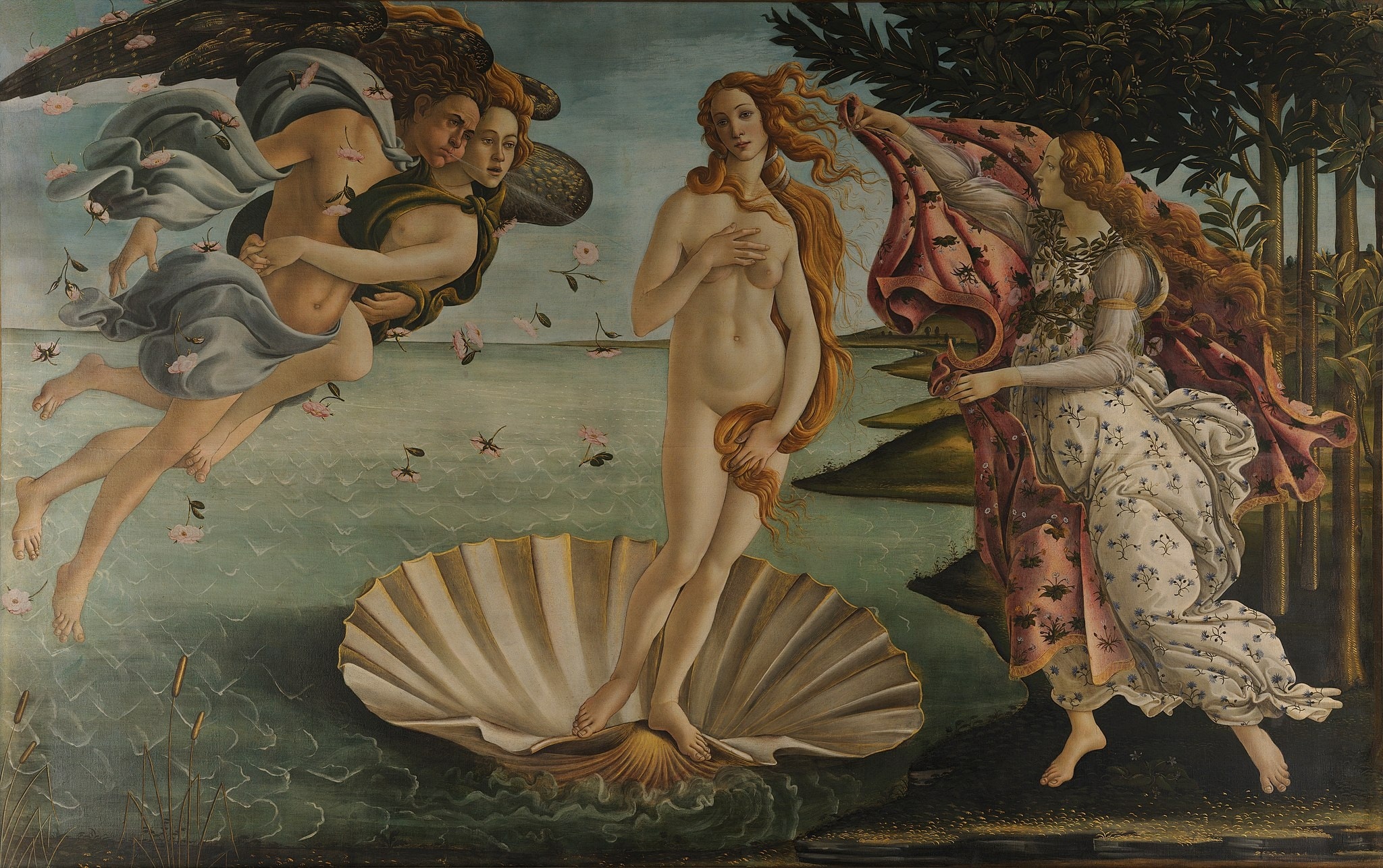
Botticelli’s left-hand duo of Zephyr and his companion surges across the canvas, their breath visibly wafting Venus toward shore. This airborne embrace crystallizes the Florentine revival of classical poetry and philosophy, turning the wind itself into a generative force that inaugurates love and spring.
Historical Context
Painted in Florence in the mid‑1480s for a Medici milieu, The Birth of Venus belongs to a new fashion for large, secular mythologies suited to villa settings. Botticelli cast the left-hand pair as Zephyr, the west wind, clasping a female breeze—identified by early sources as Aura—whose breath carries the goddess ashore. The Uffizi notes both the Medici context and the learned, classicizing program that shaped the imagery, including a probable model for the flying couple in a Hellenistic gem from Lorenzo de’ Medici’s collection 1.
Humanist poetry circulating in the same circle provided the script. Agnolo Poliziano’s Stanze vividly describes Venus on a shell driven by playful zephyrs, a scene Botticelli translates into paint. Smarthistory underscores how artists in Lorenzo’s Florence mined such texts to craft allegories that fused classical myth with contemporary philosophy, making the wind-borne advent of Venus an emblem of cultivated love and beauty 2.
Symbolic Meaning
The Zephyr group personifies the enlivening winds of spring that usher Venus—beauty and love—into the human realm. Botticelli literalizes their breath with fine white strokes radiating from their mouths, while wind‑tossed roses, each with a “golden heart,” tie the breezes to Venus and seasonal renewal 34. As such, the pair functions as the generative spark: Nature’s airy force animates the sea and sets the myth in motion 1.
The female in Zephyr’s arms has two authoritative readings. Following Vasari and many museum texts, she is Aura, a lighter breeze paired with the west wind 14. Alternatively, many scholars align her with Chloris, the nymph seized by Zephyrus and transformed into Flora in Ovid’s Fasti—an identification that forges an iconographic bridge to Botticelli’s Primavera and concentrates meaning on spring’s fecundity 582. Within the Neoplatonic current of Lorenzo’s Florence, the winds’ breath can also be read as the natural and spiritual impulse that brings ideal Beauty into view, inviting the soul’s ascent from earthly desire to intellectual love 23.
Artistic Technique
Botticelli paints in tempera on canvas, an unusual but practical support for expansive villa pictures, enabling sweeping contours and airy rhythms 13. He models the Zephyr group with crisp linearity and gilded highlights that make hair, wings, and drapery shimmer, heightening the sensation of moving air 12. The wind is pictorially “visible”: billowing cloaks, tumbling roses, and delicate white lines of breath that push Venus across the sea 4.
The intertwined, winged couple follows an ancient Hellenistic gem known in the Medici collection, giving the group a classicizing silhouette even as Botticelli stylizes anatomy for lyrical flow 1. Technical summaries note that certain greens and blues have darkened, subtly muting the original chromatic balance of sea, foliage, and wings 4.
Connection to the Whole
Placed at the far left, the winds initiate the painting’s narrative and compositional vector. Their breath propels Venus diagonally toward the shore, where the Hora of Spring advances with a floral mantle to receive her—an action that binds sea, air, and land into a single allegory of birth and renewal 17.
This left‑to‑right sweep also stages the viewer’s passage: from natural motion (winds), through ideal beauty (Venus), to civic and seasonal order (the Hora), a sequence Florentine humanists prized for its ethical and philosophical resonance. Smarthistory emphasizes how the group’s momentum activates the canvas, making the winds the engine of both narrative and meaning 2.
Explore More from This Painting
This detail is one part of The Birth of Venus. Use the links below to return to the full interpretation, browse the full set of details, or view the painting's valuation if available.
Sources
- Uffizi Galleries, The Birth of Venus (object page)
- Smarthistory, Sandro Botticelli, The Birth of Venus
- Encyclopaedia Britannica, Birth of Venus
- Wikipedia, The Birth of Venus (technical and iconographic summary)
- Ovid, Fasti V (Zephyrus, Chloris, Flora)
- Agnolo Poliziano, Stanze per la giostra (translated excerpts and commentary)
- Web Gallery of Art, The Birth of Venus (iconography overview)
- Wikipedia, Primavera (context for Chloris/Flora)