How Much Is A May Morning in the Park (The Fairman Rogers Four‑in‑Hand) Worth?
Last updated: April 24, 2026
Quick Facts
- Methodology
- comparable analysis
Assuming the finished, authenticated oil A May Morning in the Park (The Fairman Rogers Four‑in‑Hand) (1879–80) by Thomas Eakins, a hypothetical open‑market estimate today is $3,000,000–$15,000,000. If the object is a study, grisaille, photograph, or of uncertain attribution the value would be materially lower (roughly $100,000–$1,000,000); if held in a museum it is effectively not for sale and any insurance valuation could be higher.
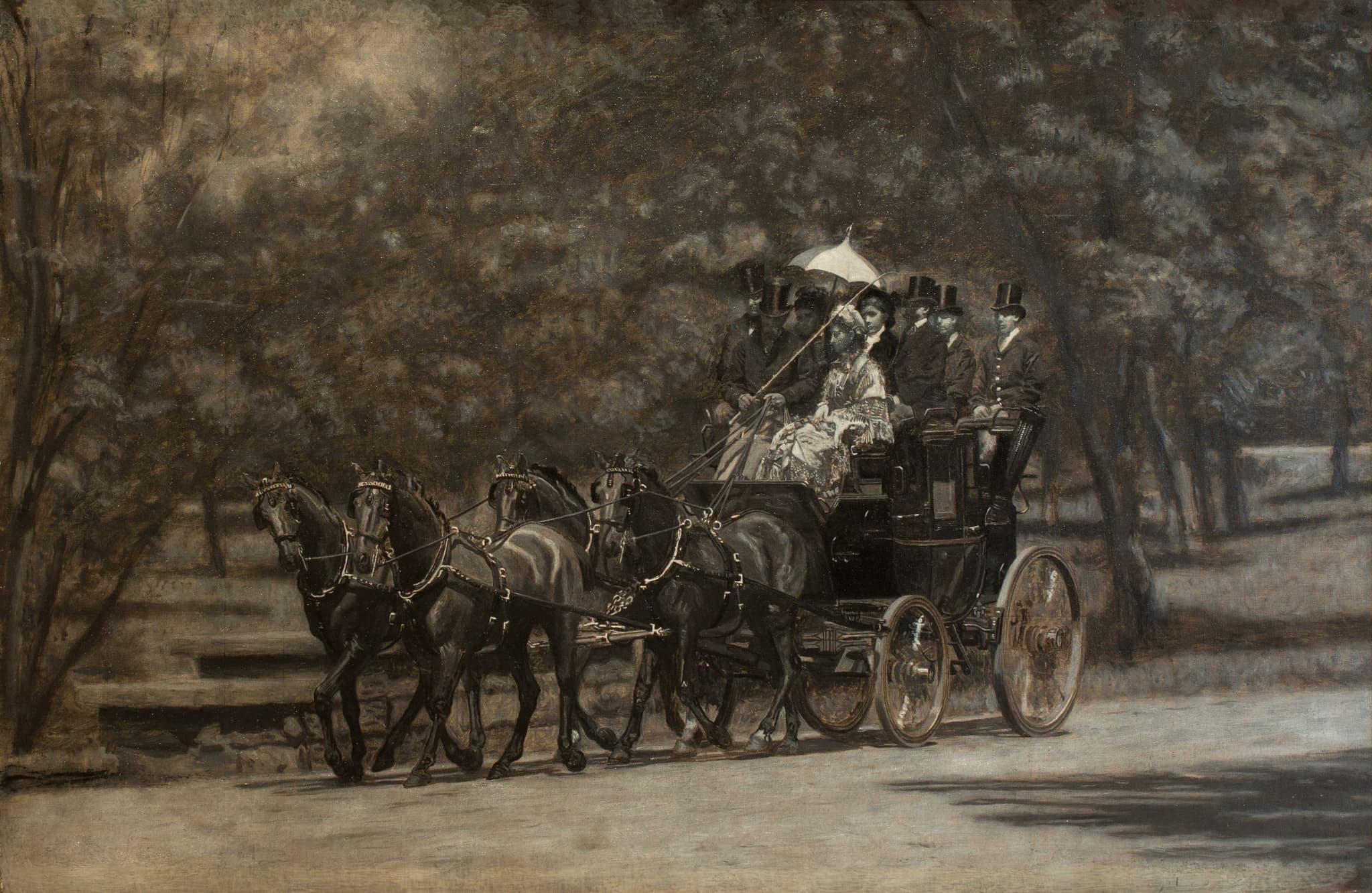
A May Morning in the Park (The Fairman Rogers Four‑in‑Hand)
Thomas Eakins • Oil on canvas
View more by Thomas Eakins →Valuation Analysis
Scope and assumption: This valuation assumes you mean the finished, authenticated oil 'A May Morning in the Park (The Fairman Rogers Four‑in‑Hand)' (1879–80) that is catalogued in the Philadelphia Museum of Art collection, which indicates institutional ownership and long public exposure [1]. Because the finished composition is held publicly, the estimate below is hypothetical and reflects what a major, museum‑quality Eakins oil of this subject would likely realize were it to reach the open market under typical conditions.
Comparables and market anchors: Direct auction comparables for museum‑quality Eakins canvases are rare, but available evidence shows finished oils can attract multi‑million dollar bids. Christie’s sale of Cowboys in the Badlands (2003) realized roughly $5.38M, demonstrating public‑auction demand for important finished Eakins oils [2]. At the same time, the high‑profile institutional negotiation to retain The Gross Clinic sets a de‑facto ceiling for unique masterpieces and illustrates how institutional interest can drive valuations well beyond ordinary auction outcomes.
How the range was derived: The $3,000,000 lower bound reflects a conservative public‑auction scenario for a major finished canvas that is well documented yet not a headline museum masterpiece; it assumes stable condition and good but not extraordinary provenance. The $15,000,000 upper bound reflects a situation where the painting is in excellent condition, has continuous, published provenance, significant exhibition history, and competitive bidding or a strategic private/institutional sale. Key variables that could move the painting within or beyond this range are confirmed attribution and dating, conservation state, the depth of provenance (especially ties to PAFA/Fairman Rogers), and sale channel (public auction vs private/institutional placement).
Alternate scenarios and caveats: If the object is a grisaille study, a photographic study, or an attributed/workshop piece rather than the finished painting, market expectations fall to approximately $100,000–$1,000,000. If the work remains in a museum collection it is effectively off‑market; insurers and museums commonly use replacement valuations that can exceed hypothetical auction estimates. No recent public‑auction sale of the PMA catalogue object was found, and institutional custody materially restricts liquidity and price discovery.
Recommended next steps: Confirm the exact object (accession number or high‑resolution image), obtain a professional condition/conservation report and technical imaging, consult the Eakins catalogue raisonné and PMA curatorial records, and solicit a formal, on‑site appraisal from an American‑art specialist at a major auction house or independent appraiser. For an institution‑quality canvas, prioritize private/institutional placement strategies as they typically produce stronger and more certain outcomes than general‑lot auction consignments.
Key Valuation Factors
Art Historical Significance
High ImpactThomas Eakins is a central figure in American realism, and a finished, large‑scale composition focused on Fairman Rogers and a four‑in‑hand subject occupies an important place in his late‑1870s practice. The subject intersects Eakins’s recurring interests—group figuration, sporting/equestrian themes and portraiture of known Philadelphia patrons—so the painting has intrinsic scholarly and curatorial value. Works that materially advance understanding of an artist’s development or that are linked to notable sitters/patrons are prioritized by museums and institutions, which increases competitive demand and pushes market valuations upward. Inclusion in major exhibition catalogues or the catalogue raisonné further amplifies desirability.
Provenance & Exhibition History
High ImpactDocumented, continuous provenance and a robust exhibition/publication record are primary value multipliers. If the painting’s ownership can be traced through major institutions, galleries or historically significant collections (including PAFA connections or documented Fairman Rogers provenance), the work’s market security and appeal rise substantially. Museum exhibitions, catalogue entries and sustained scholarly attention reduce attribution risk for buyers and invite institutional competition—often the decisive premium for late‑19th‑century American paintings. Conversely, gaps in provenance, unrecorded transfers, or contested ownership materially depress market value and increase selling friction.
Condition & Technical State
High ImpactCondition governs the practical marketability of any oil painting. A stable original surface, minimal invasive restoration, legible signature/inscription, and a clean conservation history support higher estimates. Issues such as major paint loss, overpainting, heavy relining, solvent‑damaged glazes, or structural canvas instability can subtract substantial value and introduce buyer reluctance. Technical imaging (infrared, X‑ray, pigment analysis) that supports Eakins’ hand and chronology reduces attribution risk and can materially increase buyer confidence. A recent, professional conservation report is essential to accurate valuation and sale planning.
Rarity & Market Supply
High ImpactMuseum‑quality Eakins oils appear on the open market only rarely; many of his major canvases reside in institutional collections. Because supply of canonical works is constrained while institutional demand remains strong, a fresh‑to‑market, well‑documented masterpiece typically commands a premium. The paucity of comparable public‑auction lots naturally widens estimate ranges and often shifts sellers toward private or institutional placement strategies to maximize proceeds. Scarcity therefore functions as a multiplier: availability alone can attract competitive bidding or institutional interest that exceeds typical auction expectations.
Market Comparables & Selling Channel
Medium ImpactComparable results show a wide dispersion depending on quality and channel: finished oils have achieved multi‑million dollar results at major houses, while studies, photographs and attributions trade much lower. Historic auction evidence (mid‑single to multi‑million dollars) and isolated institutional purchases indicate that private or institution‑led transactions can drive prices above typical hammer results. For a painting of this significance, a negotiated private sale to a museum or a targeted sale at a major house with institutional interest will normally produce stronger outcomes than an undifferentiated auction lot.
Sale History
A May Morning in the Park (The Fairman Rogers Four‑in‑Hand) has never been sold at public auction.
Thomas Eakins's Market
Thomas Eakins is a canonical American realist whose major finished oils are highly sought by museums and advanced private collectors. Institutional ownership of his best works constrains market supply, producing strong demand when museum‑quality canvases do appear. Auction records and private/institutional transactions show finished oils realize mid‑six to seven figures (with exceptional masterpieces or negotiated institutional placements reaching much higher). Works on paper, photographs and studies trade at significantly lower levels. Provenance, condition, and exhibition history are decisive in translating Eakins’ scholarly standing into commercial value.
Comparable Sales
The Gross Clinic
Thomas Eakins
Same artist; canonical, museum‑quality masterpiece by Eakins that sets the top‑end benchmark for the market for major finished oils by the artist.
$68.0M
2006, Reported institutional purchase/negotiated arrangement (2006)
~$108.3M adjusted
Cowboys in the Badlands
Thomas Eakins
Same artist; public‑auction sale of a finished Eakins oil at a major house — useful as an auction precedent showing mid‑to‑high single‑digit millions are attainable for important finished oils.
$5.4M
2003, Christie's New York
~$9.4M adjusted
Untitled (Male Nudes Boxing) (albumen photograph)
Thomas Eakins
Same artist but different medium (photograph/study). Demonstrates collector demand and pricing scale for Eakins' photographic/study material versus finished oils — typically orders of magnitude lower.
$328K
2022, Sotheby's (Photographs, online)
~$359K adjusted
Current Market Trends
The recent market (2024–2026) has favored a flight to quality and private/institutional sales for high‑value historical works. Auction turnover is more selective; museum exhibitions and major loans (notably 2026 Philadelphia programming) boost visibility and late‑cycle demand. Sellers of museum‑quality Eakins pieces often pursue private or institutional placements to secure stronger, less volatile outcomes; smaller studies and photographs remain the more liquid, lower‑priced segment.