How Much Is Between Rounds Worth?
Last updated: April 24, 2026
Quick Facts
- Methodology
- comparable analysis
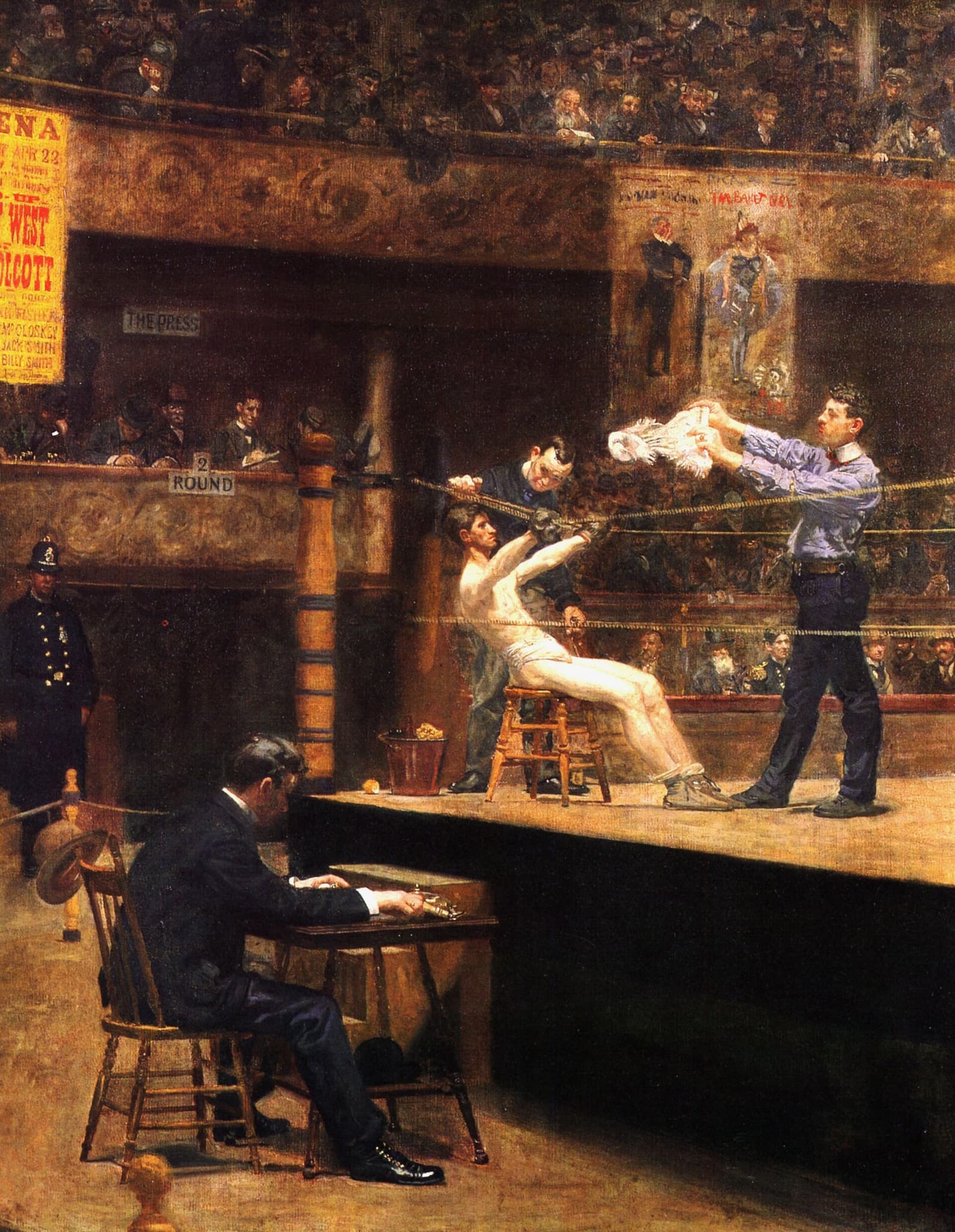
Between Rounds (1898–99) is a museum‑held Thomas Eakins oil (Philadelphia Museum of Art, accessioned 1929) and has not been market‑tested; a defensible hypothetical market range if offered is approximately $3,000,000–$10,000,000, depending on condition, documentation and whether museums compete. This valuation is based on comparative sales of large Eakins oils and related market evidence.
Valuation Analysis
Between Rounds (1898–1899) by Thomas Eakins is a finished oil (approx. 50 1/8 × 39 7/8 in) catalogued in the Philadelphia Museum of Art (accession: Gift of Mrs. Thomas Eakins and Miss Mary Adeline Williams, 1929; Goodrich #312). Because the painting has remained in institutional hands since 1929 it has no modern auction record; this valuation is therefore hypothetical and expresses what the work would likely command if released via deaccession, private treaty or an exceptional public sale [1].
Methodology and comparables: I apply a comparable‑analysis approach anchored to the limited but instructive public and private transactions for major Eakins oils. Public auction precedent for large finished Eakins paintings is thin but important: Christie's sale of Cowboys in the Badlands (2003) remains a prominent auction benchmark for major Eakins oils and informs the multi‑million dollar band for top examples [2]. Private museum purchases of canonical Eakins works (for example the reported 2006 Gross Clinic transaction) establish an institutional ceiling for the artist and demonstrate that museum competition can push values significantly higher [4]. Related market evidence — such as a Sotheby's 2022 sale of an Eakins boxing photograph for a mid‑six‑figure sum — confirms collector interest in the boxing theme but also highlights the large premium placed on finished oils and museum provenance [3].
Estimate and scenarios: Based on scale, finish, subject matter and institutional provenance, a defensible market range is approximately $3,000,000–$10,000,000. Under a conservative auction scenario without an institutional contest or with condition/provenance questions, the painting would be expected nearer the low end. A negotiated private sale to a museum or an auction that attracts competing institutional bidders could move the work toward the high end of the range.
Drivers and risks: Primary positive drivers are the artist's canonical status, the work's finished quality and its clear museum provenance. Key risks that could materially reduce value are unknown current condition (lining, restoration, overpaint), any ambiguity in attribution or signature, and practical constraints on saleability (deaccession policy, institutional preference to retain). Technical imaging and a conservator's report would materially change certainty and could move an estimate up or down.
Next steps to firm value: obtain high‑resolution recto/verso and stretcher/label photography; commission a formal condition and conservation report and technical imaging (X‑ray/IRR/pigment analysis); confirm catalogue raisonné and exhibition citations; solicit pre‑sale opinions from leading auction house specialists and at least one Eakins scholar. With that documentation the price band can be tightened and an optimal sale route (private treaty to an institution vs. major‑house auction) can be selected.
Key Valuation Factors
Art Historical Significance
High ImpactThomas Eakins is central to late 19th‑century American Realism; his finished oils carry outsized scholarly and institutional interest. Between Rounds belongs to Eakins's mature period of athletic genre painting and is often cited in literature (Goodrich #312). A finished, large canvas by Eakins depicting boxing draws both academic attention and museum interest because it connects to his photography and anatomical/athletic studies. This significance raises the floor for institutional and specialist private collector demand and supports valuation in the multi‑million band, provided attribution, signature and condition are confirmed.
Provenance & Ownership
High ImpactThe painting's provenance — a gift to the Philadelphia Museum of Art in 1929 (credit line: Gift of Mrs. Thomas Eakins and Miss Mary Adeline Williams) — is a strong positive for authenticity and scholarly acceptance. Museum ownership typically increases perceived value and reduces attribution risk, but it also removes the work from normal market circulation; any sale would require deaccession and is likely to be constrained by institutional policy. If deaccessioned, the painting's institutional provenance will attract other museums and major collectors who value acquisition security, which tends to support price at or above private‑market comparables.
Market Scarcity & Comparables
High ImpactLarge finished Eakins oils rarely appear at auction, so a very small set of comparables anchors valuation. Public auction benchmarks (e.g., Cowboys in the Badlands, Christie’s 2003) and high‑profile private museum purchases (e.g., The Gross Clinic) provide upper and mid‑market reference points. Works in the same boxing theme but different media (photographs, drawings) sell at markedly lower levels, illustrating a steep premium for finished oils. Scarcity increases both upside (if institutional competition emerges) and valuation uncertainty, because price discovery depends on individual sales rather than a liquid market.
Condition & Technical Authorship
Medium ImpactCondition and technical confirmation are decisive. A clean condition report and technical imaging that corroborate Eakins's hand and a visible signature materially strengthen marketability and can lift value toward the top of the range. Conversely, evidence of extensive lining, heavy inpainting, or later alterations will reduce buyer confidence and could depress realizations substantially. Technical analysis (X‑ray, infrared reflectography, pigment analysis) and conservation history must be established to convert the hypothetical high estimate into a saleable figure.
Marketability & Buyer Pool
Medium ImpactBuyer demand for a work like Between Rounds would concentrate among museums, major institutional donors, and private collectors specializing in American Realism. Sale route matters: a targeted private treaty to a museum or trustee‑brokered sale can capture institutional budgets and avoid auction variability; a major‑house auction in New York can create competitive bidding but also adds market risk. Current institutional programming and anniversaries that spotlight American art can enlarge the buyer pool and improve price outcomes when timed well.
Sale History
Between Rounds has never been sold at public auction.
Thomas Eakins's Market
Thomas Eakins (1844–1916) is a cornerstone figure of American Realism; his canonical oils are museum anchors and attract strong institutional interest. Public auction activity for his largest finished oils is infrequent, producing a market where a few landmark sales and private museum purchases set price benchmarks. Works on paper and photographs are more common in the auction market and trade at markedly lower levels, while finished oils with clear provenance and condition command multi‑million sums when they appear.
Current Market Trends
Current market conditions favor high‑quality, well‑provenanced examples of American Realism while buyers are selective. Institutional programming and anniversaries (e.g., 2026 national showcases) are supporting demand, but the scarcity of Eakins oils means price discovery depends on isolated transactions and targeted sale strategies rather than broad auction liquidity.
Sources
- Philadelphia Museum of Art — Between Rounds (object record)
- Christie's — Cowboys in the Badlands (Thomas Eakins), May 22, 2003 (auction record reference)
- Sotheby's — Untitled (Male Nudes Boxing) (Thomas Eakins photograph), April 2022 (illustrative thematic sale)
- Washington Post — Coverage of the reported 2006 Gross Clinic institutional acquisition (market ceiling context)