How Much Is The Biglin Brothers Racing Worth?
Last updated: April 24, 2026
Quick Facts
- Methodology
- comparable analysis
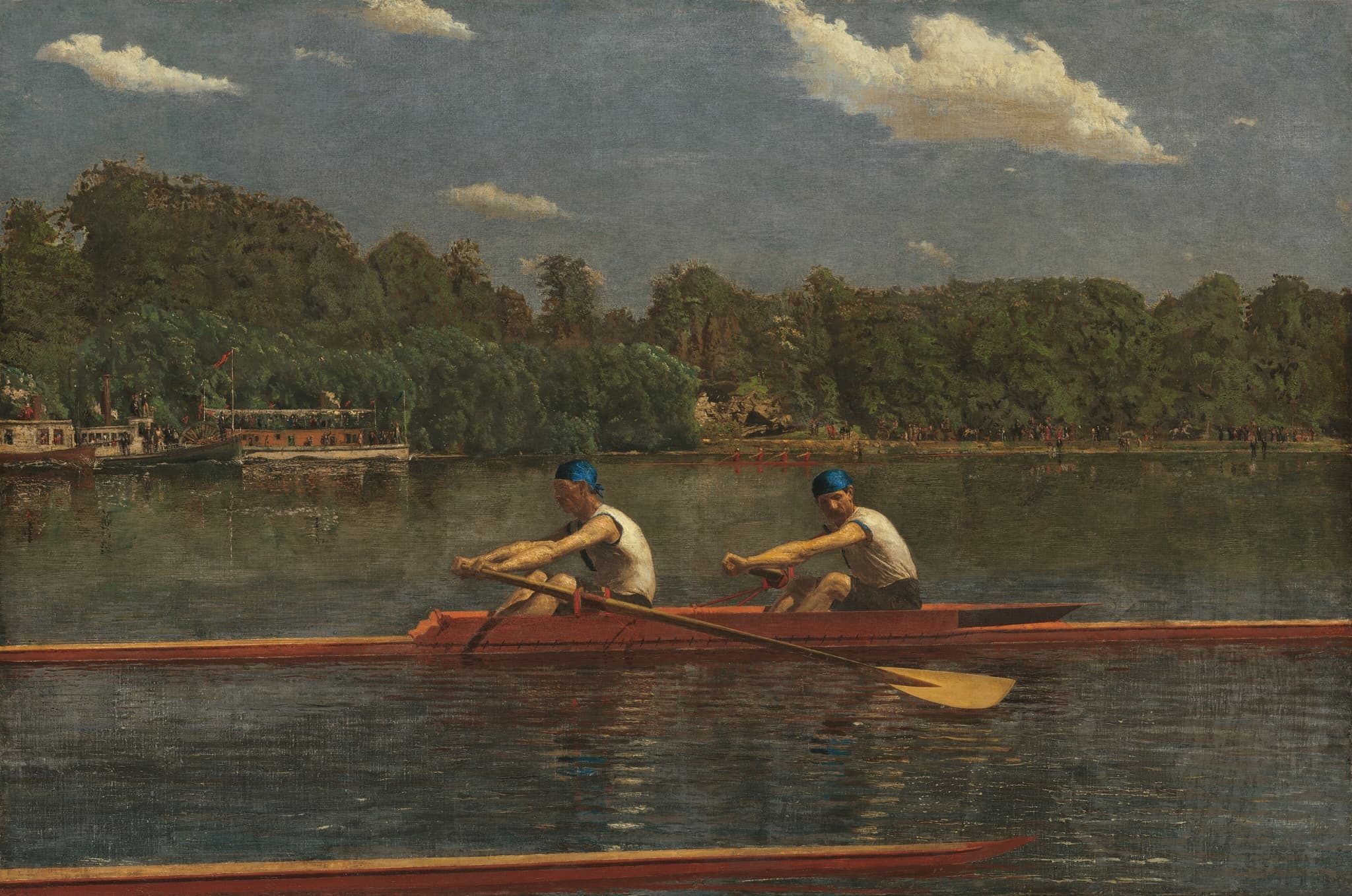
Assuming an autograph, finished Thomas Eakins oil (c.1872) in good condition, I estimate market/insurance value at $750,000–$3,500,000. The band reflects limited open‑market comparables, institutional scarcity of major Eakins oils, and the premium for well‑provenanced, exhibited canvases.
Valuation Analysis
Valuation conclusion: Assuming the painting presented is an autograph, finished oil by Thomas Eakins dating to circa 1872 (the canvas in the National Gallery of Art collection or an equivalent autograph variant) and is in good to very good condition, my market-value band is $750,000–$3,500,000. This band is offered as a working market/sale range and as an insurance/replacement figure for a museum—if the object is the NGA-owned canvas it is not available for public sale and institutional valuation procedures would apply [1].
How I derived the band: I used a comparable-analysis approach anchored to public-auction and institutional benchmarks. The public auction ceiling for Eakins’ finished oils is represented by Christie’s 2003 sale (Cowboys in the Badlands), which establishes the upper open-market precedent for a major finished Eakins oil [2]. At the same time, the private/institutional purchase of canonical works such as The Gross Clinic demonstrates institutions will pay materially higher sums for museum-caliber masterworks [3]. Because most major Eakins oils are museum-held, a scarcity discount applies to open-market liquidity; consequently the realistic sale band for a well-documented Biglin Brothers canvas sits below the highest institutional benchmarks but above the levels realized for minor studies and photographs.
Subject and market position: The Biglin Brothers motif is an important early subject for Eakins and is well-known to curators and collectors; multiple related canvases and studies are in public collections, which both affirms the subject’s significance and reduces the likelihood of frequent high-end market turnover [1]. Institutional programming and anniversaries that spotlight 19th‑century American realism can raise demand and conditional premiums for canonical works—an effect visible in recent major exhibition cycles and planned centennial/tercentenary programming [5].
Key value drivers and sensitivity: The single largest determinants of placement within the band are (a) secure autograph attribution and technical confirmation, (b) size and finish (large, finished canvases command a premium), (c) documented provenance/exhibition history, and (d) condition and restoration history. By contrast, studio replicas, later copies, or small studies typically trade in much lower ranges—regional-house evidence for modest finished oils (for example, an authenticated small Eakins sold at Doyle for approximately $38,400) illustrates the downside of weak provenance/scale [4].
Recommendation: Treat this valuation as conditional. To finalize value to within a narrow band, obtain high-resolution photography, a conservator’s condition report, technical imaging (X‑ray/IR), and provenance documentation; then consult a specialist at a major auction house or an independent appraiser experienced with Eakins and 19th‑century American painting. If desired, I can draft outreach text to a Christie’s/Sotheby’s specialist and to relevant curators to begin formal vetting and technical study.
Key Valuation Factors
Art Historical Significance
High ImpactThe Biglin Brothers subject is a pivotal early Eakins composition illustrating his study of motion, anatomy and American sporting life. It is well represented in museum holdings and scholarship, which gives the motif curatorial visibility and collector recognition. While it is not on the absolute canonical tier of The Gross Clinic, the subject’s documented role in Eakins’ development makes it desirable to institutions and specialist collectors. That said, several extant versions (finished canvases, studies, watercolors) moderate pure rarity-driven price escalation; significance supports market interest but alone does not guarantee top-tier pricing reserved for unique masterpieces.
Attribution & Condition
High ImpactSecure autograph attribution and sound physical condition are decisive. An authenticated, period‑finished Eakins canvas with confirming technical indicators (brushwork, ground/pigment analysis, IR/X‑ray evidence) will command the top of the band. If technical imaging or conservation reports reveal overpainting, heavy restoration or evidence of later manufacture, market value typically falls materially (commonly by 20–70% depending on severity). Technical confirmation materially increases buyer confidence and marketability; unresolved attribution or condition issues force conservative pricing and limit institutional interest.
Provenance & Exhibition History
High ImpactA documented chain of ownership, inclusion in major exhibitions, and citation in catalogue raisonnés or scholarly literature materially amplify value. Works with continuous, prominent provenance and exhibition history are attractive to museums and private collectors and are more likely to realize high private-sale or auction outcomes. Gaps or title ambiguities depress liquidity and price; provenance can be the difference between a mid‑six‑figure sale and a low‑seven‑figure institutional acquisition when combined with strong attribution and condition.
Market Comparables & Auction Record
High ImpactEakins’ market is anchored by a small number of benchmarks. The public auction ceiling for finished oils (Christie’s 2003 result) and the very large private/institutional transactions for canonical works frame expectations for top-tier pricing. Conversely, regional sales of small portraits and studies demonstrate the much lower realizations for lesser works. These comparables justify a band that sits above study-level pricing but below rare institutional purchase levels; availability of a museum-quality, well-provenanced Biglin canvas could push toward the upper end of the band in a targeted private sale.
Demand & Institutional Interest
Medium ImpactInstitutional demand for Eakins remains the principal engine for high valuations—museums strategically acquire canonical works to fill collection gaps. Curatorial programming, anniversary surveys and major exhibitions can create episodic uplift and spur private‑sale competition. However, the cohort of institutions able and willing to purchase multi‑million‑dollar Eakins is limited; demand is therefore meaningful but selective. For an autograph Biglin Brothers canvas, targeted institutional interest can produce premium outcomes, but broad market demand is more muted than for universally recognized masterpieces.
Sale History
The Biglin Brothers Racing has never been sold at public auction.
Thomas Eakins's Market
Thomas Eakins (1844–1916) is a central figure of American realism whose best works are strongly held by museums. Market behavior is bifurcated: canonical masterpieces attract institutional/private sums (the Gross Clinic is a notable private/institutional benchmark) while public auction records for finished oils are significantly lower (the Christie’s 2003 auction record remains the open‑market high). Smaller oils, studies and photographs trade in far lower ranges, and active liquidity is concentrated in mid‑tier and study categories. Attribution, provenance and condition are the dominant determinants of realized price.
Comparable Sales
Cowboys in the Badlands
Thomas Eakins
Same artist; a major finished oil sold at public auction — serves as the public auction ceiling/benchmark for Eakins oils.
$5.4M
2003, Christie's New York
~$9.3M adjusted
The Gross Clinic
Thomas Eakins
Same artist; the artist's canonical masterpiece and the high‑water institutional/private benchmark — shows institutional willingness to pay for museum‑quality Eakins.
$68.0M
2006, Private / institutional acquisition (announced Nov 2006)
~$107.6M adjusted
Untitled (Male Nudes Boxing) [photograph]
Thomas Eakins
Same artist but different medium (photograph). Demonstrates market strength for rare Eakins photographic/study material in the mid six‑figure range.
$328K
2022, Sotheby's (Photographs sale, New York)
~$357K adjusted
The Singer (Mrs. Liego)
Thomas Eakins
Same artist; example of a smaller finished oil/portrait on the recent market — shows that modest oils/portraits can realize low‑to‑mid five figures at regional/top‑specialist sales.
$38K
2024, Doyle (American Paintings & Prints, New York)
~$39K adjusted
Current Market Trends
Current market conditions favor scarcity and selectivity: high-quality 19th‑century American works see steady institutional demand, while mid‑tier works remain price-sensitive. Major exhibitions and anniversary programming (notably planned Philadelphia surveys) can boost short-term interest and acquisition budgets. Supply of important Eakins oils remains constrained, so meaningful open-market opportunities are rare and often proceed via targeted private-sales or curator-driven placements rather than broad auction competition.
Sources
- National Gallery of Art — The Biglin Brothers Racing (object page)
- Christie's — Cowboys in the Badlands (Thomas Eakins), auction record reference
- PBS — Coverage of The Gross Clinic institutional acquisition and significance
- Doyle — Example regional sale (The Singer), recent market evidence for smaller Eakins oils
- Philadelphia Museum of Art — A Nation of Artists / exhibition programming (market context)