How Much Is The Writing Master Worth?
Last updated: April 24, 2026
Quick Facts
- Methodology
- comparable analysis
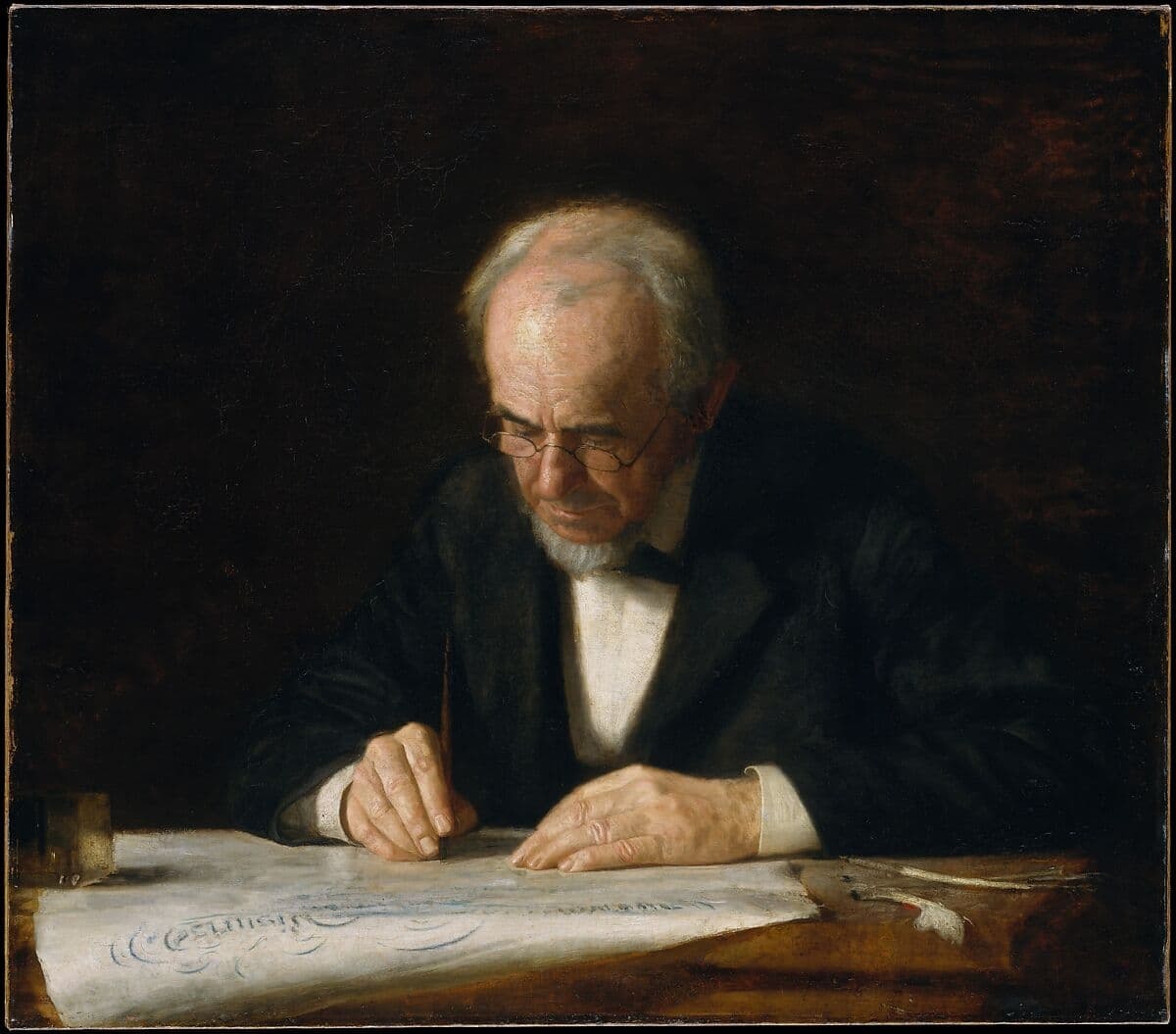
The Writing Master (1882) by Thomas Eakins is in The Metropolitan Museum of Art (accession no. 17.173) and has no public sale history since acquisition. If hypothetically offered on the open market, a defensible public‑sale estimate is approximately $2,000,000–$6,000,000 based on auction comparables, institutional provenance, and the painting’s mature quality.
Valuation Analysis
Hypothetical market valuation: $2,000,000–$6,000,000. The Writing Master (1882) is held in The Metropolitan Museum of Art (accession 17.173) and therefore carries long institutional provenance rather than a recent sale history; this valuation is a hypothetical open‑market estimate based on comparable auction results, institutional context, and known exhibition history [1].
The primary market anchors for this assessment are realized public‑auction results for mature, finished Eakins oils and documented museum‑level transactions. A leading public‑auction benchmark is the 2003 Christie’s sale of a major Eakins oil (commonly cited as a top public result), which indicates the open‑market upper bound for significant Eakins canvases in auction rooms absent extraordinary institutional competition [2]. At the extreme institutional end, the privately mediated transfer of The Gross Clinic demonstrates how canonical Eakins works can command much larger sums when museums and consortia drive acquisition decisions [3]. Smaller portrait and study sales in the low tens of thousands establish the market floor for less substantial Eakins works [4].
Specific factors supporting the $2M–$6M band are the work’s maturity (an 1882 portrait of the artist’s father), comfortable dimensions (approx. 30 × 34¼ in.), and strong early recognition culminating in Met acquisition (John Stewart Kennedy Fund, 1917). Institutional ownership materially increases scholarly prestige and collector demand in the rare event the canvas were offered, but also reduces liquidity because museums seldom deaccession major examples. Absent a professional condition and technical report, condition‑related uncertainty is the main variable that could move value materially up or down.
Risk scenarios: if conservation or connoisseurship downgraded the attribution (or revealed major condition problems), a credible downside band would be roughly $300,000–$1,000,000. Conversely, if the painting became the focus of renewed scholarship or a competitive institutional buyer pursued it privately, a placement could exceed typical auction norms and push toward higher single‑figure millions — an uncommon but documented outcome for museum‑grade Eakins [3].
To refine this estimate into an insured replacement value or an auction presale estimate, obtain recto/verso high‑resolution images and inscriptions, a formal conservation/condition report, the Met’s accession/provenance file and exhibition/catalogue citations, and a formal pre‑sale opinion from a senior American‑art specialist. With those inputs a narrower, transaction‑ready valuation can be produced.
Key Valuation Factors
Art Historical Significance
High ImpactThomas Eakins is a central figure in American realism; a mature 1882 portrait such as The Writing Master documents his interest in naturalism, character study and steady studio technique. Although not a large canonical history painting, a portrait of the artist’s father has intrinsic biographical and scholarly value and contributes to narratives about Eakins’s development. Works with clear autograph authorship from this period attract institutional interest and specialist collectors. Art‑historical importance therefore exerts a high positive impact on value, particularly when combined with museum provenance and exhibition history that confer academic validation.
Provenance & Institutional Ownership
High ImpactThe Met accession (John Stewart Kennedy Fund, 1917) is a very strong provenance indicator: museum ownership elevates the painting’s scholarly profile, supports higher insured/replacement valuations, and signals quality to potential buyers. At the same time, institutional ownership diminishes market liquidity because such works rarely enter the commercial market; if they do, sales tend to be by private treaty or institutional negotiation and can attract premium pricing. Verification of pre‑1917 provenance would further firm the valuation; unknown gaps introduce some uncertainty.
Condition & Technical State
Medium ImpactNo condition report has been provided. Condition issues (structural problems, heavy relining, extensive inpainting, unstable ground or problematic varnish) can materially reduce market value; conversely, excellent conservation standing and documented unobtrusive restoration support top estimates. A professional conservation assessment (including cross‑section/IR/UV as needed) is required to remove the principal technical uncertainty from the valuation. Because condition is unknown, I assign a medium impact: it is decisive but currently indeterminate.
Exhibition & Publication History
High ImpactEarly exhibition at a major event (listed among Eakins’ works at the Chicago fair/World's Columbian Exposition) and century‑long Met ownership meaningfully increase collectability. Works that appear in museum catalogues, monographs or landmark exhibitions typically command higher multiples because institutional buyers and informed private collectors prize documented works. Continued scholarly attention or inclusion in new monographic or survey exhibitions will further elevate market desirability and can translate to stronger realizations.
Market Comparables & Liquidity
Medium ImpactComparable auction evidence shows a bifurcated market: mature Eakins oils can reach mid‑single to low‑seven figures at public auction (a 2003 Christie’s sale is a benchmark), while exceptional museum‑driven transactions have far exceeded auction norms. Small portraits, studies and drawings commonly sell in the low tens of thousands, reflecting limited liquidity for non‑canonical works. Given this landscape, comparables support a mid‑range auction estimate but also show that private/institutional placements can produce materially different outcomes.
Sale History
Thomas Eakins's Market
Thomas Eakins (1844–1916) is one of the most important American realist painters; his best works are held by major museums and receive strong institutional attention. Public auction results vary widely: mature, finished oils have occasionally achieved multi‑million dollar results (a 2003 Christie’s sale is a key benchmark), while many studies, small portraits and works on paper sell at much lower levels. The highest value outcomes are frequently museum‑driven or private placements rather than routine auction competition. Institutional demand and scholarly visibility are therefore the primary drivers of top‑tier pricing in Eakins’s market.
Comparable Sales
Cowboys in the Badlands
Thomas Eakins
Same artist; large finished oil sold at public auction and represents the artist's benchmark auction result — useful as a top-tier public-auction comparable for major Eakins canvases.
$5.4M
2003, Christie's New York
~$9.2M adjusted
The Gross Clinic
Thomas Eakins
Canonical masterpiece by Eakins and an institutional-level transaction that sets the exceptional ceiling for museum-grade Eakins works; not a routine market comparable but important for upper-bound valuation.
$68.0M
2006, Private / museum transaction (reported purchase/transfer)
~$106.0M adjusted
The Singer (Mrs. Liego)
Thomas Eakins
Recent small Eakins portrait sold at auction; shows current lower-end public-market realizations for Eakins portraits/studies and helps define the market floor for non-master, small-format works.
$38K
2024, Doyle, New York
~$39K adjusted
Current Market Trends
The current market (2023–2026) shows fewer headline mega‑sales and relatively stronger activity at mid and lower price bands. Institutional exhibitions and scholarship (including 2026‑era American‑art programming) can temporarily increase demand for museum‑quality works. For Eakins, major price movements are typically driven by institutional buying or high‑profile private placements; routine auction liquidity for large oils remains limited, while small works continue to trade more frequently at modest prices.
Sources
- The Metropolitan Museum of Art — Collection: The Writing Master (Thomas Eakins), Object no. 17.173
- Christie's — Major Thomas Eakins oil sale ("Cowboys in the Badlands"), Christie’s New York, 22 May 2003
- The Gross Clinic — documented institutional acquisition and coverage (background on exceptional museum‑level pricing)
- Doyle — Recent small Eakins portrait sale (example of lower‑end realized prices), The Singer (Mrs. Liego), 23 Oct 2024