Surveyed Streets vs Sidelong Stages
Both artists rebuild modern vision rather than merely record it. Caillebotte stabilizes Paris with axes and vanishing lines; Degas makes perception itself move—off‑axis, cropped, provisional. Read together, they show how a painting can be engineered like a bridge or choreographed like a rehearsal.
Comparison frame: How do Caillebotte’s “surveyed” streets and Degas’s “sidelong” stages reengineer what a painting lets us see?
Quick Comparison
| Topic | Edgar Degas | Gustave Caillebotte |
|---|---|---|
| Primary vantage | Measured survey; calibrated horizon; viewer as steady onlooker | Off‑axis, wing‑side, or overhead; viewer as glancing participant |
| Space built by | Strong perspective, vanishing lines, architectural scaffolds | Cropping, diagonals, footlights, and withheld centers |
| Light as structure | Cool daylight, reflective pavements, lucid mid‑distance | Artificial glare and contre‑jour; zones of glare/shadow |
| How the “instant” is made | Constructed clarity that exceeds camera limits of the 1870s | Choreographed fragments; the instant as a moving sequence |
| Typical setting | Haussmann boulevards, bridges, bourgeois interiors | Opéra rehearsals, shops, laundries, baths |
| Treatment of labor | Procedures and tools mapped in perspective (planing, surveying) | Repetition and pressure turned into gesture (barre, ironing) |
| Social temperature | Detached clarity; civic space read at arm’s length | Complicit proximity; intimacy under institutional rules |
Shared Ground
Caillebotte and Degas turn modern Paris into a laboratory for vision. Instead of chasing plein‑air shimmer, both construct scenes in the studio from precise observation, drawing, and revision. They adapt photography and Japanese prints—cropped edges, raking diagonals, high horizons—while keeping drawing and structure in charge. The result is a hybrid modernism that makes seeing itself the subject: how a glance assembles a world, and how composition can stage that assembly.
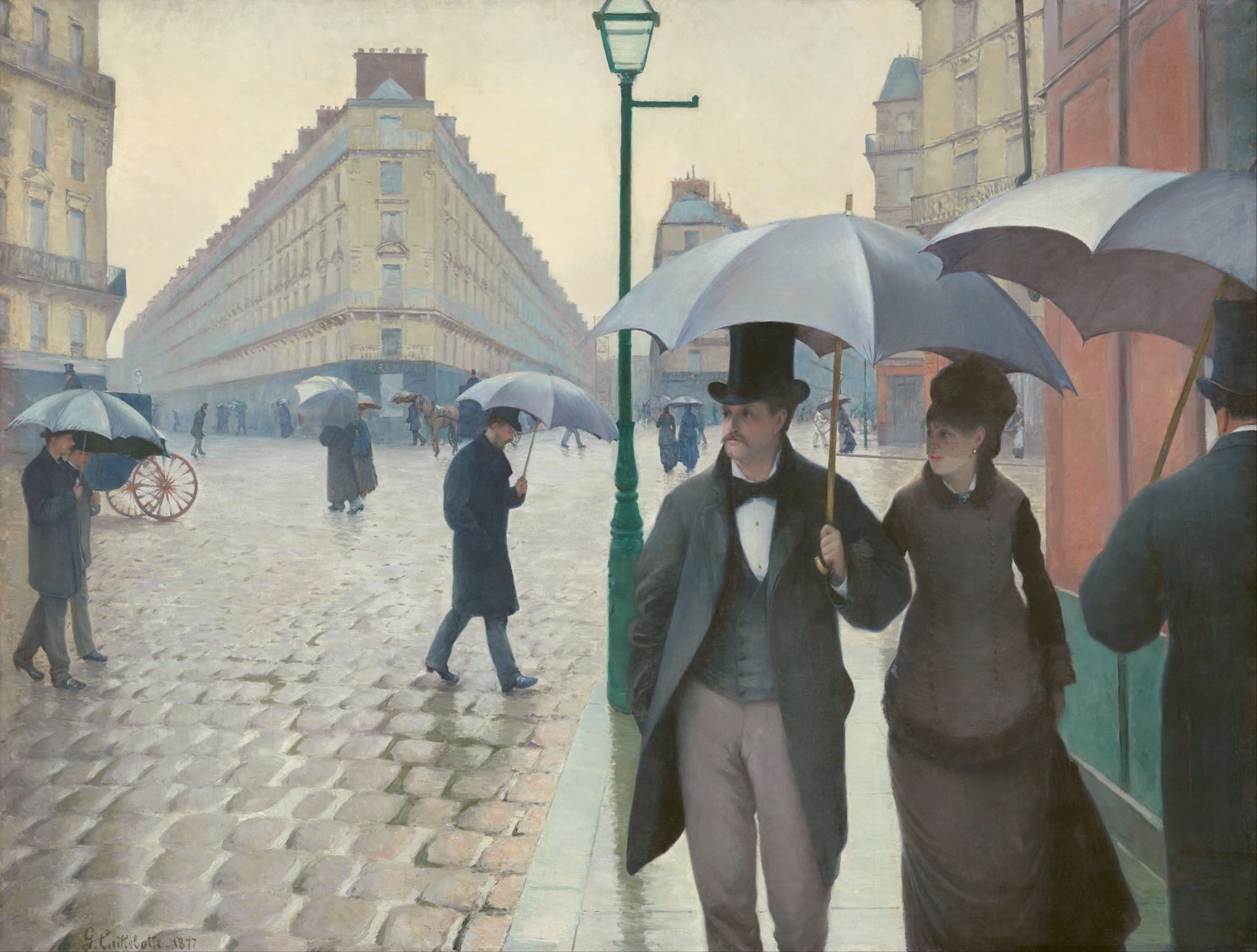
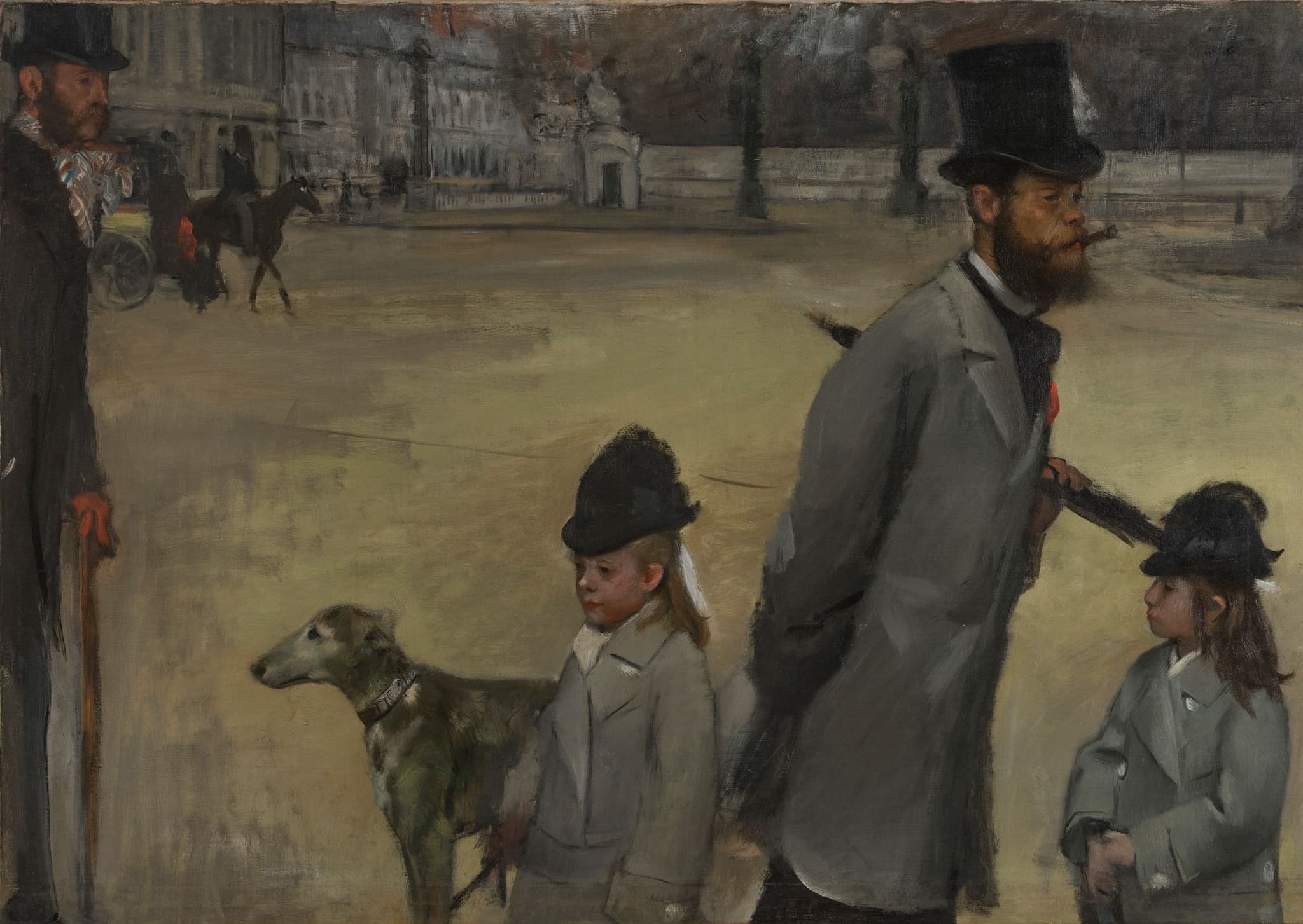
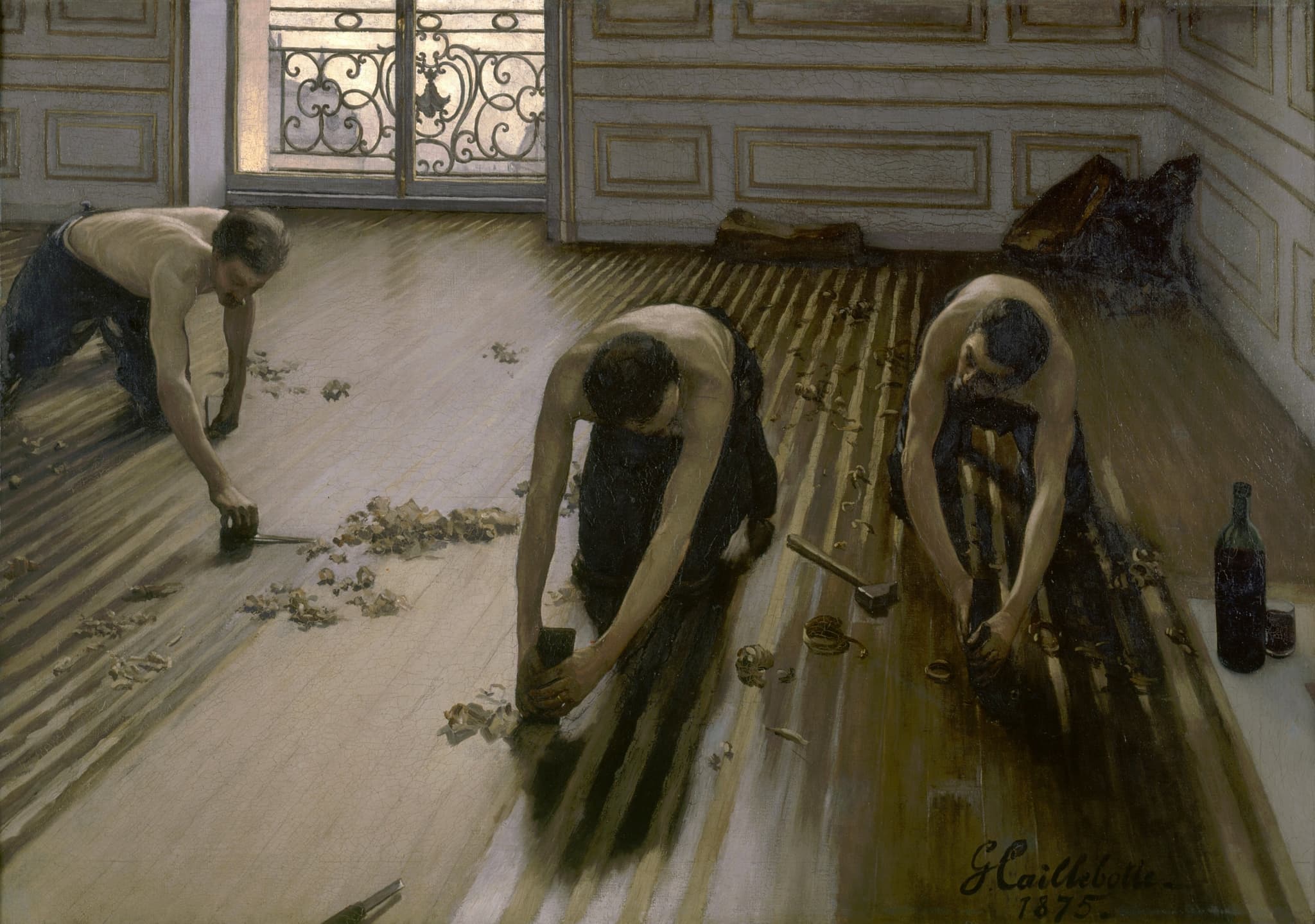
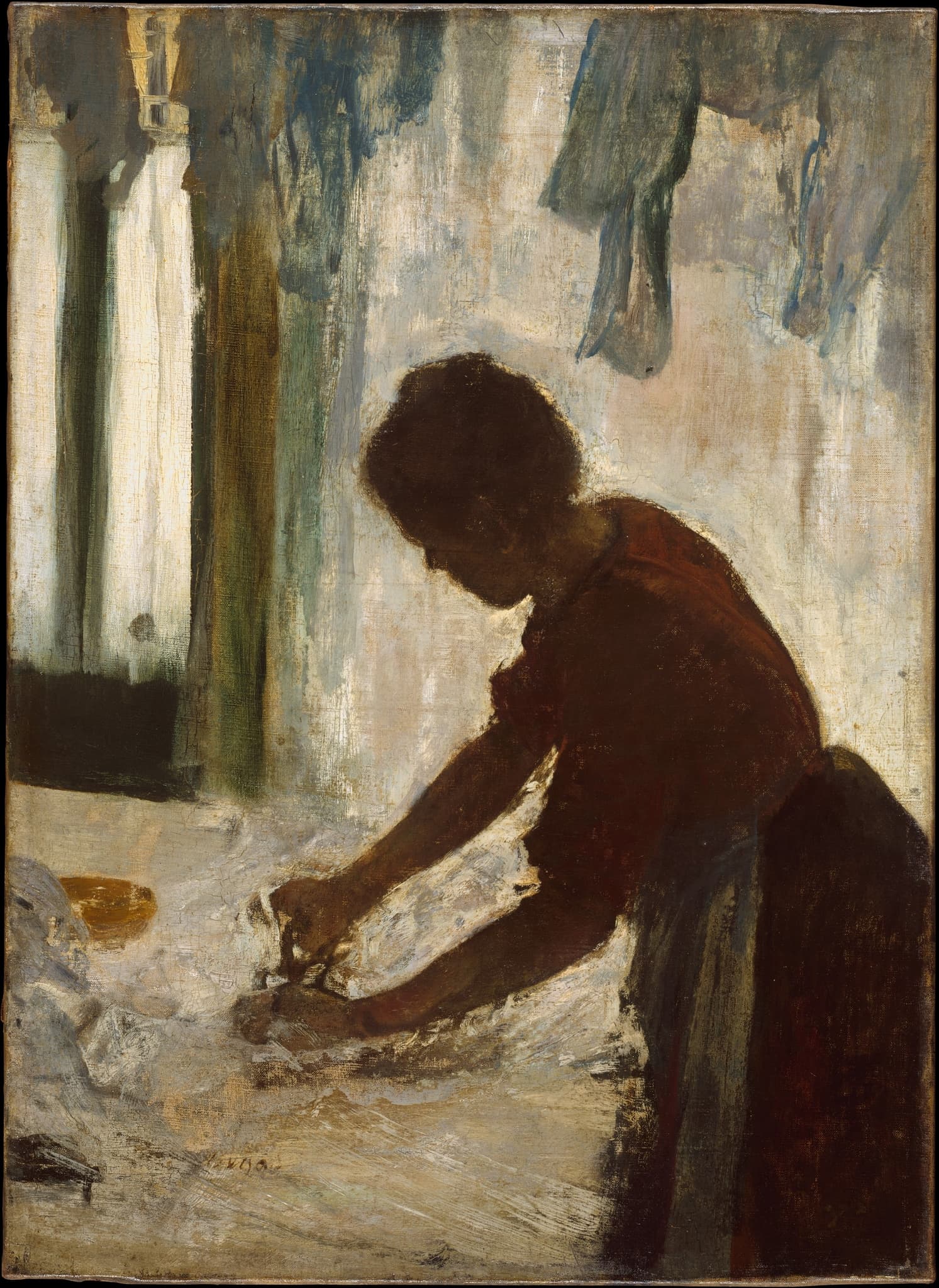
Work sits at the center of their art and their method. Caillebotte’s The Floor Scrapers turns a bourgeois interior into a ledger of procedure—tools, raking light, and a measurable workflow across the parquet—while Degas’s laundresses and dancers convert repetitive pressure into pictorial rhythm. In public space, both register urban estrangement. Caillebotte’s Paris Street; Rainy Day arrays passersby across a lucid grid of curbs and façades; Degas’s Place de la Concorde disperses figures across a blank plaza, contact withheld. Architecture and apparatus become engines of form: Caillebotte’s bridges and boulevards provide bones for perspective; Degas’s wings, pits, staircases, and footlights expose institutions that organize looking. Even when their subjects differ—Haussmann’s streets versus the Opéra’s routines—the stakes align: modern life appears as systems of circulation, training, and display made visible through designed seeing.
Decisive Difference
Caillebotte measures vision. He treats the rebuilt city as an engineered optic—axes, vanishing lines, and calibrated viewpoints that hold perception steady even as weather and traffic flicker. Paris Street; Rainy Day aligns a lamppost like a spine and locks façades to a vanishing point so the viewer can survey the scene with unusual clarity. Technical research suggests perspectival apparatus and a constructed depth that outstrips the single‑plane sharpness of period photography. The effect is a lucid field the eye can read, yet tinged with estrangement: figures share space without forming a public, and the very legibility of the street clarifies social distance.
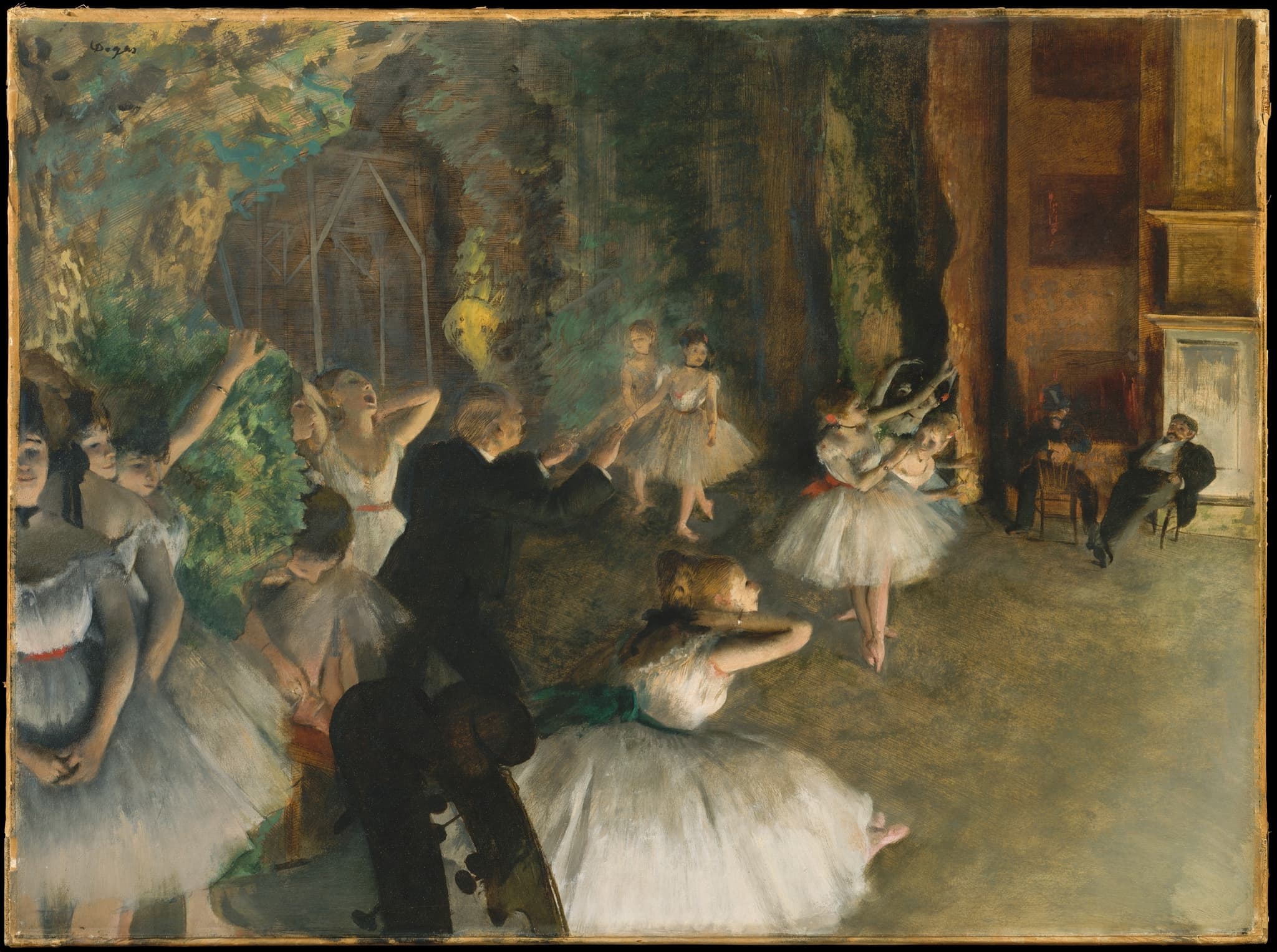
Degas mobilizes vision. He composes from the wings, from above, or up close under artificial light, so images feel like sequences of looks rather than a single, stabilized view. In Place de la Concorde, aggressive cropping and wide negative ground interrupt continuity; onstage and in rehearsal, footlights flatten color and isolate gesture, and abonnés in the wings turn seeing into a social act. Degas’s serial reworking—across drawings, oils, monotypes, and pastel—builds scenes that acknowledge partiality: the picture is truest when it behaves like attention itself, fragmentary and provisional. Measured survey versus mobile glance is the decisive divide. Each artist modernizes vision, but Caillebotte makes the city legible; Degas makes perception itself palpable.
Paired Works
Public space and the instant
Focus question: How does each artist make a city moment legible—or fragmentary?
Paris Street; Rainy Day vs Place de la Concorde
Labor as form
Focus question: What happens when physical work becomes the engine of composition?
The Floor Scrapers vs Woman Ironing
Architecture as visual engine
Focus question: Where is the machinery of modern life placed—and how does it drive seeing?
Le Pont de l’Europe vs The Rehearsal of the Ballet Onstage
Why This Comparison Matters
Seeing these artists together clarifies two durable modern strategies. Caillebotte proposes that clarity can be made: if you engineer space precisely, the city becomes legible, and its social distance becomes visible without rhetoric. Degas proposes that truth lives in partial views: if you accept the mobility of attention and the pressures of institutions, the image can register how perception actually unfolds—cropped, provisional, and lit by new technologies.
Those positions still shape how we look. Urban photography, film editing, even phone screens inherit Degas’s grammar of fragments and intervals; architectural visualization and street design often chase Caillebotte’s promise of coherent, navigable fields. The comparison restores agency to painting in the age of cameras: both artists use photography’s lessons without yielding control, turning composition into analysis. Their pictures are not just of modern life; they model how to think within it—by measuring a field or tracking a glance.
Related Links
Sources
- Art Institute of Chicago — Paris Street; Rainy Day (digital publication, perspective and construction)
- Art Institute of Chicago — Paris Street; Rainy Day (collection entry)
- Musée d’Orsay — Raboteurs de parquets (The Floor Scrapers)
- The Metropolitan Museum of Art — The Rehearsal of the Ballet Onstage
- The Metropolitan Museum of Art — Japonisme (essay)
- Degas Catalogue Raisonné — Place de la Concorde
- Actual Art Studies — On the cropping of Place de la Concorde
- Musée d’Orsay — Degas at the Opera (exhibition overview)
- Art Institute of Chicago — Caillebotte and Seurat: Setting the Stage for Masterworks (on optical aids)
- The Metropolitan Museum of Art — Manet/Degas visiting guide (constructed modern vision)