Painting Meanings Essay
The Courtesan Behind the Sword
Start in a rented room with a curtain pulled high. A banker is waiting for a deliverable; a patronage network is watching a comet of a painter.
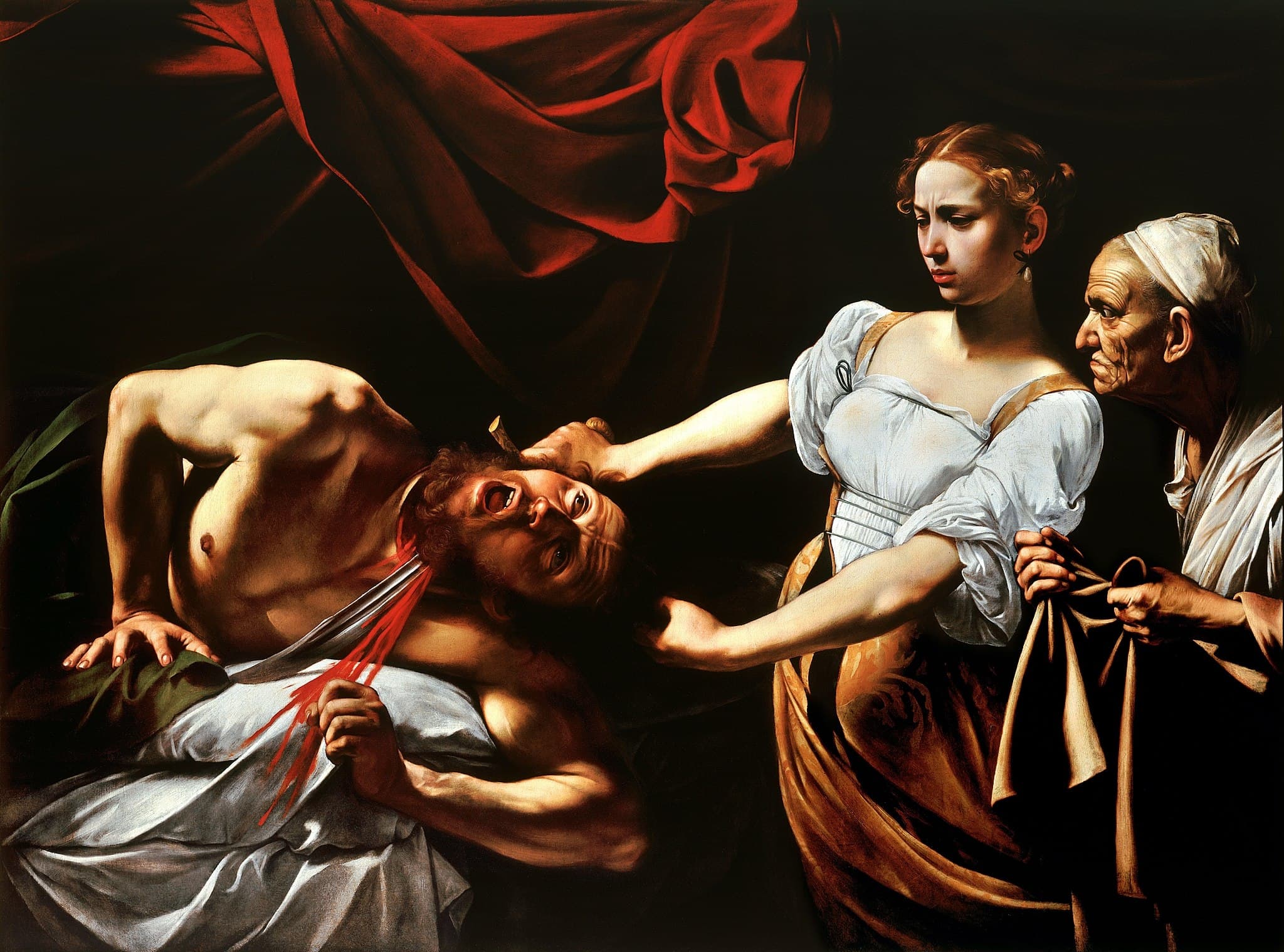
Start in a rented room with a curtain pulled high. A banker is waiting for a deliverable; a patronage network is watching a comet of a painter. Caravaggio steps to the canvas and chooses his Judith — not a saint from a sermon, but a woman Rome’s police could name.
“And she smote twice upon his neck, and cut off his head.” The Book of Judith gives the script. Caravaggio turns it into live theater.
Here’s the tension: 1599 is Caravaggio’s breakout year in Rome, the season he gains elite backing and a path to the Contarelli Chapel. This is the moment you don’t make a dumb move. Yet scholars think he does something that could nuke a career — he gives Judith the features of the celebrated courtesan Fillide Melandroni. The Kimbell Art Museum’s catalogue doesn’t blink: “the model for Judith may have been the Roman courtesan Fillide Melandroni.” Kimbell [2]
Why risk it? Because Caravaggio is betting on a revolution of credibility. He paints people who breathe the city’s air. The National Gallery boils it down: “He painted straight onto the canvas from posed models, without preliminary drawings.” National Gallery [3]
Now look at the picture that resulted — you can zoom in on it here: Painting Meanings: Judith Beheading Holofernes [5]. The young heroine’s brow knots, her body leans, her hand holds a fistful of hair; an old maid steadies a sack like a stagehand. Above them, a red curtain doesn’t decorate so much as announce: the show is on.
The Roman audience knew how to read that cue. In a city of Counter-Reformation pageantry, executions were public rituals staged for moral instruction; civic life ran on spectacle. Scholars have tied Caravaggio’s choreography to that culture of seeing, where faith and punishment shared a set. University of Vienna thesis [4]
And the money? A powerful banker — likely Ottavio Costa — is in the loop, acquiring the painting early. Institutional notes point to his role and to the work’s quick path into high-status collections, a sign the image wasn’t meant for a side room. Gallerie Nazionali Barberini Corsini 1
Here’s the twist: the gore isn’t the scandal. Rome in 1600 was fluent in blood and theater. What unsettled was recognition. If Judith’s almond face belonged to Fillide — a woman Caravaggio painted more than once — then the line between biblical virtue and brothel reality snapped tight. A saint now wore the city’s most gossiped-about features. That turned a devotional picture into a social mirror and put reputations on the block: the painter’s, the model’s, and the collector-banker’s.
Caravaggio’s light does the rest. He throws an executioner’s beam across skin and tendon so the truth can’t be ducked. The Barberini curators describe the curtain and shock as a deliberate frame for “a moral spectacle,” not a private fantasy. The message lands: virtue isn’t an airbrushed ideal; it’s a decision made with blood on your hands. Gallerie Nazionali Barberini Corsini 1
The payoff is cultural aftershock. Viewers didn’t just see a biblical heroine; they saw a woman like them killing a tyrant like the ones they feared. That realism became contagious. Artemisia Gentileschi would soon paint her own devastating Judits, turning the subject into a rallying cry for lived female agency — a line that flows straight from Caravaggio’s wager on real faces. Smarthistory [6]
So what was truly on the line in Judith Beheading Holofernes? Not decency. Credibility. Caravaggio risked respectability to make belief look like life. Abrupt, undeniable, and lit like a confession.
Sources
1 Gallerie Nazionali Barberini Corsini — Object page: https://barberinicorsini.org/en/opera/judith-beheading-holofernes/
[2] Kimbell Art Museum — Caravaggio’s Judith Beheading Holofernes: https://kimbellart.org/caravaggio-judith-beheading-holofernes
[3] National Gallery, London — Caravaggio overview: https://www.nationalgallery.org.uk/artists/michelangelo-merisi-da-caravaggio
[4] University of Vienna thesis — Caravaggio and Roman spectacle context: https://phaidra.univie.ac.at/detail/o%3A1311365
[5] Painting Meanings — Judith Beheading Holofernes: /artworks/caravaggio/judith-beheading-holofernes
[6] Smarthistory — Artemisia Gentileschi on Judith: https://smarthistory.org/artemisia-gentileschi-judith-and-her-maidservant-with-the-head-of-holofernes/
Sources & Further Reading
Judith Beheading Holofernes — Caravaggio