Painting Meanings Essay
The Homesick Secret Inside Kandinsky’s ‘Painting with White Border’
1913. Munich.
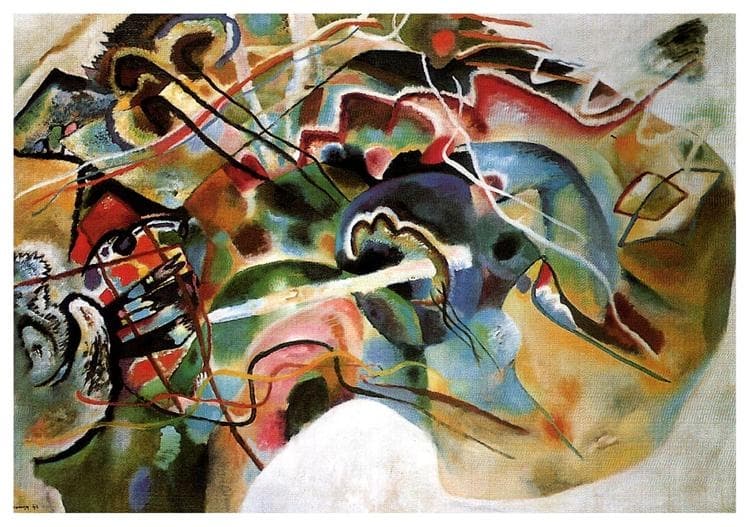
1913. Munich. A Russian outsider is betting his reputation that color alone can carry emotion. If it fails, he’s the crank who left reality. If it works, he’s about to rename it. “Color is a power which directly influences the soul,” he’d already declared, daring the public to feel before they could recognize. 1
The painting he stakes it on arrives like a weather system: a surge of zigzags and arcs, a slashed diagonal, and—oddly—a blank perimeter that refuses to join the party. Viewers call it chaos. Collectors hesitate. Teachers mutter. Is he just making noise?
He won’t let it be a mess. He drafts more than twenty studies, pushing shapes and rhythms around his studio floor until something locks. Still wrong. Then he does the strangest thing imaginable for an apostle of freedom: he boxes it in. He paints a white border around the riot, a literal edge—discipline for the unruly. 2
Here’s where the stakes turn human. Kandinsky is far from home and deep in an argument with the visible world. Russia is in his bones, but abstraction is his banner. If he can’t reconcile the two, he loses both: the homeland that formed him and the future he believes in.
Look again at that diagonal slash—the white lance knifing through the center. It isn’t random. It’s the spear of Saint George, the dragon-slayer stamped across Moscow’s coat of arms and across Kandinsky’s childhood imagination. The clustered forms—those scalloped domes, those red and green eruptions—aren’t mere squiggles. They’re Moscow memories, encrypted. Even the title outs him: Painting with White Border (Moscow). 2
The unexpected truth lands with curatorial precision: this so-called non-objective painting is saturated with place. The Guggenheim, which now guards the canvas, spells it out—Kandinsky pursued the image through study after study to capture Moscow’s heat and the rider’s thrust, then used the white margin to contain the storm he’d summoned. 2
And the border? It’s not an afterthought. It’s the key. Kandinsky had already written about white as a charged silence—“not dead, but pregnant with possibilities.” That’s what he paints around the edge: a bright pause holding the city inside. 1
He wasn’t alone in hitching abstraction to myth. Across his 1910s canvases, the Saint George figure keeps surfacing like a recurring dream, a galloping line that spears narrative straight into non-objective space. Scholars still track it as a private emblem, riding under the color storms. 3
So the border doesn’t mute the painting. It makes a container tough enough for memory. It’s Kandinsky’s seatbelt.
The reversal reframes everything. Abstraction wasn’t Kandinsky’s escape from life; it was the form that could finally hold it. He had to smuggle Moscow into a new language because the old one—church domes, cobbled streets, a literal knight—felt too small for what he remembered.
There’s a practical twist, too: the border is strategy, not style. He’s managing force. White, to him, is silence that heightens the next sound; the margin builds pressure so that the color chords hit like brass. When the lance flashes, you hear it.
And the clock was ticking. Within a year, war would shove him out of Germany and back to Russia. The gamble of belonging stayed unsettled. 4
Which means the story people tell—“nothing is pictured, it’s just lines and color”—misses the vulnerability hiding in plain sight. Painting with White Border is a love letter folded into a new alphabet. The border is the envelope; the message is Moscow; the courage is admitting that even revolution needs roots. That’s the shock: the most radical move in the room is homesickness. 23
“White… is like the silence of things before they are born,” he wrote—and in 1913 he painted that silence around his city so the feeling wouldn’t spill. 1
Endnotes: 1 Kandinsky, Concerning the Spiritual in Art (quotation on color and on white; curated quotes via Wikiquote: https://en.wikiquote.org/wiki/Wassily_Kandinsky). 2 Guggenheim Museum, Painting with White Border (Moscow), 1913: studies, border decision, Moscow and Saint George context: https://www.guggenheim.org/artwork/512 and Painting Meanings overview: https://www.paintingmeanings.com/artworks/wassily-kandinsky/painting-with-white-border. 3 Khan Academy, Kandinsky, Composition VII (recurring Saint George motif): https://www.khanacademy.org/humanities/art-1010/abstraction-expressionism/abstraction/a/kandinsky-composition-vii. 4 Tate biography (expulsion from Germany in 1914 and return to Russia): https://www.tate.org.uk/art/artists/wassily-kandinsky-1382.
Sources & Further Reading
Painting with White Border — Wassily Kandinsky
Painting with White Border — Wassily Kandinsky
Painting with White Border — Wassily Kandinsky
Painting with White Border — Wassily Kandinsky
Painting with White Border — Wassily Kandinsky
Continue Exploring
Zoom the white edge, then the spear. If you can’t unsee Moscow, share this with the next person who says abstraction has nothing to say.