Painting Meanings Essay
The Night Pissarro Learned to See Again
He was in his mid‑sixties, the elder statesman of Impressionism with bills to pay and younger stars sprinting past. Critics loved the myth of Pissarro the tireless outdoor painter.
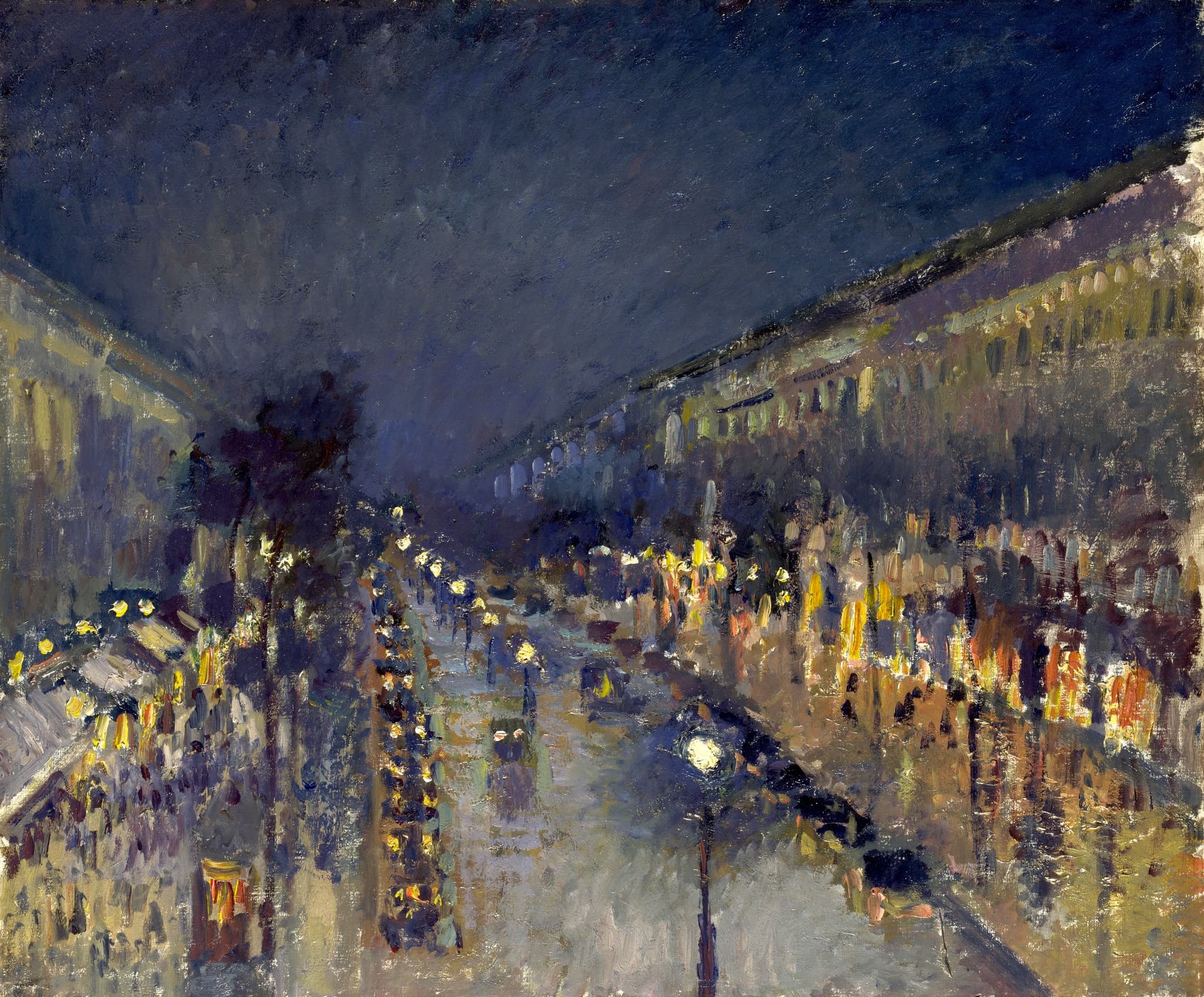
He was in his mid‑sixties, the elder statesman of Impressionism with bills to pay and younger stars sprinting past. Critics loved the myth of Pissarro the tireless outdoor painter. But his reality was uglier: an infection had made bright, dusty daylight brutal. So he moved indoors and up—into a rented high window on the Boulevard Montmartre—staking his reputation on whether a man who couldn’t face the sun could still paint light.5
What was on the line? Money, yes. But also legacy. Monet had serial cathedrals; the market was hot for series with a single view and endless moods. If Pissarro failed at this Paris project, he risked becoming a pastoral relic while the city defined modern taste.4
He took a room at the Grand Hôtel de Russie, a perch over the traffic torrent. From there he began the Boulevard Montmartre series—snow, spring, late afternoon, and, most dangerously, night—trying to trap movement without ever stepping into it.3
"I am working from my window on the boulevard," he wrote to his son, reporting the chaos below. "The carriages and people whirl past—it’s terribly difficult."2
Night in 1897 Paris wasn’t simply darkness; it was a technology problem. Electric lamps were muscling in beside gaslight. Two kinds of glow, two rhythms of shadow, two futures colliding on wet stone. That’s the secret motor inside Boulevard Montmartre at Night: not romance, but incompatible light sources fighting for the same street.1
Dealers wanted spectacle; passersby wanted recognition; the painter wanted proof he still had new eyes. He faced the hardest motif—motion under mixed light—armed with nothing but a static vantage point and a brush that refused to sit still.
Here’s the reversal. The most kinetic city painting of the 1890s was made from absolute stillness. Pissarro’s window is a tripod. His strokes act like long exposure, each dab a tiny shutter that opens and closes while omnibuses and umbrellas smear through the frame. The vantage wasn’t a compromise; it was the invention.4
"What a task—crowd, vehicles, lights!" he confessed, the exasperation doubling as a dare to himself.2
Look again at the center lane: beads of yellow-white pulse away like a telegraph. The sidewalks flare warm where shops still burn gas; the median runs cooler where new electric lamps drill into the drizzle. He stacks these temperatures into a city that shivers, and it reads like a live feed. The brushwork is not decoration; it’s information about a city changing its wiring in real time.1
And because the painter cannot chase the street, the street has to come to him. That constraint forces a radical focus: one fixed view, many moments. It’s the Paris equivalent of refreshing the same tab and watching the world update. Pissarro, the supposed pastoralist, out-modernizes everyone by treating the boulevard like a laboratory.45
Payoff? The work proves that limitation can be an engine, not a cage. Boulevard Montmartre at Night isn’t Impressionism retreating indoors; it’s modern vision finding its platform—a higher floor, a steadier gaze, a better problem. See the painting up close here (/artworks/camille-pissarro/boulevard-montmartre-at-night), and you can feel the stakes: a career, a city, and the future of looking balanced on a windowsill.
Sources: 1 National Gallery, London — The Boulevard Montmartre at Night: https://www.nationalgallery.org.uk/paintings/camille-pissarro-the-boulevard-montmartre-at-night 2 National Gallery — Picture of the Month (Apr 2023): https://www.nationalgallery.org.uk/paintings/picture-of-the-month/picture-of-the-month-april-2023 3 Art UK entry (hotel vantage and series context): https://artuk.org/discover/artworks/the-boulevard-montmartre-at-night-115484 4 Brettell & Joachim Pissarro, The Impressionist and the City (series logic and window vantage): https://www.si.edu/object/siris_sil_448003 5 Encyclopaedia Britannica — Pissarro biography (eye condition; turn to windowed urban views): https://www.britannica.com/biography/Camille-Pissarro
Sources & Further Reading
Boulevard Montmartre at Night — Camille Pissarro
Boulevard Montmartre at Night — Camille Pissarro
Boulevard Montmartre at Night — Camille Pissarro
Boulevard Montmartre at Night — Camille Pissarro
Boulevard Montmartre at Night — Camille Pissarro
Continue Exploring
What limitation could be your vantage point? Revisit Pissarro’s window and decide.