Diego Velazquez Paintings in Madrid — Where to See Them
Madrid matters for seeing Diego Velázquez because, while the city only has approximately two of his paintings on permanent display, those works are placed in distinct museum contexts that illuminate different aspects of his reception in Spain — from the international, curated hang of the Museo Thyssen-Bornemisza to the intimate, collector-driven setting of the Museo Lázaro Galdiano. Across three museums (Museo Thyssen-Bornemisza: 1 painting; Museo Lázaro Galdiano: 1 painting; Museo Cerralbo: 0 paintings), you can follow how Velázquez is framed by both public and private collections and by period interiors that shape how his portraits and technique are seen.
At a Glance
- Museums
- Museo Thyssen-Bornemisza, Museo Lázaro Galdiano, Museo Cerralbo
- Highlight
- See Velázquez works at Museo Thyssen-Bornemisza and Lázaro Galdiano.
- Best For
- Art lovers, history buffs, and fans of Spanish Golden Age painting.
Museo Thyssen-Bornemisza
Though it holds only a single Velázquez, the Thyssen matters because that one work is presented within a broad, international survey of European painting — letting you compare Velázquez directly with Italian, Flemish and Northern Baroque pieces in adjacent rooms. Its placement in a small, purposefully hung gallery highlights compositional and technical features (brushwork, tonal control) you might miss in denser displays, so the painting reads differently than it does in a primarily-Spanish national collection.
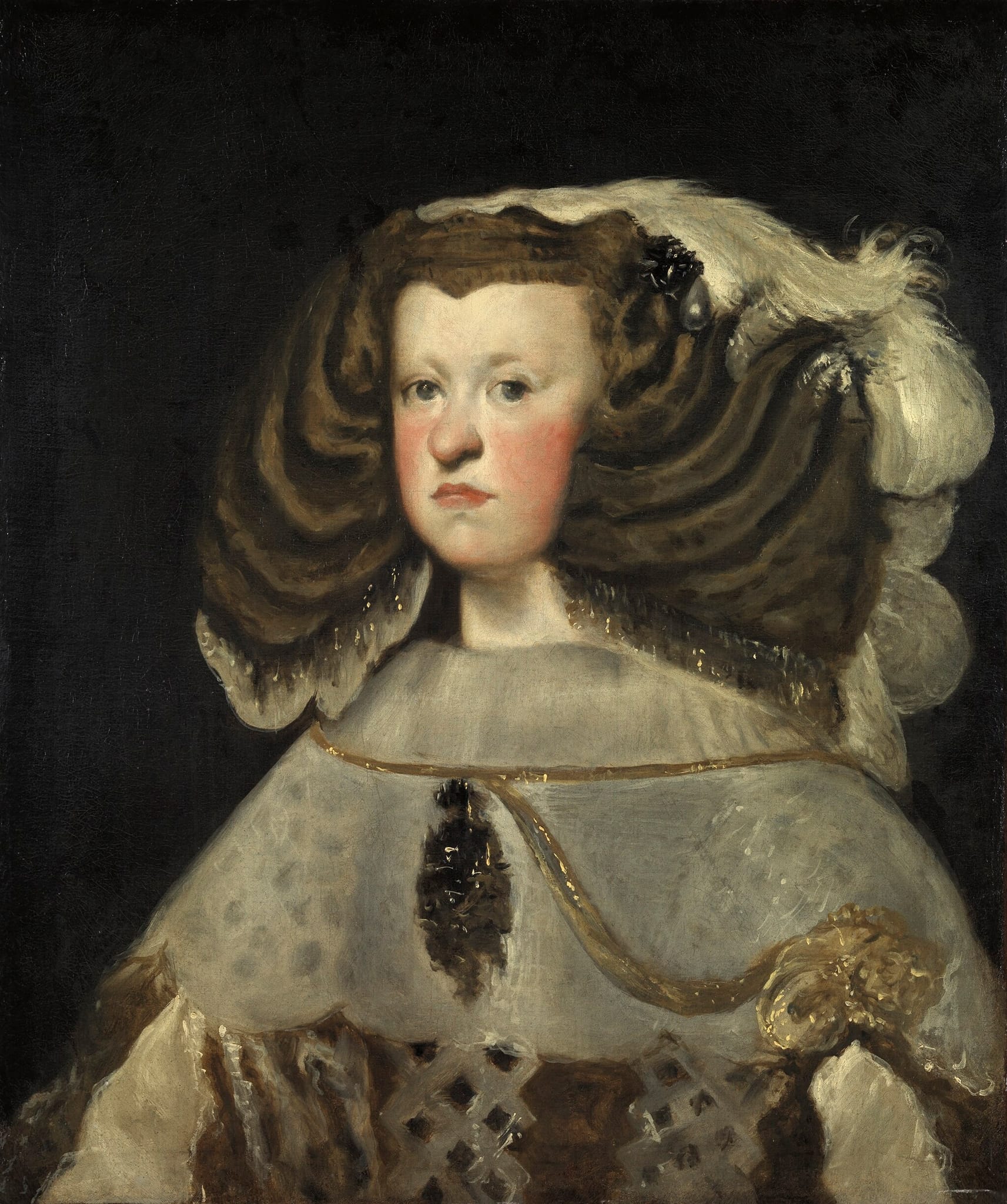
Portrait of Mariana of Austria, Queen of Spain
1655-1657
Diego Velázquez presents Queen Mariana in formal court dress against a dark, neutral ground, emphasizing her pale face and the carved volumes of her ruff, lace and jewels; the pose and costume mark her status as queen consort and future regent. The work is significant as a late Velázquez court portrait that combines sober royal iconography with the artist’s economical, fluid brushwork and psychological acuity. Viewers should look closely at the loose yet precise handling of light on the face and fabrics, the subtle modeling of the eyes and mouth that convey character, and the contrast between richly rendered details (pearls, lace) and areas treated with broader, suggestive strokes.
Must-seeMuseo Lázaro Galdiano
As a private collector’s museum centered on Spanish Golden Age art, Lázaro Galdiano presents its single Velázquez within the intimate scale and domestic taste of early-20th-century collecting — offering a close, almost conversational viewing experience. The work’s proximity to other Spanish masters and drawings in the collection helps you appreciate Velázquez’s influence on portraiture and technique in a setting that emphasizes connoisseurship rather than grand national narrative.
Museo Cerralbo
Even though Cerralbo has no Velázquez paintings, it matters for experiencing Velázquez indirectly: the museum’s intact aristocratic interiors and its collection of Spanish and European 16th–19th century works show the sort of private collecting and display practices that helped preserve and promote Golden Age painters like Velázquez. Seeing the period rooms, portraits, and Spanish works by his contemporaries and followers gives important social and material context for how Velázquez’s art circulated among noble patrons and collectors.