Campbell's Soup Cans Auction History
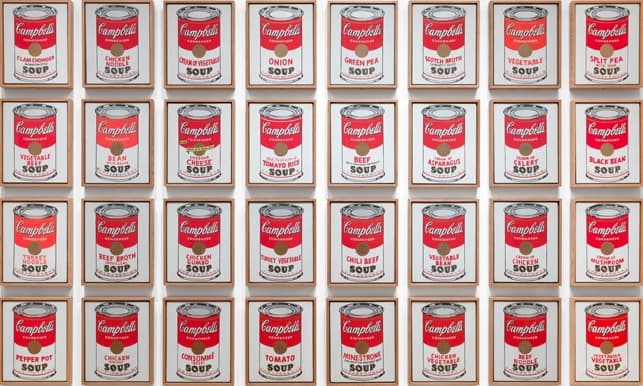
This 32-canvas set has never appeared at public auction. In 1962, dealer Irving Blum consolidated the entire group for $1,000 after briefly selling a few at $100 each. The Museum of Modern Art acquired it in 1996 as a partial gift/purchase, with Blum citing a $15 million purchase component. It remains in MoMA’s collection.
- Artwork
- Campbell's Soup Cans
- Artist
- Andy Warhol
- Best-known sale or transfer
- 1996 MoMA partial gift/purchase (~$15m reported)
- Sale type
- No known public sale
- Current location / owner
- The Museum of Modern Art, New York
Auction and Ownership Timeline
Work completed
New York
Warhol painted the 32 canvases in 1962; the work is cataloged as object no. 476.1996.1–32 at MoMA [2].
First exhibition at Ferus Gallery
$100 per canvas (asking price) · Ferus Gallery, Los Angeles
Debuted at Ferus Gallery, Los Angeles, in Warhol’s first solo Pop exhibition; some canvases were initially offered at $100 each [3][4].
Irving Blum acquires the full set
$1,000 · Los Angeles
After briefly selling a few canvases, Blum bought them back and acquired the complete set from Warhol for $1,000, paid in $100 monthly installments [3].
Long-term loan to National Gallery of Art
National Gallery of Art, Washington, DC
Blum’s set was placed on long-term loan and exhibited at the National Gallery of Art, Washington, DC [5].
Acquired by MoMA as partial gift/purchase
$15,000,000 (partial purchase component reported by seller) · The Museum of Modern Art, New York
MoMA announced the acquisition as a partial gift/purchase from Irving Blum; Blum has stated the deal was a partial gift plus $15 million [1][6].
MoMA reinstallation recalling Ferus display
The Museum of Modern Art, New York
MoMA’s focused exhibition reinstalled the 32 canvases in a single line, echoing the 1962 Ferus presentation [3].
Provenance and Ownership
Created in 1962 and first shown at Ferus Gallery, the set was briefly offered at $100 per canvas before dealer Irving Blum bought back those sales and acquired the entire 32-canvas group for $1,000, paid over installments [3][4].
In 1987 Blum lent the work on a long-term basis to the National Gallery of Art in Washington, DC, where it was publicly shown [5].
On October 10, 1996, The Museum of Modern Art announced it had acquired the set as a partial gift/purchase from Blum; Blum has stated the transaction was a partial gift plus $15 million. MoMA lists the work as object no. 476.1996.1–32 in its permanent collection [1][2][6].
Quick Facts
- Last known sale
- 1996-10-10
- Known sale price
- $15,000,000 (partial purchase component reported)
- Sale type
- Museum acquisition
- Venue / institution
- The Museum of Modern Art, New York
- Current owner or location
- The Museum of Modern Art, New York
- Publicly viewable?
- Yes
Why This Sale Matters
No known public auction appearances: This exact 32-canvas set has never been to auction; it moved privately from Warhol to Irving Blum in 1962 and then to The Museum of Modern Art in 1996 as a partial gift/purchase [1][3]. Blum’s decision to keep the paintings together, after briefly selling a few at $100 each, preserved a canonical serial work that embodies Warhol’s strategy of repetition and mass-media imagery [3][4].
1996 MoMA deal as market benchmark: MoMA’s acquisition cemented the set’s institutional status. While MoMA did not disclose the price, Blum has stated the transaction was a partial gift plus $15 million, and contemporaneous analysis in The Economist characterized the deal as setting a new benchmark and signaling Warhol’s canonization in the museum canon [1][6][7]. The placement effectively removed the definitive soup-can ensemble from the market, concentrating collector demand on related single canvases and variants.
Comparable Warhol results: Warhol’s market trajectory since the 1990s underscores the significance of the MoMA acquisition. His Shot Sage Blue Marilyn (1964) realized $195,040,000 at Christie’s in 2022, the auction record for a 20th‑century artwork [8]. Other major sales include Silver Car Crash (Double Disaster) (1963) at $105.4m (Sotheby’s, 2013) and Green Car Crash (Green Burning Car I) (1963) at $71.7m (Christie’s, 2007) [9][10]. For the soup-can theme beyond the MoMA set: Small Torn Campbell’s Soup Can (Pepper Pot) (1962) sold for $11.7m in 2006, and Big Campbell’s Soup Can with Can Opener (Vegetable) (1962) brought about $27.5m in 2017; historically, a torn-label soup can set a then-record $60,000 in 1970 [11][12][7].
Significance: By anchoring the iconic set at MoMA and establishing a widely cited ~$15m partial purchase component, the 1996 transaction helped frame value expectations for related soup-can works while affirming Warhol’s blue-chip status. The absence of auction comparables for the full set enhances its singular, museum-grade standing and channels market attention to individual canvases and variants [1][6][7].
Related Pages
Other auction histories by Andy Warhol
Sources
- MoMA press release: MoMA acquires Andy Warhol’s Campbell’s Soup Cans — The Museum of Modern Art
- MoMA Collection: Campbell’s Soup Cans, 1962 (Object no. 476.1996.1–32) — The Museum of Modern Art
- MoMA Inside/Out: Serial & Singular—Andy Warhol’s Campbell’s Soup Cans — The Museum of Modern Art
- Warhol’s 32 Soup Flavors (Ferus opening date) — Smithsonian Libraries and Archives
- NGA to Show Warhol Soups (long-term loan report) — The Washington Post
- Irving Blum interview (partial gift plus $15 million) — Interview Magazine
- The Pop masters’ highs and lows (market analysis) — The Economist
- Warhol’s Marilyn sells for $195 million (press release) — Christie’s
- Warhol’s Silver Car Crash leads Sotheby’s sale — Sotheby’s
- Green Car Crash (Green Burning Car I) achieves $71.7m — Christie’s
- Eli Broad buys Warhol soup can for $11.7 million — Los Angeles Times
- 2017 Post-War & Contemporary Auction (includes Warhol soup can) — Artemundi (sale summary citing Christie’s)