The Repeated Marilyn Face in Marilyn Diptych
A closer look at this element in Andy Warhol's 1962 masterpiece
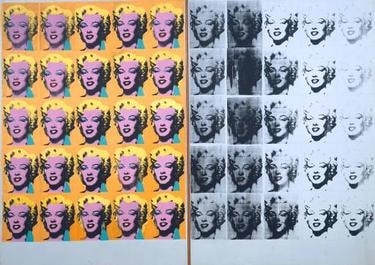
Warhol’s repeated Marilyn face—fifty impressions of a single Niagara publicity still—turns a studio headshot into a modern icon. Vivid at left and fading to ghostly monochrome at right, the image collapses celebrity, mass reproduction, and mortality into one unforgettable motif.
Historical Context
Warhol created Marilyn Diptych in the autumn of 1962, immediately after Marilyn Monroe’s death that August and at the very moment he embraced photo‑silkscreen as his primary method. The work’s organizing image is a single studio publicity headshot, multiplied across two joined canvases to create a field of identical faces. This turn to photographic transfer allowed Warhol to import the look and logic of the mass media directly into painting, replacing the expressive brushstroke with mechanical reproduction and the serial grid. The diptych’s left panel presents twenty‑five color impressions; the right panel shifts to black‑and‑white impressions that weaken as they descend, underscoring the medium’s mechanical facture and the cultural context of Monroe’s sudden death. These choices—date, technology, and format—bind the work to 1962’s media landscape and to Warhol’s decisive pivot from hand‑painted Pop toward the silkscreened image that would define his practice 12.
Symbolic Meaning
The serial headshot converts Monroe’s face into an endlessly reproducible commodity-sign, aligning people with products. By repeating a single publicity still—an image already engineered for circulation—Warhol mirrors the marketplace in which fame is fabricated, packaged, and distributed 43. The face reads less as an individual than as a logo, a mask whose power lies in its repeatability rather than in psychological depth.
The work’s format intensifies these meanings. As a diptych, it echoes portable altarpieces and invites devotional looking; the star becomes a secular icon bathed in chromatic allure 2. At the same time, the right panel’s thinning impressions operate as a memento mori, staging a stark life/death dialectic: bright presence versus spectral disappearance 2. Recent scholarship extends this tension, reading the decaying prints as a Gothic “corrosion” of celebrity that pits the image’s promise of immortality against the mortal body’s finitude 6. In this frame, the repeated face is both shrine and warning—proof that modern culture grants immortality through images while simultaneously eroding the person beneath them.
Artistic Technique
Warhol laid painted color grounds and then silkscreened the same photographic headshot across the surface, embracing off‑registration, variable ink density, and mechanical glitches as aesthetic features 57. The medium is acrylic and silkscreen ink on canvas (two panels), a hybrid that fuses the flatness of commercial printing with the scale of painting 8. On the left, he overprints high‑key blocks—lemon yellow hair, pink skin, turquoise lids—so that the image pops but also slips at its edges. On the right, he prints the image in black‑and‑white with progressively depleted ink, yielding bleached, broken impressions that visualize the fatigue of reproduction itself 57.
Connection to the Whole
The work’s entire structure is built from this single, repeated head: a five‑by‑five grid per panel, fifty faces total. Repetition delivers a double effect—impact through scale and saturation, and numbness through overexposure—mirroring how media spectacle both dazzles and desensitizes 2. The two-panel choreography completes the argument: the left’s chromatic vitality plays against the right’s fading monochrome, so that the motif becomes a running meter of presence turning to absence. Titled as a diptych and installed at mural scale, the repeated face binds the painting’s formal order to its meaning, fusing consumer icon, secular icon, and elegy into one image-system 12.
Explore More from This Painting
This detail is one part of Marilyn Diptych. Use the links below to return to the full interpretation, browse the full set of details, or view the painting's valuation if available.
Sources
- Tate collection record: Andy Warhol, Marilyn Diptych (T03093)
- Smarthistory: Marilyn Diptych (context, format, repetition, life/death reading)
- MIT Dome: Niagara publicity still marked by Warhol (Gene Korman, 1953)
- Whitney Museum audio guide: Michael Lobel on celebrity-as-commodity
- The Andy Warhol Museum: Underpainting and photographic silkscreen printing
- Celebrity Studies (2022): Warhol’s Marilyn and decaying portrait/immortality
- Art Institute of Chicago: Marilyn portfolio (technique, off-registration, color)
- Smithsonian record: Marilyn Diptych (medium and materials)