How Much Is Marilyn Diptych Worth?
Last updated: February 9, 2026
Quick Facts
- Methodology
- extrapolation
We estimate Andy Warhol’s Marilyn Diptych (1962) at $300–500 million. The range extrapolates above Warhol’s $195 million auction record for a single‑panel Marilyn (1964), reflecting the Diptych’s earlier date, monumental scale, and unparalleled canonical status within Pop Art.
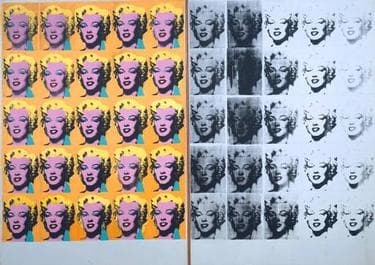
Marilyn Diptych
Andy Warhol, 1962 • Silkscreen ink and acrylic paint on canvas
Read full analysis of Marilyn Diptych →Valuation Analysis
Conclusion: A defensible current valuation for Andy Warhol’s Marilyn Diptych (1962) is $300–500 million. This estimate reflects the work’s singular art-historical importance, its position at the core of Warhol’s practice and Pop Art, and price discovery evidenced by the artist’s 2022 auction record for a closely related subject. The figure is theoretical, as the painting is an institutional treasure held by Tate (accession T03093) and is not a market object in practical terms [1].
Why this range: In May 2022, Warhol’s Shot Sage Blue Marilyn (1964)—a single 40 × 40 in. Marilyn—sold for $195,040,000 at Christie’s, setting the standing auction record for the artist and for any American work of art [2]. Marilyn Diptych is earlier (1962), vastly larger, and arguably the most complete summation of Warhol’s serial method, celebrity fascination, and meditation on fame and mortality. On qualitative grounds, it merits a substantial premium over the $195 million benchmark in a competitive sale.
Comparable market evidence: Trophy-level demand for early, serial, multi-image Warhols has repeatedly reached the high eight and nine figures. White Disaster (White Car Crash 19 Times) (1963) achieved $85.35 million at Sotheby’s in November 2022, underscoring market appetite for monumental, serial 1960s icons [3]. In May 2024, a monumental Flowers (1964) realized $35.5 million at Christie’s, leading a selective season and reaffirming depth for blue-chip Warhols from the core period [5]. These data points bracket the apex of the Warhol market and support extrapolating above $195 million for a work of greater art-historical centrality.
Context and timing: The ultra-high end moderated in 2024, with sellers increasingly favoring private channels, but demand for best-in-class, museum-caliber trophies persisted; by 2025, confidence around top lots improved even as the market remained selective [4], [5]. Against that backdrop, Marilyn Diptych occupies a vanishingly scarce stratum: a 1962, monumental, museum-vetted masterpiece with iconic subject matter and exhaustive publication/exhibition history. Its theoretical market value therefore aligns with the top of the global postwar field.
Assumptions and structure: The $300–500 million range contemplates a marquee auction with third‑party competition or a brokered private sale. At the lower bound (~$300 million), the work comfortably resets the Warhol record; the upper bound (~$500 million) reflects upside in an exceptional bidding environment where brand, subject, provenance, and cultural significance converge. Because the work is institutionally held and effectively irreplaceable, an insurance figure could equal or exceed the high end, but we have not located a public line‑item disclosure by Tate [1].
Key Valuation Factors
Art Historical Significance
High ImpactMarilyn Diptych (1962) is among the most important works in Warhol’s oeuvre and a touchstone of Pop Art. Executed immediately after Marilyn Monroe’s death, it synthesizes Warhol’s defining themes—mass reproduction, celebrity, desire, and mortality—through a serial image that fades from saturated color to ghostly monochrome. The painting’s dual structure is the clearest early articulation of Warhol’s silkscreen method and its existential undertone. Canonical status is reinforced by decades of scholarship, frequent inclusion in surveys of the 1960s, and persistent reproduction as a shorthand for Pop. Few works by Warhol—or any postwar artist—match its cultural penetration and pedagogical presence. This centrality warrants a premium over even the artist’s highest-priced auction comparables.
Subject Matter and Iconicity
High ImpactWarhol’s Marilyn imagery commands a subject-matter premium, evidenced by the $195 million sale of Shot Sage Blue Marilyn (1964). The Diptych is the most conceptually complete and historically pivotal Marilyn painting: 50 images in a monumental field, half in color and half in black-and-white, directly addressing the construction and decay of celebrity. Marilyn is the defining Warhol theme for a broad global audience, from connoisseurs to new buyers, and it bridges fine art, fashion, film, and media culture. The subject’s cross-category resonance supports deep bidding pools at the very top end, and within that subset, the Diptych’s scale, date, and composition place it at the apex of desirability.
Scale, Period, and Rarity
High ImpactCreated in 1962—the critical breakthrough year in which Warhol perfected silkscreen—Marilyn Diptych is a monumental painting that exemplifies his mature language at inception. Large, early, multi-image works are exceptionally scarce, and the museum-provenanced Diptych is unique in format and effect. Few comparables exist that combine early date, seriality, museum-level stature, and iconic subject. Works from 1962–63 with analogous serial structures (e.g., large Disasters, multi-image Elvis/Jackie) are rare events on the market and have achieved some of Warhol’s highest prices. Given the scarcity of direct substitutes, price elasticity diminishes at the trophy tier; where supply is functionally fixed, valuations hinge on competitive demand, which historically has been robust for works of this scale and period.
Market Benchmarks and Demand Depth
High ImpactPrice discovery at the apex is anchored by Warhol’s $195,040,000 record for a 1964 Marilyn, complemented by strong results for monumental, serial 1960s canvases such as White Disaster (White Car Crash 19 Times) at $85.35 million and a 208 cm Flowers at $35.5 million. These benchmarks demonstrate sustained willingness to pay for early, large-format Warhols with iconic imagery, even through selective market phases. Extrapolating above the $195 million ceiling is justified by the Diptych’s earlier date, scale, and unparalleled canonical weight. In a high-visibility sale with multiple motivated bidders, these factors reasonably support a price in the $300–500 million range, resetting the artist’s record and positioning the work among the most valuable postwar paintings.
Sale History
Marilyn Diptych has never been sold at public auction.
Andy Warhol's Market
Andy Warhol is one of the most liquid and widely collected postwar artists, with a deep, global market spanning unique paintings and highly traded editions. His auction record stands at $195,040,000 for Shot Sage Blue Marilyn (1964), achieved at Christie’s in May 2022, setting the benchmark for an American artwork at auction. Monumental early works from 1962–64—Marilyn, Death and Disaster, Elvis, Jackie, and Flowers—command the highest prices and draw the broadest bidder pools. Even in selective markets, top-tier 1960s Warhols reliably lead evening sales, while editioned material provides consistent turnover and new entry points. Private sales remain an important channel for eight-figure works, with third‑party guarantees often underwriting marquee consignments.
Comparable Sales
Shot Sage Blue Marilyn
Andy Warhol
Closest subject-matter benchmark (Marilyn), top-tier single-panel icon from the 1960s; evidences peak demand for Marilyn imagery.
$195.0M
2022, Christie's New York
~$215.7M adjusted
White Disaster (White Car Crash 19 Times)
Andy Warhol
Monumental, serial, multi-panel 1963 canvas from the core Death and Disaster series; structurally analogous to the Diptych’s scale and repetition.
$85.4M
2022, Sotheby's New York
~$94.4M adjusted
Silver Car Crash (Double Disaster)
Andy Warhol
Historic high for a large multi-panel Disaster painting; early-1960s seriality and scale make it a strong structural comp to the Diptych.
$105.4M
2013, Sotheby's New York
~$146.6M adjusted
Flowers (208 × 208 cm)
Andy Warhol
Monumental 1964 Pop icon from Warhol’s most recognized series; confirms strong demand for large-format 1960s canvases.
$35.5M
2024, Christie's New York
~$36.4M adjusted
Sixteen Jackies
Andy Warhol
1964 multi-image celebrity portrait rooted in media imagery and mourning; closely aligned with Diptych’s seriality and cultural resonance.
$25.9M
2023, Christie's New York
~$27.5M adjusted
Current Market Trends
The top end of the Postwar and Contemporary market tightened in 2024, with fewer nine-figure trophies at auction, but blue-chip demand remained resilient for best-in-class works. By 2025, confidence improved at the apex even as sellers and buyers favored private negotiation for eight-figure material. Within this environment, early, iconic Pop Art—particularly Warhol’s 1960s canvases—continues to attract deep global interest. Recent sales confirm robust pricing for monumental Warhols and selective outperformance when subject, date, scale, and provenance align. Against this backdrop, a museum-caliber, irreplaceable icon like Marilyn Diptych would likely trigger exceptional competition, supporting a valuation well above the artist’s 2022 auction record.
Study print
Study this painting as a print
Pair the full artwork with a museum-style study sheet focused on one meaningful detail.
Sources
- Tate: Andy Warhol, Marilyn Diptych (1962), accession T03093
- Artnet News: Warhol’s ‘Shot Sage Blue Marilyn’ Sells for $195 Million
- Sotheby’s: White Disaster (White Car Crash 19 Times), sale result (Nov 16, 2022)
- Artnet Intelligence Report: The Year Ahead 2025
- Artnet News: Christie’s 20th Century Evening Sale, May 16, 2024 (Flowers at $35.5m)