The Gaslights in Boulevard Montmartre at Night
A closer look at this element in Camille Pissarro's 1897 masterpiece
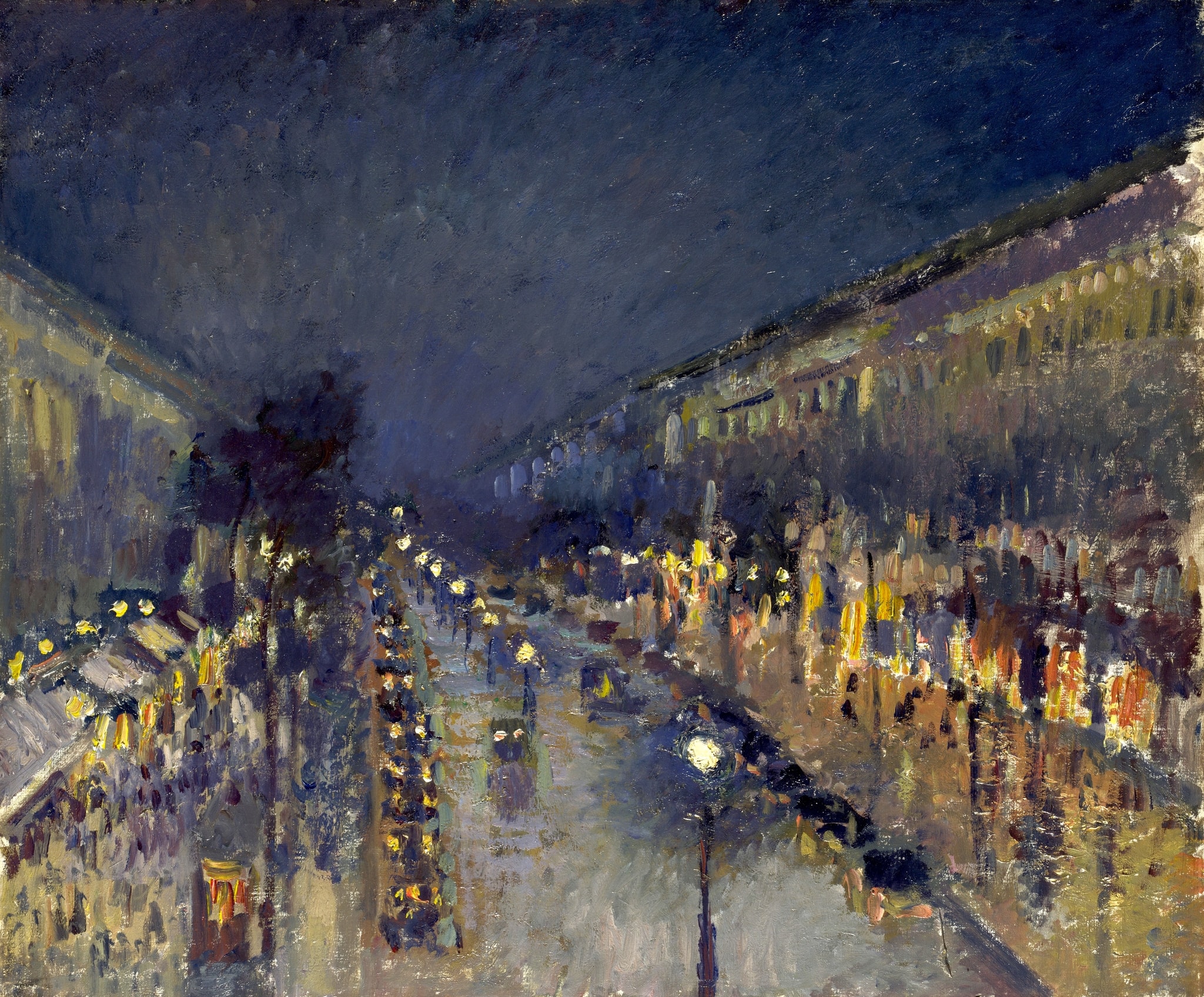
In Pissarro’s Boulevard Montmartre at Night, the true “gaslights” are the warm, amber shop and café windows that fringe the sidewalks, not the cool orbs marching down the boulevard’s center. Their glow turns the street into a stage of urban commerce and sociability while Pissarro counterposes them with the bluish, newly electric streetlamps to visualize a city remade by modern light.
Historical Context
In early 1897, Camille Pissarro rented an upper-floor room at the Grand Hôtel de Russie and produced a serial group of fourteen views of the Boulevard Montmartre, tracking the artery through weather, traffic, and time of day; Boulevard Montmartre at Night is the sole nocturne in the set. From this high vantage he could scrutinize Paris’s evolving illumination: cool, newly installed electric streetlamps running down the boulevard’s spine and the older, warmer gaslight radiating from shop and café fronts along the pavements 1, 2.
The subject aligns with a city transformed since Haussmann—broad boulevards engineered for circulation and spectacle—now entering a transitional lighting regime where gas and electric coexisted. Pissarro’s night view records that coexistence with documentary clarity and artistic purpose: the electric lamps read as bluish-white nodes of civic infrastructure while the gaslit windows throw amber bands across wet sidewalks, defining the boulevard’s social edges. His serial method and elevated perch made the competing lights legible as both topographical fact and modern experience 1, 2.
Symbolic Meaning
Pissarro’s gaslit zones—those yellowed shopfronts and café interiors—stand for the boulevard’s street-level commerce and leisure. Their warmth suggests invitation and desire: the promises of goods, company, and respite that draw bodies to the pavement. Set against the bluish regiment of electric lamps in the median, they articulate a modern urban double register: intimate consumption at the flanks, infrastructural order at the center. The painting therefore reads not only as a nocturne but as a diagram of how light organizes social life on the grands boulevards 1.
Hollis Clayson’s work on Belle Époque illumination clarifies these meanings: artists of the gas/electric era pictured the technologies as socially distinct—gaslight connoting spectacle and allure, electric light telegraphing progress, reach, and municipal control. Pissarro gives that theory optical form by color-coding function: amber for the porous, shop-lined threshold between interior and street; cool white for the disciplined, state-backed circuitry of the roadway. The coexistence of the two registers in 1897 captures a city mid-transition and frames nighttime Paris as a modern spectacle literally constructed by competing forms of light 1, 3.
Artistic Technique
Pissarro renders the gaslights with clustered strokes of warm yellows and oranges, especially under awnings and across wet pavements where reflections pool and flicker. By contrast, the electric streetlamps are small, cool, bluish-white orbs that recede in strict intervals down the boulevard’s center, some edged by indigo halation. Across the surface he lays a “patchwork of dashes and daubs” to suggest crowds, carriages, and the vibration of nocturnal light, letting the rain-slick street scatter color and intensify the gaslit glow at the edges. The composition’s strong diagonals—rooftops, tree line, traffic lanes, and lamp rows—drive the eye into depth, with the alternating warm/cool bands functioning as a chromatic architecture for the scene 1.
Connection to the Whole
The gaslights are the painting’s human register: they animate the sidewalks, index shop and café life, and counterbalance the boulevard’s cool, centralized spine. Their warm reflections create lateral currents that pace the viewer’s gaze from storefront to storefront before yielding to the disciplined beat of the electric lamps in the median. This alternation organizes the canvas and crystallizes its theme: modern Paris as a system of movement, commerce, and control orchestrated by light. Remove the gaslit fringes and the scene loses its social temperature; keep them, and the boulevard becomes an illuminated stage where the city’s nightly drama unfolds 1.
Explore More from This Painting
This detail is one part of Boulevard Montmartre at Night. Use the links below to return to the full interpretation, browse the full set of details, or view the painting's valuation if available.